


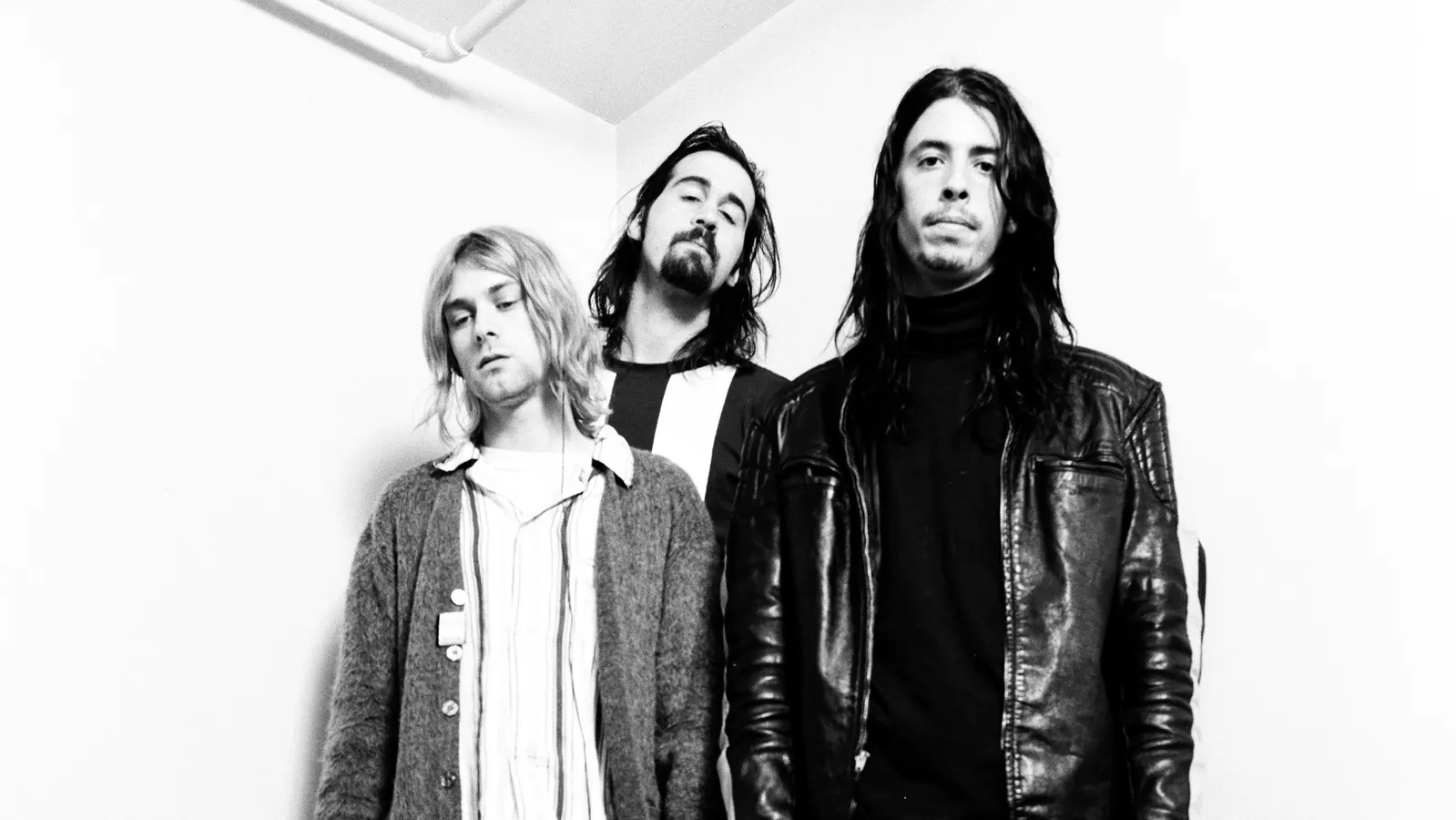

Nirvana’s ‘Nevermind’ turns 35 as the landmark album remains a Billboard hit and “Smells Like Teen Spirit” reaches new global peaks. (MANDATORY CREDIT Gutchie Kojima/Shinko Music/Getty Images) Nirvana, group portrait, backstage at Nakano Sunplaza, Tokyo, Japan, 19th December 1992. (From left) Kurt Cobain, Krist Novoselic, Dave Grohl. (Photo by Gutchie Kojima/Shinko Music/Getty Images)
Getty Images
Nirvana is about to receive the Video Vanguard Award at the 2026 MTV Video Music Awards, Nevermind is still present on the Billboard 200 – as always – and “Smells Like Teen Spirit” has recently been hitting new peaks on Billboard’s global charts. Those would be impressive accomplishments for any band with a new project to promote, but Nirvana hasn’t released a studio album in more than 30 years.
Nevermind officially turns 35 tomorrow (September 24), and the project is remembered as one of the defining rock albums of the 1990s – but its importance extends beyond the music itself. Nevermind helped prove that what the music industry regarded as alternative could actually become the mainstream and could stand the test of time.
Nirvana Wasn’t Expected to Become One of the Biggest Bands in America
Nirvana had already established itself within underground rock by the time Nevermind arrived. Its debut album Bleach, released in 1989, had sold only tens of thousands of copies initially, though, and the trio was far from a household name, but that would change.
Expectations for Nevermind were initially modest, and the set’s single “Smells Like Teen Spirit” wasn’t predicted to become an enormous crossover smash, which it ultimately did. The song was released shortly before Nevermind largely to build interest among alternative-rock audiences, but it has since come to be regarded as a classic and something of a masterpiece in its own right – one which generations of listeners continue to hear to this day.
Nevermind Shot From No. 144 to No. 1
“Smells Like Teen Spirit” quickly reached beyond the confines of alternative radio and MTV’s more specialized programming and became unavoidable. The single climbed to No. 6 on the Billboard Hot 100, turning the grunge outfit into pop hitmakers.
Nevermind followed an even more dramatic path. The album debuted at only No. 144 on the Billboard 200 – the company’s list of the most popular albums in America – but demand for the full-length grew at an astonishing pace. By January 1992, it was reportedly selling around 300,000 copies every week. On January 11, Nevermind finally reached No. 1, replacing Michael Jackson’s Dangerous on top of the competitive tally.
American musician Michael Jackson performs onstage at the Rosemont Horizon during his ‘BAD’ tour, Rosemont, Illinois, April 19, 1988. (Photo by Paul Natkin/Getty Images)
Getty Images
That change at the summit became a symbol for something much larger happening in popular music. Nirvana certainly didn’t invent alternative rock, and the group did not single-handedly end polished pop or mainstream rock. But three musicians from the Pacific Northwest had displaced one of the biggest pop stars in history on America’s main albums ranking, and the industry could no longer treat the sound emanating from so many car windows as something meant only for a small audience.
Nirvana Helped Make Alternative Rock Mainstream
The success of Nevermind showed labels, radio programmers and MTV that alternative rock could generate blockbuster business. Seattle became an industry obsession, while acts like Pearl Jam, Soundgarden and Alice in Chains were welcomed by increasingly receptive national audiences.
Part of Nevermind’s success may have come from the fact that it lived between two worlds. The album retained punk aggression and Nirvana’s underground sound, but producer Butch Vig and mixer Andy Wallace helped give the music enough clarity and punch to work on mainstream radio, not just rock-oriented stations.
Nevermind Is Still a Win on the Billboard Charts
Jamaican reggae singer-songwriter Bob Marley (1945 – 1981), 27th November 1979. (Photo by Michael Ochs Archives/Getty Images)
getty
The set’s thirty-fifth anniversary would be meaningful even if Nevermind existed only as a piece of music history, as a milestone in rock’s subgenres. But that was not the fate for Nirvana’s massive win. In fact, it’s still counted as one of the most-consumed albums in the country every week.
Earlier this month, the album sat at No. 66 on the Billboard 200, and in only a matter of weeks, it will celebrate 800 frames on the chart. For context, only half a dozen projects – Pink Floyd’s The Dark Side of the Moon, Bob Marley and the Wailers’ Legend, Journey’s Greatest Hits, Metallica’s self-titled Metallica, Creedence Clearwater Revival’s Chronicle: The 20 Greatest Hits and Eminem’s Curtain Call: The Hits – have reached that landmark.
“Smells Like Teen Spirit” is doing something even more unusual. The smash recently climbed to new all-time peaks on both the Billboard Global 200 and the Billboard Global Excl. U.S., rankings that didn’t exist until decades after the song was released. The lead Nevermind single remains one of the 200 most-consumed tracks of any style on the planet, three and a half decades later.
Three days after Nevermind turns 35, Nirvana will receive the Video Vanguard Award at the MTV VMAs. The honor is appropriate for a band whose rise was so closely connected to the network and the “Smells Like Teen Spirit” visual.













Leave a comment