


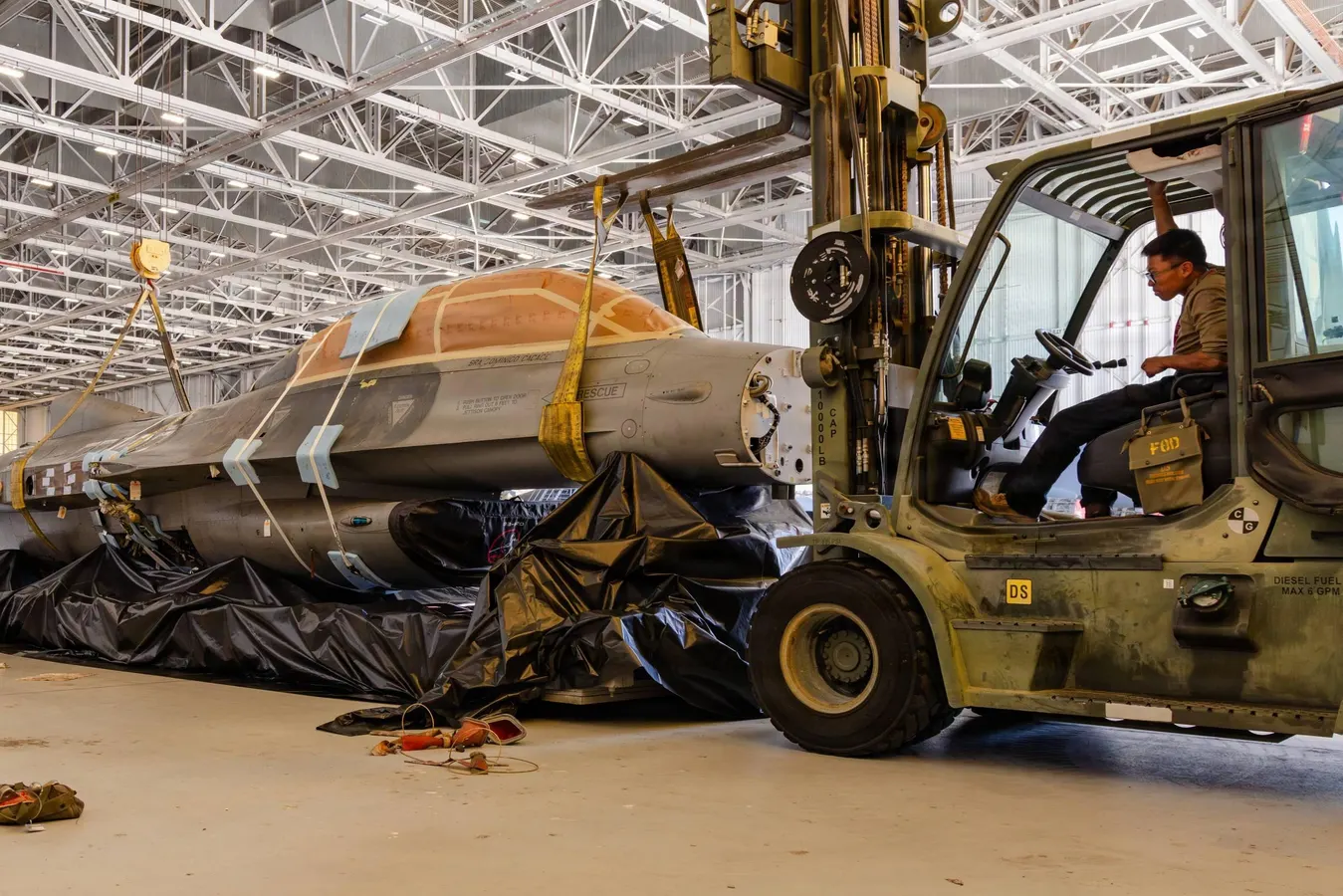

Senior Airman Jezreal Rae, 309th Aircraft Maintenance Group, lifts the bare fuselage of an F-16 Fighting Falcon onto a heavy-duty shipping cradle at Edwards Air Force Base, California, Aug. 24.
(U.S. Air Force photo by Lindsey Iniguez)
The United States Air Force currently operates between 826 and 838 F-16 Fighting Falcons, but the service received its final aircraft more than 20 years ago, on March 18, 2005. Lockheed Martin continues to produce the aircraft for foreign military sales, and as production continues, parts are still available.
Yet, the U.S. Air Force acknowledged that an eight-person depot crew was sent to Edwards Air Force Base, California, earlier this year to dismantle a damaged F-16 to keep the remaining Fighting Falcons in service.
The particular aircraft, tail number A86-0047, which arrived at Edwards AFB back in 2010, suffered a ground mishap that “caused irreparable landing gear damage,” forcing its early retirement. As the rest of the components still had service life remaining, the Air Force opted to use those parts on other warbirds.
“When we take apart a jet, we aren’t just clearing hangar space,” Tech. Sgt. Thomas Sickafoose, the team chief from Hill AFB, said in a statement. “We are salvaging hard-to-find, discontinued parts that keep other combat aircraft mission-ready.”
Although the F-16 remains in service, the U.S. Air Force still reuses parts from retired aircraft to save money and to bypass the manufacturing delays. Lockheed Martin’s active F-16 production lines face heavy demand from international orders, which can make rapid acquisition of new factory parts difficult.
The other issue is that the F-16s used by the U.S. Air Force may be just different enough from the Block 70/72 models now being produced. That makes cannibalization of the parts a more practical logistics solution.
“Every jet on our ramp plays a unique role in flight test programs across so many different airframes, whether it’s flying chase support for F-22 Raptors and F-35 Lightning IIs or testing the newest software upgrades and capabilities,” explained Master Sgt. Ryan O’Neal, 416th Aircraft Maintenance Unit section chief. “While A0047 won’t support from the sky anymore, its new place in the boneyard will supply parts for F-16 Fighting Falcons flying all different missions across the Air Force.”
Specialized Roles Required
The eight-person crew from the 309th Aircraft Maintenance Group at Hill AFB, Utah, was deployed to Edwards AFB, where they “surgically” deconstructed the F-16. It was a time-consuming process that began even before the team left Utah.
The first step of the process was to work with the 412th Maintenance Squadron at Edwards AFB to cross-check inventories to determine what equipment could be sourced at the site, and what needed to be brought to California to carefully disassemble the fighter.
“Packing and crating is our specialty, so our core kits are always prepped and ready to deploy,” Sickafoose said. “Coordinating with the 412th MXS helped us leave our heaviest gear behind. For example, we left our master crane in Utah because we could tie straight into their hangar’s overhead crane system.”
The Air Force added that the maintenance team is given just around two weeks to dismantle a fighter, which leaves little room for unexpected delays.
The dismantling isn’t without some risks, as maintainers must first remove various Class 1.3 explosives from the airframe, including the canopy removers, trajectory divergence rocket, vernier rockets and seat rocket catapult.
The most delicate part of the process involved “unbolting the fighter’s primary flight surfaces without putting stress on the metal,” where even hairline damage would ruin the value of an entire wing assembly.
“This isn’t a demolition; it’s a preservation effort,” said Master Sgt. Brett Jones, a fuels specialist from Hill AFB. “Every single part, large or small, heavy or light, is tagged and packed into custom-fitted shipping crates, so it arrives at the supply depot fully protected, easily identified and ready for reuse.”
After the aircraft was dismantled and the parts – including critical avionics, structural hardware and flight controls – were crated up, they will head to the 309th Aerospace Maintenance and Regeneration Group, commonly known as “the Boneyard,” at Davis-Monthan Air Force Base, Arizona. The facility stores nearly 300,000 line items of aircraft production special tooling and special test equipment, alongside thousands of aircraft and engines.
The unit continues to reclaim thousands of individual spare parts annually to supply the active operational fleet and supply system.
Staff Sgt. Joshua Warner and Senior Airman Jezreal Rae (top), 309th Aircraft Maintenance Group, work to detach the vertical stabilizer of an F-16 Fighting Falcon, while Tech. Sgt. Mikah Mattingly (center) and Staff Sgt. Alijah Gonzales (bottom), also 309th AMG, disassemble parts of the center fuselage at Edwards Air Force Base, California, Aug. 24.
(U.S. Air Force photo by Lindsey Iniguez)
“Getting A0047 off to the boneyard has been an effort that took months of coordination and teamwork,” said Capt. Jenna Kuperberg, 416th Aircraft Maintenance Unit officer in charge. “It’s a perfect example of how we can take an aircraft at the end of its service life and repurpose it for something entirely different, giving constrained parts and pieces back to other aircraft and units across the fleet for years to come.”
Other F-16s Sent To Ukraine
Although this effort to save as many usable parts as possible highlights the value of old F-16 components, the U.S. Air Force has shared some of its inventory to support its allies and partners. In the spring of 2025, several stripped-down F-16s were shipped from the Boneyard to Rzeszów-Jasionka Airport in Poland, where the partially disassembled Fighting Falcons were readied for transfer to Ukraine. None of those aircraft could be restored to “flyable condition,” and many of the most critical components were saved for potential U.S. Air Force use. However, the airframes were sent to keep Kyiv’s growing fleet of F-16s operational.
NATO members Belgium, Denmark, the Netherlands, and Norway have pledged to send approximately 85 Fighting Falcons to Ukraine, along with a handful of non-operational aircraft for spare parts. The first aircraft arrived in August 2024.
The U.S. donated airframes, believed to be from the older Block 15 models, were likely operated by U.S. Air National Guard units before being sent to the Boneyard in the early 2000s.
Given that Kyiv is operating many Fighting Falcons of a similar vintage, the donated aircraft will help Ukrainian maintainers. The old airframes may also be serving in another role.
After all usable parts were removed, it was speculated that Ukraine’s troops would mock up the fuselages with fabricated wings to serve as decoys to help confuse the Kremlin as to the actual basing of the operational F-16 Fighting Falcons.
Sometimes the sum of the parts is worth more than a whole aircraft!















Leave a comment