


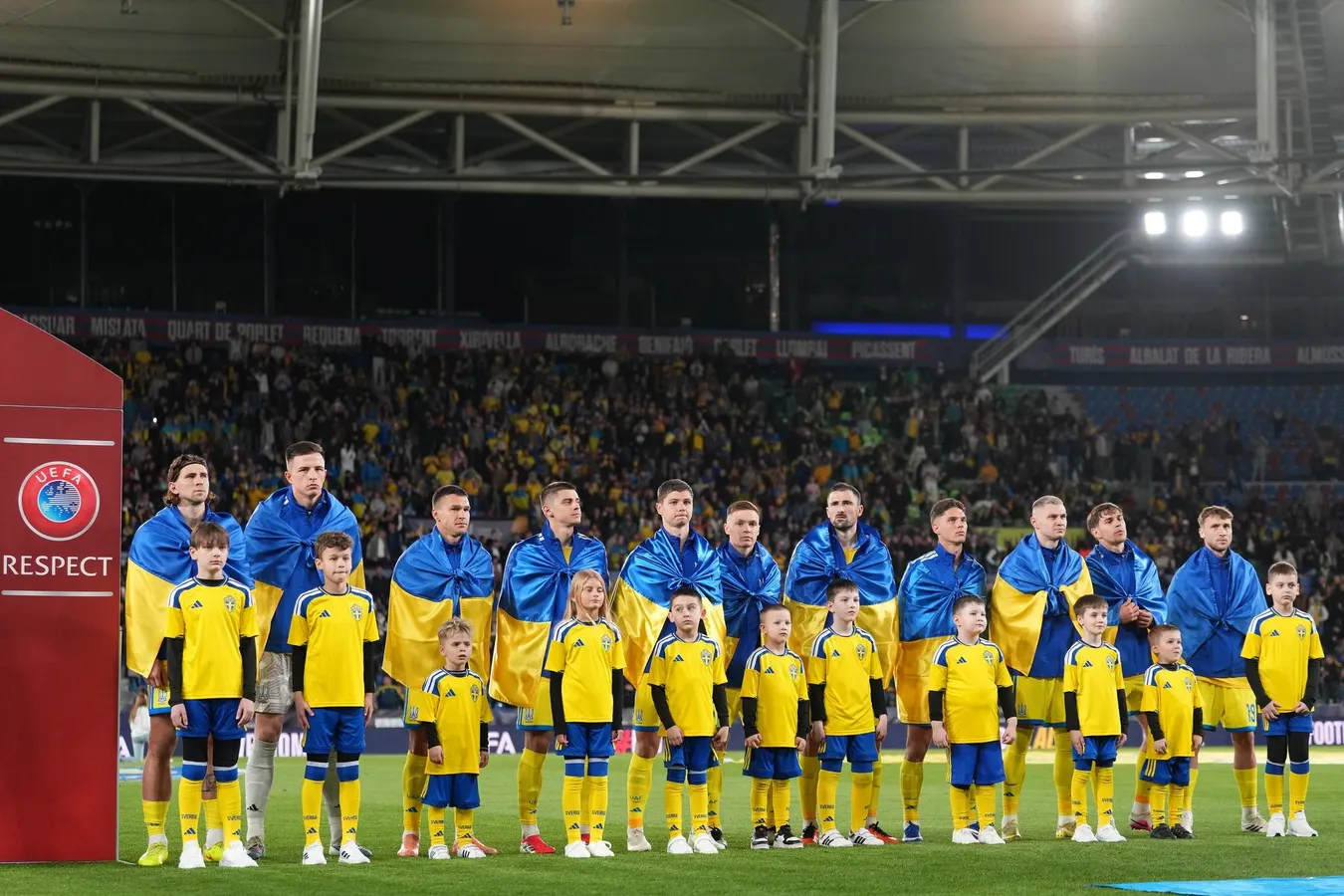

VALENCIA, SPAIN – MARCH 26: Players of Ukraine line up whilst draped in the national flag of Ukraine prior to the FIFA World Cup 2026 European Qualifiers KO play-offs match between Ukraine and Sweden at Ciutat de Valencia on March 26, 2026 in Valencia, Spain. (Photo by Alex Caparros – UEFA/UEFA via Getty Images)
UEFA via Getty Images
This week, 54 countries across Europe, the Caucasus, and Central Asia will come together to compete in the 2026-2027 edition of the UEFA Nations League. Formed in 2018, this soccer (football) competition was created to give countries competitive matches outside of the qualification process for the FIFA World Cup and the European Championships. The Nations League is also linked to qualification cycles for both the World Cup and the EUROs, where Nations League performances determine whether some countries advance to the playoff rounds based on their results.
Ukraine will be one of the countries participating in the UEFA Nations League this autumn. The Ukrainians will play four games in late September and early October. But for a fourth consecutive year, the Ukrainians will be forced to play all their competitive soccer matches outside of their homeland. This is due to Russia’s ongoing full-scale invasion of Ukraine.
The Ukrainians have selected Trnava, Slovakia as their new “home” during this competition. But this is not the first time Ukrainian soccer has had to select a new venue for competitive matches. It is also unclear where Ukraine’s national soccer team will play in 2027. Why is this the case?
GLASGOW, SCOTLAND – MAY 30: The Ukraine National Team arrive into Glasgow Airport before the World Cup Play-off match against Scotland, on May 30, 2022, in Glasgow, Scotland. (Photo by Craig Foy/SNS Group via Getty Images)
SNS Group via Getty Images
Ukraine’s Senior Men’s National Soccer Team: Nomads Without A Home
When Russia’s full-scale invasion of Ukraine began on February 24, 2022, senior officials from FIFA and the Union of European Football Associations came together to discuss how the Russian Federation would be punished for its war, and what would happen with Ukraine. On February 28, 2022, FIFA and UEFA announced that all Russian soccer clubs, as well as Russia’s men’s and women’s national soccer teams, would be suspended from all FIFA and UEFA competitions. As a result, they would not be allowed to qualify for, or participate in, the men’s and women’s World Cups and EUROs. Russian clubs would also be barred from participating in European soccer competitions. While Russia’s full-scale invasion continues, the suspension has remained in place.
As for Ukraine, UEFA decided that Ukrainian clubs, as well as Ukraine’s men’s and women’s national soccer teams, would be “required to play their home matches at neutral venues.” This stemmed from safety and security concerns for players, coaches, staff, and fans. The last time Ukraine’s senior men’s national soccer team played on Ukrainian soil was in November 2021, in what was an international friendly.
After this decision, the Ukrainians spoke with government officials, the heads of various European national soccer teams, and senior officials at numerous European clubs to arrange Ukrainian teams’ participation in FIFA and UEFA competitions. Over the past four years, Ukraine has adopted five countries to host its “home” matches at the national team level. They have played their “home” games in the 2022-2023, 2024-2025, and 2026-2027 UEFA Nations League, the qualification cycle for EURO 2024, and the qualification cycle for the 2026 FIFA World Cup in Poland, Germany, Czechia, Spain, and Slovakia.
“The Ukrainian Association of Football and Ukrainian fans are always very grateful for the opportunity and openness of host countries allowing them to play their ‘home’ games across Europe,” Ukrainian soccer journalist Andrew Todos told me in an interview. “Largely, these come about from relationships between federations and footballing bodies, depending on the fixtures.”
Despite having played outside their homeland since November 2021, Ukraine’s senior men’s national soccer team has adjusted well as the Ukrainians play their matches in their adopted homes. For example, during the 2023-2024 qualification process for EURO 2024, the Ukrainians played their home matches across Poland, Czechia, and Slovakia. They did not lose a single “home match” then, and they qualified for the 2024 European Championships via the playoffs.
At the time, Serhiy Rebrov, then manager of Ukraine’s senior men’s national soccer team, said qualifying for EURO 2024 was for Ukraine’s supporters, the country, its people, and the “soldiers who are now protecting [Ukraine’s] freedom.” He added that everyone understands how important qualifying for EURO 2024 was for Ukraine.
Meanwhile, in the UEFA Nations League, Ukraine has held its ground in the competition’s League B. (There are four divisions, A through D.) During the 2022-2023 and 2024-2025 cycles, the Ukrainians retained their place in League B, where they will compete again this autumn, all while Russia’s full-scale invasion has continued.
The Ukrainians have had less success when attempting to qualify for the FIFA World Cup, but they have still delivered strong performances. During the qualification campaign for the 2026 FIFA World Cup, the Ukrainians traveled across Poland for their home matches, while also traveling to France, Iceland, and Azerbaijan for their away games. This was in addition to the travel Ukrainian professional soccer players had to undertake, as they regularly leave Ukraine by train or bus to reach these destinations because international flights and commercial travel to Ukraine have become restricted due to the war.
Despite these challenges, the Ukrainians advanced to the 2026 FIFA World Cup playoffs, although they ultimately missed this past summer’s competition because they did not win their qualification playoff bracket. Nonetheless, as reported by The Athletic, these players primarily play soccer in a country at war, which is no small feat.
Over this four-year stretch, Ukraine’s relationships with several host countries and cities have also strengthened. This has allowed the Ukrainians to play at multiple venues.
“Strong footballing partnerships have been built with Spain and Germany” along the way, Todos told me. “The Ukrainians have also previously called Trnava their home in 2023,” meaning the Ukrainians will be familiar with Slovakia ahead of their upcoming UEFA Nations League matches this autumn.
Finally, Ukraine’s senior men’s national soccer team has received support from its fans along the way. While playing their “home” matches outside Ukraine, the Ukrainian Association of Football has worked to arrange Ukraine’s competitive matches in front of large Ukrainian crowds. Reuters notes, for example, that Poland has “the largest concentration of Ukrainian refugees of any country.” Similarly, statistics published by the European Commission found that Germany, Czechia, Spain, and Slovakia also have large Ukrainian populations. While this is not the same as playing in Ukraine, holding competitive matches in these countries has created a sense of unity and support between Ukrainians who have fled the war and a national team of nomads who are constantly traveling. (Ukrainian soccer clubs such as Shakhtar Donetsk and Dynamo Kyiv have had similar experiences, playing their “home” games in European competitions outside Ukraine, primarily in Poland and Germany. Shakhtar is currently holding its “home” games in England this season in the UEFA Champions League.)
The pitch and stands of the Chornomorets Stadium are pictured after a Russian attack, Odesa, Ukraine, August 7, 2026. Russian forces struck the southern Ukrainian city with S8000 Banderol missiles, one of which hit the Chornomorets Stadium. Two people were injured in the attack. The arena sustained damage to its roof, glazing and stands. (Photo by Nina Liashonok/Ukrinform) (Photo credit should read Nina Liashonok/Future Publishing via Getty Images)
Future Publishing via Getty Images
The Impact Of Russia’s War On Ukrainian Soccer Infrastructure
But as Ukraine’s senior men’s national soccer team and Ukrainian clubs competing in European competitions have found ways to adapt abroad, Russia’s ongoing full-scale invasion of Ukraine has continued to impact Ukrainian civil society at home. According to a joint report published by the Government of Ukraine, the World Bank Group, the European Commission, and the United Nations, reconstruction and recovery costs in Ukraine are estimated at nearly $588 billion.
Throughout the war, the United Nations Educational, Scientific, and Cultural Organization has reported that over 500 cultural sites have been damaged. Similarly, the UN has reported that there have been more than 3,000 documented attacks on Ukraine’s healthcare infrastructure. Ukraine’s Ministry of Foreign Affairs reported that at least nine Ukrainian cities have been destroyed as a result of Russia’s full-scale invasion. Given this devastation and destruction, the UN Refugee Agency reports that “one third of Ukraine’s total population has been forcibly displaced by the war.”
Like all aspects of Ukrainian life, soccer has been subjected to the brutality of the war. Since the start of Russia’s full-scale invasion of Ukraine in February 2022, over 77 soccer stadiums have been damaged or destroyed by Russian missile attacks. Many of these stadiums are located in southern and eastern Ukraine, regions that have been most impacted by Russia’s full-scale invasion, although sports infrastructure in northern and central Ukraine has also been affected.
The Kyiv School of Economics Institute estimates that the war has caused hundreds of millions of dollars’ worth in direct losses to Ukrainian soccer. The UAF has also reported that at least 20 Ukrainian soccer clubs have gone bankrupt due to the financial and physical losses caused by Russia’s ongoing full-scale invasion.
One of the latest Russian attacks that impacted Ukraine’s soccer infrastructure occurred last month, when one of Ukraine’s largest soccer stadiums was damaged. Reuters reported that Chornomorets Stadium, located in Odesa, was hit by a Russian strike on the city. Coincidentally, this stadium is where Ukraine’s senior men’s national soccer team last played a match on Ukrainian soil before the start of Russia’s full-scale invasion of Ukraine in February 2022. The stadium, however, is still regularly used in domestic soccer matches by Ukrainian men’s club FC Chornomorets and the women’s club SeaSters.
Chornomorets Stadium is not the only venue affected by the war. In southern Ukraine, soccer stadiums in Kherson and Mariupol have been damaged. Elsewhere in Ukraine, venues in Chernihiv and Zaporizhzhia have sustained damage from Russian artillery strikes. Finally, given their geographic proximity to Russia, stadiums in Kharkiv, Luhansk, and Donetsk have been impacted by Russia’s ongoing full-scale invasion.
“Some of Ukraine’s strongest footballing cities have been forced into decline,” Ukrainian soccer blogger Michael Jaworskyj told me in an interview. “Renovations and construction are difficult due to a lack of funding, as well as the threat that further damage could occur at any moment.”
Despite these events, Ukraine’s domestic soccer league, the Ukrainian Premier Liha, has resumed play. Structured Ukrainian soccer returned in Ukraine in August 2022, six months after the start of Russia’s full-scale invasion. Since then, organized professional club soccer in Ukraine has successfully completed four full seasons. While the Ukrainian Premier Liha features clubs from across the country, matches are predominantly played in stadiums in western Ukraine and the Kyiv region for safety and security reasons, as these areas have faced fewer Russian missile and drone strikes, although attacks still do occur. The stadiums also now have air raid shelter facilities in case referees, soccer players, and club staff need to take cover if a Russian attack occurs during a match. While this disrupts play, the Ukrainian Premier Liha has adjusted to this style of football, although Ukrainian players are still coping with the difficulties of the war.
Keeping the domestic league running “is an achievement in itself,” Jaworskyj told me. He explained that clubs and local military administrations cooperate closely, and the latter “permit matches to take place in whatever city the UPL is hosted.” He added that the current 2026-2027 season has “seen its most danger and interruptions since the return of the UPL in August 2022,” noting that Ukrainian cities such as Kyiv, Chernihiv, Sumy, and Dnipro have “seen matches regularly interrupted due to air alerts, with some games having to be abandoned.”
MUNICH, GERMANY – JUNE 17: (——EDITORIAL USE ONLY – MANDATORY CREDIT – ‘UKRAINIAN ASSOCIATION OF FOOTBALL / HANDOUT’ – NO MARKETING NO ADVERTISING CAMPAIGNS – DISTRIBUTED AS A SERVICE TO CLIENTS——) The President of the Ukrainian Association of Football Andriy Shevchenko poses in front of the tribune section in the colors of Ukrainian flag of Sonyachny stadium display at Wittelsbacherplatz square ahead of the Ukrainian national team’s first match at the 2024 European Football Championship (EURO 2024) in Munich, Germany on June 17, 2024. Sonyachny Stadium, originally built for the 2012 European Football Championship (EURO 2012), was destroyed in May 2022 during Russian attacks. (Photo by Ukrainian Association of Football/Anadolu via Getty Images)
Anadolu via Getty Images
The Psychological Impacts Of Russia’s War On Ukrainian Soccer Players
More than half of Ukraine’s current senior men’s national team members play for soccer clubs in Ukraine. This means that, aside from the normal challenges athletes face when competing at the highest level of soccer, they are also constantly facing threats from Russian attacks during the ongoing war. The majority of players on Ukraine’s senior men’s national soccer team also come from cities and villages in eastern and southern Ukraine, many of which are currently under Russian occupation.
Ukrainian soccer figures have tried to help those they can during the war. For example, when Russia’s full-scale invasion of Ukraine began, UAF President Andriy Shevchenko announced that he was taking in some child refugees into his home in London. He also worked to find shelter for Ukrainian refugees coming to the United Kingdom.
Meanwhile, Andriy Yarmolenko, the captain of Ukraine’s senior men’s national soccer team, helped his family, as well as teammate Roman Yaremchuk’s in-laws, flee Ukraine during the start of Russia’s full-scale invasion. Taras Stepanenko, the former vice-captain of Ukraine’s senior men’s national soccer team, also helped his family, noting that he feels obligated to raise awareness of the war in Ukraine and find ways to aid family members, friends, and compatriots, as well as the soldiers and volunteers defending the country.
But not everyone has been able to flee the war. According to Stepanenko, many Ukrainian soccer players still have family members, friends, and colleagues who reside in Russian-occupied regions of Ukraine. Many of them were unable to escape when the Russians arrived.
For example, during the 2022 FIFA World Cup playoffs in May 2022, Ukrainian soccer player Oleksandr Karavayev told journalists that his parents and other family members were living under Russian occupation in Kherson. At the time, he recounted moments when his parents did not respond to his messages for several days because they had lost power. He stated that the “scars” of that moment when he was unable to reach his parents “won’t ever go away.” Then, when the Ukrainian Armed Forces liberated Kherson from Russian occupation in November 2022, Karavayev posted a video on social media expressing his gratitude to the Ukrainian army.
There is also the ultimate sacrifice. In September 2023, Ukrainian goalkeeper Dmytro Riznyk lost his brother during the war. His older brother, Serhiy Riznyk, had joined the Ukrainian Armed Forces as a volunteer when Russia’s full-scale invasion of Ukraine began. Serhiy was a junior sergeant, and had been in the Kharkiv and Luhansk regions during the war. Dmytro recounted that Serhiy raised him in childhood while his parents were away for work, and that Serhiy had become like a father to him. Dmytro added that his brother taught him how to play soccer and that Serhiy gave him advice when Dmytro started his soccer career. Dmytro concluded that the war has “brought a lot of death and grief” to Ukraine.
These are examples of the wider situation Ukrainian citizens have endured during the war. According to the United Nations Human Rights Office of the High Commissioner, at least 16,431 civilians have been killed during Russia’s full-scale invasion since February 2022. (Over 760 former Ukrainian athletes and coaches have also been killed during the war.) Additionally, 48,613 have been injured. The UN has reported that casualties in Ukraine are also continuing to rise this year, and in its current state, it is unknown when or how Russia’s full-scale invasion of Ukraine will end. In the meantime, members of Ukraine’s soccer figures will continue to do their part to help their country in its time of need.
Now, as the Ukrainians prepare for another international soccer campaign that will require constant travel, the players will be reminded of the events unfolding in their homeland as they look to deliver strong performances in the UEFA Nations League. Playing well in this competition will not rebuild Ukraine’s war-torn stadiums, nor will it reunite families that have been impacted by the war. Ukrainian soccer will also not stop Russia’s ongoing full-scale invasion of Ukraine. Nonetheless, Ukraine’s ability to continue professional soccer, both internationally and domestically, has persisted despite the war.
Participation in these games provides Ukraine with an opportunity to remind soccer fans, geopolitical analysts, and casual viewers about Russia’s ongoing invasion and the devastation that has been caused by the war. Ukraine’s soccer stars will aim to make their family, friends, and compatriots proud as they represent their country in the UEFA Nations League this autumn, with the hope that one day they will return to FIFA and UEFA competitions on Ukrainian soil.












Leave a comment