


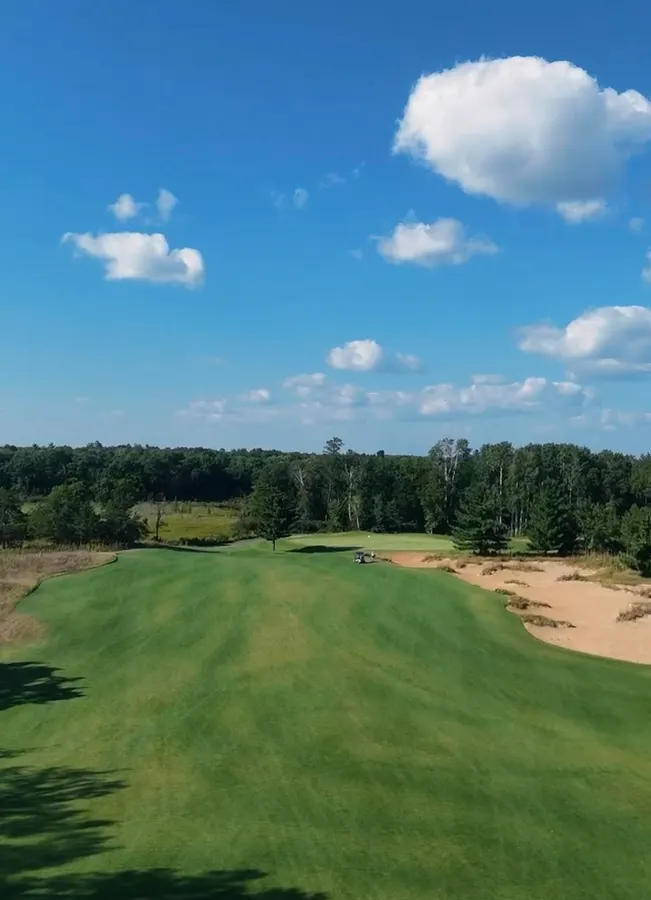

The Farms at Crosswoods designed by golf architect Scott Hoffmann is a sand hills gem trapped within the north woods of Minnesota.
Break80 Gold
Renowned golf destination Brainerd, MN, continues to build its course portfolio as it adds a new Scott Hoffmann design.
The Brainerd Lakes Area, located two and half hours northwest of the Twin Cities, started as a fishing and boating getaway. An outdoorsman’s paradise. Things changed when The Pines opened at Grand View Lodge , bringing a championship golf course to the area.
The man who would reshape Brainerd and Minnesota golf opened his first design, The Classic at Madden’s, in 1997. Scott Hoffmann started his golf career as a superintendent, maintaining the then-45 holes at Madden’s, which included Pine Beach East and West and the Social Course.
“At just 21, I was hired by Jim Madden to take over the reins of Madden’s 45-hole golf operation, coming from 9-hole Mitchell CC in South Dakota. Quite a change. But my naive outlook was same thing, just more of it. It didn’t take long for my veteran crew to ‘educate’ me!” Hoffmann said in his autobiography.
Three years after opening, Hoffmann’s first 18-hole championship design reached Golf Digest’s Top 100 Public list, debuting at No. 33. The prestige quickly lifted the Brainerd Lakes Area from a family vacation spot to a golf destination.
“I spent years becoming intimate with a 220-acre wooded property owned by Madden’s: designing golf holes while cross-country skiing or hiking the land and studying the topography map,” Hoffman said on his website. The time finally came for Madden’s to build a championship golf course. When Brian Thuringer offered me the rare opportunity to not only design but to manage the construction of The Classic, I was ready with a plan. I just needed to find a good consultant. Three came to mind. Geoffrey Cornish, Warren Rebholz, and John Harris came on to fill that role beautifully. The Classic opened in 1997 as a Golf Digest Public Top 100 and has remained there to this day.”
The Classic is a parkland retreat. Despite its easy access, surrounded by other resorts and close to the city center, The Classic feels like it is set in a nature preserve. With no homes, condos, or resort rooms on the course, it feels at one with nature. The course sits adjacent to a large lake that is incorporated into multiple holes, along with a few lily-pad-strewn ponds and calm, flowing streams. Towering pines separate the holes, and the course is surrounded by dense forest.
The Classic at Madden’s is Hoffmann’s first original design, after opening in 1997 it climbed into Golf Digest’s Top 100 public rankings in 2003 and has remained there.
Break80 Golf
The golf itself isn’t as serene. It’s beautiful, but not for the faint of heart—a hilly course with some narrow, pine-lined fairways and occasional challenging shots over water from sidehill or downhill lies.
The Brainerd area would grow to more than 20 golf courses and become a permanent leader in affordable, quality golf trips in the United States.
Hoffmann’s next course went in a completely different direction. A plot of land in the center of Brainerd’s golf resorts would be transformed into a wild 23-and-a-half holes of par-3 golf.
The repurposed gravel pit was transformed into a rugged mining golf landscape. The green sites seem to rise from the rocky ground, while water-filled holes provide players with severe putting surfaces to land their golf balls.
Holes include 70-foot tee-to-green drops, trees in the center of greens, putting surfaces shaped like half-pipes, and a unique 60-yard hole that requires a high, soft shot over a 60-foot-high wall of gravel and fescue.
The pristine conditioning and quiet atmosphere of The Classic are reversed at The Gravel Pit. Its rocky contours, open layout, and rowdy patio—which likely has a live band playing—mesh perfectly with the off-the-wall angles needed to access pin locations and make putts.
Hoffmann’s newest creation in the area is a Nebraska Sand Hills course transplanted to the North Woods. The Farm at Crosswoods is a 9-hole addition that complements the existing courses.
“Some of my favorite books were by Robert Hunter, George Thomas Jr., Donald Ross, and Alister MacKenzie. Mackenzie’s book “The Spirit of St. Andrews” was a game changer for me, both for his design philosophy and practical approach to greenskeeping, given his Scottish roots. His design philosophy to “leave a broad and pleasurable road that leads to destruction” is very evident at Augusta National–with its comparatively few bunkers and scant rough. The course challenges the best in the world and still provides great pleasure for the average golfer,” Hoffman said on his website.
The Farm sits on some of the sandiest soil in the North. After striking usable sand veins on the property, Hoffmann used the material to create a links-style dunesland course through the tall pines of the Brainerd Lakes.
The firm conditions achieved with the sand base are accentuated by the bluegrass-hybrid fairways. The soil and grass, partnered with the tree removal, make for some of the most unique playing conditions and course architecture in northern Minnesota.
“Let’s do kind of a family legacy project, let’s do something that could be theirs,” Mike Stone owner of Crosswoods said in an interview with Break80. “When land comes available we buy it. When the kids come back here we said let’s put another golf course up here.”
A short drive across the street from the log-cabin clubhouse, the change is so dramatic that teleportation seems like the most likely transportation method. The first hole features a wide fairway with a massive dunescape bunker on the left, requiring a 230-yard carry, and an equally large right-side fairway bunker beginning at 250 yards.
The greens on Hoffmann’s newest design, The Farm, are massive, designed large enough to incorporate two pin placements allowing players a unique 18 hole experience on only nine holes.
Break80 Golf
The football-field-sized greens have immense slopes and feature two pins, providing players with two unique 9-hole loops and significantly different strategies for approaching the different hole locations.
“I said okay Scott, I have this parcel, would you try to fit 18 holes or would you do the nine. I did some research and found Sweetens Cove and I looked at their business model and if they could make it work there with a two flag system, I said Scott if we can do two flags lets make the greens bigger,” Stone said.
The Farm emulates Sweetens Cove in its rugged, open landscape and laid-back environment. It passes the ultimate golf test: the need to play a bonus shot on each hole to utilize an additional slope, with the possibility of putting a shot ever so slightly closer to the hole.
With three drastically different designs, Hoffmann will add a fourth in the upcoming years with Valkyrie, a private parkland-style country club a few miles west of town.
Only a handful of holes have been revealed via CAD, but the new course looks to cut the gap between the open layout of The Farm and the parkland peace of The Classic. Hoffmann looks to incorporate some of the Minnesota pines into a more open layout, with short-grass runoffs around green sites and the use of local rock to bring a near-Victorian feel to some of the approaches.
Hoffman also designed an Augusta National themed par three course, Alec’s Nine at Ruttgers Bay Lake Resort. Six of the nine holes incorporate the lake. The walking only course has holes measuring 65 to 120 yards.
Playing the five Hoffmann courses in Brainerd brings a golfer four unique challenges within 25 minutes of each other. Teleportation may not be a reality yet, but the closest a player may find are on his courses in northern Minnesota.















Leave a comment