


This is the basis for remarks I shared during the closing plenary of the National Trust for Historic Preservation’s National Preservation Summit on September 23, 2026, at the Washington National Cathedral. I have kept these words in the form of a speech.

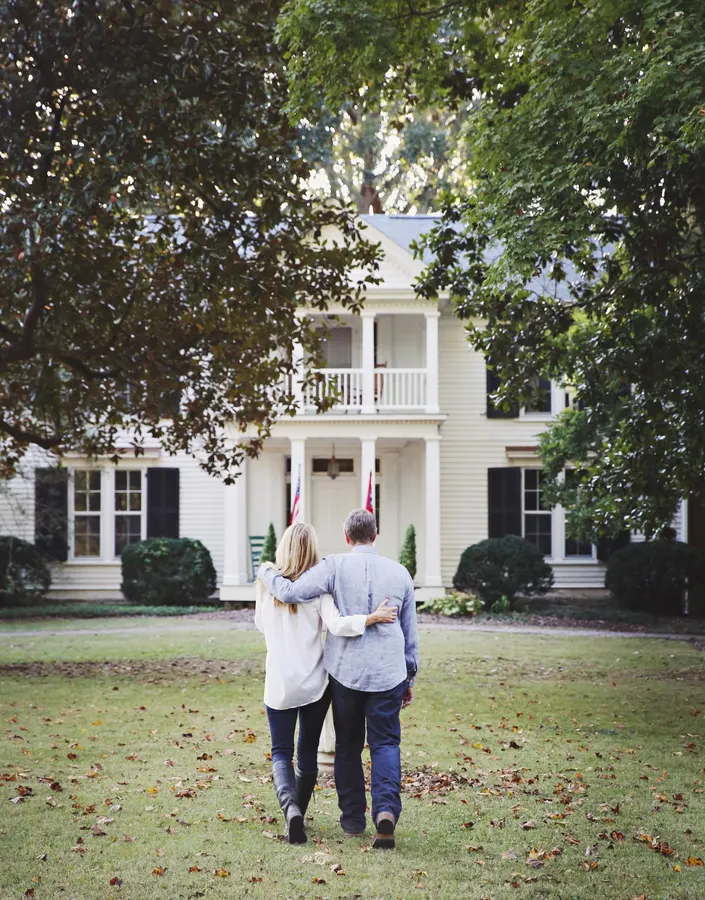
Tracy and Bill Frist in front of their historic 1846 farmhouse in Franklin, Tennessee. Constructed in the nineteenth century by Thomas and Margaret Brown, the Greek Revival-styled home stands gracefully at the juncture of the Big Harpeth River and Dollison Creek (now called Brown’s Creek) with the original, storied Natchez Trace just east of the home. All of the home’s yellow poplar and long leaf pine timbers were hand-sawn and joined with pegs and square headed nails.
Bill Frist, MD
When Tracy and I wake up every day at Old Town, we wake up in an 1846 farmhouse surrounded by old trees, the Harpeth River and its tributary Brown’s Creek, and gentle rises to the south that might otherwise go unnoticed.
Those rises are ancient earthen temple mounds. Our home stands amid the remains of a thriving Native town built about a thousand years ago.
That changes how you see a farmhouse—and the immediate world around it. It has changed how Tracy and I understand preservation, and how closely it is tied to conservation.
You, as preservationists, know what can be lost when an old house is torn down, a bridge is neglected, or a familiar street loses its character. I share that concern. But at Old Town, the house itself tells only part of the story.
The ancient town had a fortified center of roughly twelve acres. There, towering pyramidal earthen mounds supported temples and civic structures used by its leaders. There were large public spaces with adjacent playing fields, and families lived inside and outside the town walls throughout the river valley. Picture people tending crops, grinding maize into cornmeal, fishing in the adjacent river, hunting in the nearby forests, sculpting effigies from clay, pounding drums, and regularly gathering joyfully with their neighbors.
Old Town archaeological site in Williamson County, Tennessee. Depiction of semicircular, 12-acre, fortified (see brown palisaded wall) site, bordered by the Harpeth River, as it existed a thousand years ago. Note temple mounds, burial mounds, houses, and cultivated maize fields (upper left), identified by modern Ground Penetrating Radar. Contemporary site of Locust Grove is at center. Painting by Nick Fielder, 2021.
Bill Frist, MD
They chose a high place where a spring-fed creek meets a powerful river. The abundant water and fertile ground helped sustain them. The land shaped what they could grow, where they could build, and how they lived together.
The mounds, plowed by generations that followed, have softened over the centuries. Beneath the ground are traces of homes and other buildings, along with hundreds and hundreds of limestone stone box graves. Working with archaeologists at Middle Tennessee State University, we have used ground penetrating radar to map the town beneath our feet. Each discovery helps us see and honor those who lived and loved in this place, just as we do so many generations later.
There is something else about Old Town that is harder to measure.
When Tracy and I walk beneath the towering trees, past the mounds, with the creek moving nearby, we sense the presence of those who came before us. I can’t tell you what the ancient residents believed or felt when they stood there. I can tell you what we feel, and what visitors often tell us without prompting. People slow down. They live in the moment. They grow quiet. They settle. The place offers a kind of peace and space that allows us to breathe, to reflect, and to restore ourselves.
That belongs in the story, too. Old Town holds memory and it gives us room to heal.
Centuries later, another chapter began. Thomas Brown started building the farmhouse in 1846 along the original wilderness path of the Old Natchez Trace. Enslaved people helped construct it, and we honor that. Families who followed cared for the home and grounds, each leaving something of themselves behind. Tracy and I are its stewards now, for this brief stretch of a much longer history.
So, what are we preserving at Old Town? The farmhouse where we live, certainly. The mounds and the evidence of the ancient town. The graves, which call for our respect. The stories of everyone who lived and worked there. And the river, the creek, the trees, the soil, and the life around us.
A horse stands atop of one of the temple mounds at Old Town. The large earthen pyramids (the temple mounds) once served as substructures for large temples and the palatial residence of the ancient ruling family. It was a sophisticated and highly structured society and was one of the most densely populated areas east of the Mississippi in the prehistoric era. Today, it’s listed on the National Register of Historic Places.
Bill Frist, MD
At Old Town, we have come to see preservation and conservation as inseparable. If we care for the house while neglecting the water and land and living world around it, we lose part of what made life there possible. Protecting the creek, restoring habitat, and caring for biodiversity extend the work of preservation beyond the walls of a building. They help us care for the whole place.
Old Town also reminds us how deeply every community depends on the world around it.
The ancient town flourished for centuries. Then conditions changed. Tree rings tell us that this region suffered a series of severe droughts during the 1300s and 1400s. Those dry years would have strained crops and daily life. They, scientists believe, would likely have brought severe food insecurity. The changing environment likely added to other pressures that led people to move away. We do not know every cause of their departure. But standing there today, it is hard to miss how much their lives depended on the land and water around them.
Pencil sketch of an ancient Mississippian woman.
Bill Frist, MD
We are capable and resourceful people. We still depend on water, food, and land that can sustain us. I see that connection as a physician as well as a conservationist. The world around us shapes the health within each of us.
Our circumstances today are different. The droughts that affected Old Town were part of natural climate variation. Today, human activity contributes to warming the planet. We understand far more about what is happening, and we have choices about what to address.
Some choices begin close to home: protecting a creek bank, caring for the soil, restoring native plants, making room for pollinators. Others depend on cleaner energy and modern technology. As chair of The Nature Conservancy, I have seen people do this work far beyond one farm. The particulars differ from place to place, but the responsibility is familiar: pay attention to what sustains life, then actively care for it.
I hope that when we work to save a historic building, we will step outside its doors as well. Who built it? Who lived and worked there? What did the surrounding land and water make possible? What can we care for now so that its story continues?
Tracy and Bill Frist feeding their goats, horses and donkey at Old Town Farm.
Bill Frist, MD
Each morning at Old Town, Tracy and I wake in a house built 180 years ago, amid the remains of a town whose story began about a thousand years ago. Others cared for this place before us. Our turn is to understand more of its history and leave its land and water in good hands.
Preservation gives a place its memory. Conservation gives that memory a living future.
*************
For more on the intersection of preservation, conservation and health, click here to watch the National Trust for Historic Preservation’s National Preservation Summit, including my discussion with renowned architect Michael P. Murphy.
Senator Bill Frist, MD (R) and accomplished architect and preservationist Michael P. Murphy (L) before delivering remarks at the National Preservation Summit on the importance of saving old places, conserving natural spaces, and the impact on human health and well-being.
Bill Frist, MD









Leave a comment