



GYOPO Annual Chuseok Benefit Honors EJAE
L. Sirikul
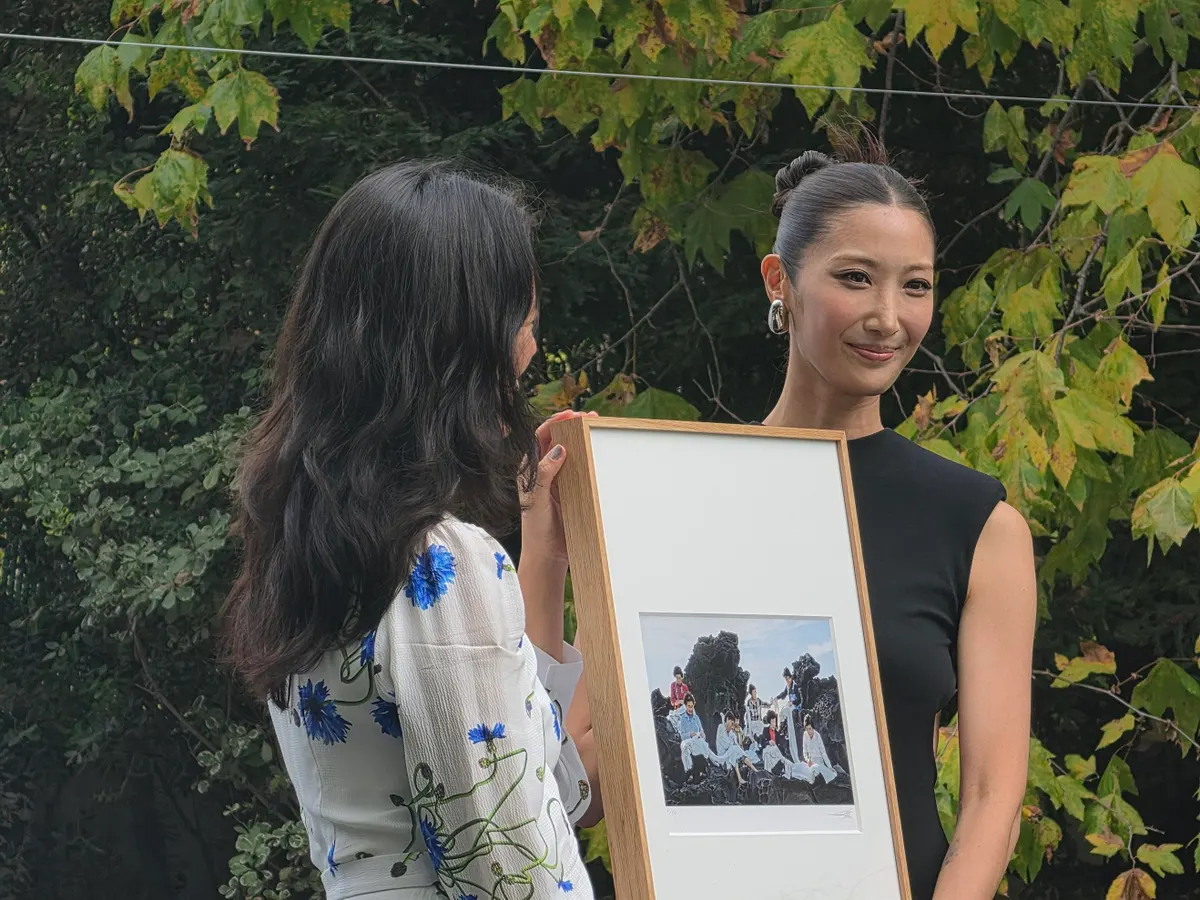
GYOPO, a nonprofit focused on arts and culture for the Korean diaspora in Los Angeles and beyond, celebrated its annual Chuseok Benefit on Sunday and honored award-winning artist EJAE.
Presented by CJ and hosted by GYOPO Board member and founder of Kikori Whiskey, Ann Soh Woods, the fundraiser celebrated the mid-autumn harvest holiday with the GYOPO community of influential figures in art, design, fashion, and entertainment, including Jenny Han, Audrey Nuna, Jeanne Yang, Anicka Yi, Jon Moon, Kevin Woo, Raymond Lee, Dumbfoundead (Jonnie Park), and more.
EJAE, who is Korean American, was honored for her work in pop culture and music, and has spoken frankly about her journey before and after the global success of Netflix’s Kpop Demon Hunters. GYOPO Executive Director Yoon Ju Ellie Lee, who introduced EJAE before her speech, highlighted the singer’s tenacity and her role as a role model for those in the Korean diaspora.
“EJAE has used her platform to speak frankly about failure, rejection, pressure, and transformation, and we need honesty like this,” says Lee. “We need the humility and the clarity that artists give to us. So thank you, EJAE. I’m going to reiterate this: EJAE and HUNTRX’s ‘Golden’ won all these awards, but it’s the quiet work that you did – honing the edge, the discipline, the perseverance, the [unseen] – all that perfection of your craft. That’s what we celebrate today.”
During EJAE’s speech, she talked about her childhood celebrating Chuseok – one of her favorite holidays next to Christmas – and learning about gratitude. She recalled the food – one of Korea’s great love languages – and the memories she has of being with her family. She also mentions how she was from both worlds – living in both the U.S. and Korea, and how she experienced both cultures – and how, living in America, she began to celebrate Chuseok less and less.
GYOPO Annual Chuseok Benefit Honors EJAE
L. Sirikul
She admits, “When I eventually chose to move to the States on my own as an adult, I started to struggle a lot with imposter syndrome. I felt like I was losing my Koreanness. But at the same time, I never fully felt American either, and being bicultural meant that I had these strange little holes in my knowledge of both cultures.”
She never truly felt she belonged anywhere because she was always wondering if she was Korean enough or American enough. She recalls her mom getting frustrated with her, telling her, ‘You can’t pick and choose when you’re Korean and when you’re American.’ She realized her mother was right. She explains, “When I worked with Korean writers, I was often the Western one. My melodies were too American, and I didn’t have enough of both. Then I came to America, and they’re like, “You’re K-pop, you know. I also had to deal with a lot of racism.”
She recalls a producer giving her a backhanded compliment by telling her she was a pretty good singer – “for an Asian girl.” But she kept writing and pushing forward, especially in areas she rarely saw herself. She trusted her gut and voice, and with each rejection, she just kept going. Then she got this little Netflix animation about three K-pop stars who fight demons.
“When you say it out loud, it sounds insane, but I had absolutely no idea what I was putting myself into as my first film, but I knew I was excited that it was my first American animated film based in Korea,” she shares. “I really wanted to show my American friends Korean culture. Somewhere in the process of making Kpop Demon Hunters, I realized something: the part of myself that I had spent years thinking was a weakness – being stuck somewhere in between – was actually my superpower. My secret sauce. Being bicultural and bilingual wasn’t a gap in my identity; it was my favorite sauce: my gochujang.”
KPOP Demon Hunters
Netflix
She praises being among her fellow gyopo (those of Korean descent living outside of Korea) and says those like her don’t need to choose whether they are “Korean enough” or “American enough.” She tells the audience, “You don’t have to perfectly fit into one box. Take all of ot. Mix it all. Take the traditions you grew up with, the ones you lost, the things your parents taught you, and the things you learned somewhere else – put it all in your bowl and mix it however you want. Bring that version of yourself into every room you walk into, because the combination that once made you feel like you didn’t quite belong anywhere could be the exact combination that makes something that no one else could. And I guarantee, it’s gonna be real good.”
With a menu prepared by Chef Debbie Lee of Yi Cha, gelato dessert by Lefty Gelateria, and rice cakes by Migaam, the annual GYOPO event raises funds for the organization’s year-round free public programming and funds the organization’s mission of generating progressive, critical, intersectional, and intergenerational discourses and community alliances among diasporic Korean and Asian cultural producers.










Leave a comment