


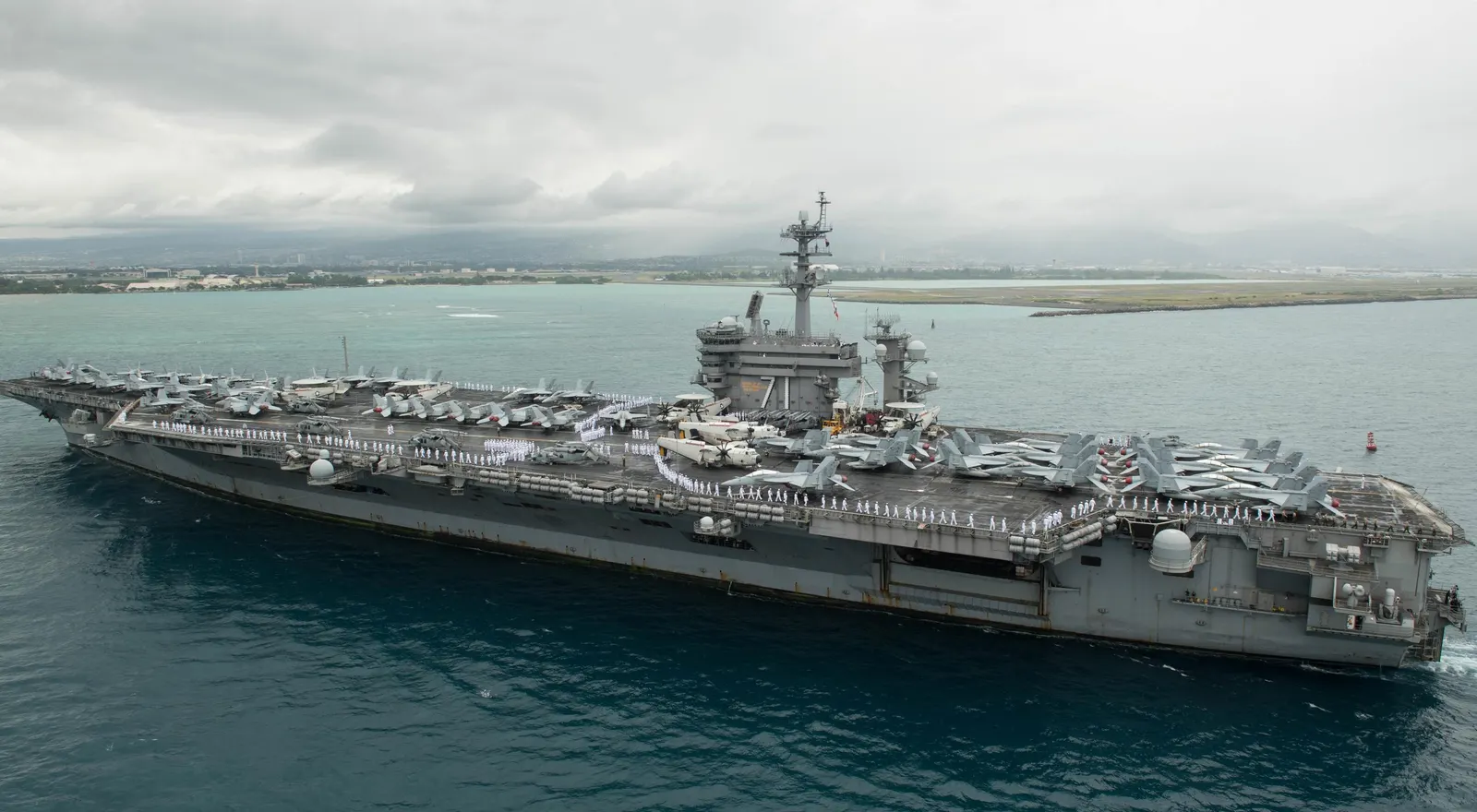

Aircraft carrier USS Theodore Roosevelt (CVN 71) arrives in Pearl Harbor, Hawaii, April 27, 2018. Image courtesy Petty Officer 3rd Class Jessica Blackwell / Navy Public Affairs Support Element Detachment Hawaii. (Photo by Smith Collection/Gado/Getty Images)
Getty Images
Ship spotters reported on Sunday that the United States Navy’s fourth Nimitz-class nuclear-powered supercarrier, the USS Theodore Roosevelt (CVN-71), departed from Naval Base San Diego, California, with little fanfare, beginning its 2026 deployment.
The warship spent much of August preparing for its next patrol after leading the 2026 Rim of the Pacific international naval exercises off Hawaii in July. The aircraft carrier then returned to San Diego, where it completed its pre-deployment training and certifications. It is unclear when it will be back in America’s Friendliest City, yet it may not be until next spring or even summer 2027, given that the U.S. Navy is continuing to rotate its limited number of aircraft carriers to the Middle East.
Another San Diego-based aircraft carrier, the USS Abraham Lincoln (CVN-72), departed from the Arabian Sea in August, after spending more than 250 days at sea without a port visit, the longest of any U.S. Navy flat-top. By the time CVN-72 finally arrives in San Diego, it will also have had the second-longest deployment of a nuclear-powered supercarrier and the second-longest for any aircraft carrier since the end of the Cold War.
As of Wednesday, the USS Abraham Lincoln has been deployed for 313 days since it departed from Naval Base San Diego on November 21, 2025. Most of that was at sea, with the carrier only finally making a full port visit to Thailand earlier this month.
It is part of an alarming trend, as the USS Gerald R. Ford (CVN-78), the United States Navy’s newest and largest supercarrier, spent 326 days deployed, including several months in the Middle East in support of Operation Epic Fury.
Two Carriers In The Middle East Is The New Norm
Since February, just weeks before the United States launched Operation Epic Fury against Iran, the United States Navy has maintained a two-carrier presence in the region. It has also deployed an amphibious ready group and dozens of independent warships, USNI News confirmed.
Maintaining two carriers in the Middle East left other areas without a carrier presence.
The U.S. Navy’s only forward-deployed nuclear-powered aircraft carrier, the Yokosuka, Japan-based USS George Washington (CVN-73), which began its patrol in May, was operating in the South China Sea in July when it was ordered to the Middle East after media reports indicated issues with morale aboard CVN-72.
The USS Abraham Lincoln had also been patrolling the South China Sea, waters that China maintains are part of its sovereign territory, when it was dispatched to the Arabian Sea. For much of the early spring, the US Navy had no carriers in the Western Pacific, and CVN-73 will likely only return after it is relieved by CVN-71 in the coming weeks.
For a very brief period, there were three supercarriers in the region, as the Naval Station Norfolk, Virginia-based USS George H.W. Bush (CVN-77), the tenth and final Nimitz-class flattop, arrived in the Middle East in April after taking the long way around Africa. That allowed the USS Gerald R. Ford to conclude its deployment and head home. CVN-77 has already been deployed for 183 days, and it may not return home in time for the Christmas holiday.
Long Deployments Are Putting Strain On The Crews
The United States Navy has acknowledged the strain put on the crews during the long mission, as eight sailors on CVN-72 attempted suicide over the summer.
On Sunday, Congressional lawmakers, including Rep. Sara Jacobs (D-Calif.), whose district includes San Diego, visited the USS Abraham Lincoln at sea to meet with the ship’s command staff as well as sailors and Marines on board.
“For months, I’ve taken the concerns shared with me about mail delays, food and supply shortages, low morale, and mental health crises aboard the USS Abraham Lincoln straight to CENTCOM and the Navy,” Jacobs said in a statement. “Unfortunately, their answers have been wholly insufficient.”
Jacobs has called for the US Navy Inspector General to investigate conditions on the ship following its long time at sea, and has pushed for the House Armed Services Committee to hold a field hearing in San Diego, where the lawmakers could hear directly from the crew.
Although it has been the carriers that have been in the spotlight, the escorts in the carrier strike groups are also spending months deployed. It was only on Monday that the Arleigh Burke-class guided-missile destroyer USS Frank E. Petersen Jr. (DDG-121) became the first warship of Carrier Strike Group 3 to return to its home port, when it arrived at Joint Base Pearl Harbor-Hickam, Hawaii.
“This deployment challenged us in many ways and required every sailor to perform at their very best,” Capt. Casey Mahon, commanding officer of the USS Frank E. Petersen Jr., told The Military Times. “Despite the pressures and complexities of our missions, the crew rose to the occasion every time, ensuring the safety, security, and strategic interests of our nation. Most importantly, the crew never gave up on the ship and never gave up on their shipmates.”
Other Carriers That Could Deploy In The Coming Months
The United States Navy has limited options as it has too few carriers to deal with multiple crises at a time. It has been stated that every long deployment will require a longer post-deployment maintenance period, which then pushes the time at sea for the next carrier.
Today’s nuclear-powered supercarriers can’t be rushed out.
The USS Dwight D. Eisenhower (CVN-69) has been preparing for its next deployment off the coast of Virginia. However, on Monday, four crew members were injured following a mishap involving an EA-18 Growler electronic warfare aircraft from Electronic Attack Squadron 130 (VAQ-130), which also required the two aviators to eject, but they were safely rescued by a search-and-rescue team from Helicopter Sea Combat 7. One sailor had to be flown to a Norfolk-area hospital for non-life-threatening injuries, while the others were evaluated on-site or at Naval Medical Center Portsmouth.
It isn’t known if that incident will impact the upcoming deployment of the USS Dwight D. Eisenhower, which was expected to begin later this fall or in early 2028. The carrier previously suffered a fire in April while undergoing a maintenance availability at Norfolk Naval Shipyard in Portsmouth, Virginia.
The San Diego-based USS Carl Vinson (CVN-70) also spent much of summer 2026 preparing for its next deployment.
Four Carriers That Can’t Deploy Right Now
There are five carriers that won’t be deployed this fall, and likely won’t be available for 2027. The United States Navy’s oldest active carrier, the USS Nimitz (CVN-68), completed its homeport shift from Naval Base Kitsap-Bremerton, Wash., to Naval Station Norfolk earlier this year. CVN-68 is on track to be decommissioned in March 2027, when the future USS John F. Kennedy (CVN-79) is handed over to the U.S. Navy.
The USS John C. Stennis (CVN-74) is nearing the end of its midlife refueling, and will then need to undergo post-redelivery sea trials and training. Next up for the same process, which could take four years or longer, is the USS Harry S. Truman (CVN-75), meaning it will be sidelined until 2030 or later.
The USS Ronald Reagan (CVN-76) completed its 17-month-long Docking Planned Incremental Availability at the Puget Sound Naval Shipyard & Intermediate Maintenance Facility. The supercarrier will also need several months of post-DPIA sea trials, certifications and training before it can deploy again.
Given these situations, the U.S. Navy will be forced to rotate carriers on extended deployments.















Leave a comment