


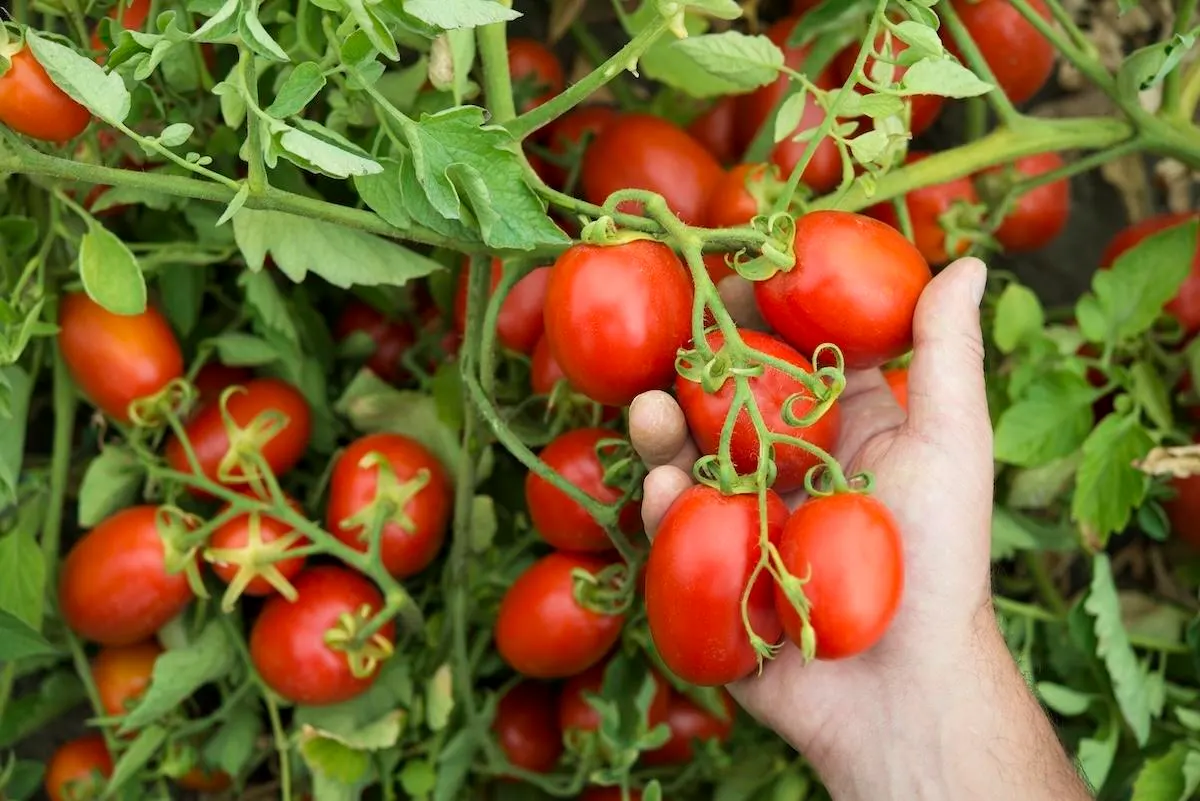

Tomatoes grow horizontally in the fields in Parma, rather than on stakes.
Mutti
Food enthusiasts likely know Parma as the home of two of Italy’s most iconic specialty foods: Parmigiano Reggiano cheese and Prosciutto di Parma ham.
But until my recent trip to Emilia-Romagna, I didn’t realize that tomatoes are one of the region’s leading agricultural crops. Parma grows and processes roughly half of Italy’s tomatoes, dubbed “red gold” because of their economic significance.
Headquartered in the small town of Montechiarugolo in Parma, the family-run Mutti Group is a global leader in Italian tomato processing, catering to food suppliers, eateries, and home chefs alike. During my visit to the region, I had the opportunity to meet CEO Francesco Mutti to learn more about the company’s history, philosophy and products.
Tomato Season In The Food Valley
Tomato season in Parma generally runs from mid-July through late September, with the fields rotated on a three-year cycle.
Traveling along the narrow, less-than-two-lane roads, one finds endless miles of flat plains, only 15 minutes from Parma’s historic center. Farms with sprawling fields of alfalfa, grains, and rows of tomatoes are punctuated by occasional lines of poplar trees marking property boundaries.
Occasionally, one spots an antique farmhouse, a vintage warehouse, or, in the distance, rolling hills terraced with Lambrusco and Malvasia vines used to produce the region’s flagship wines.
Impeccably attired and wearing tomato-red suspenders at the company headquarters, Mr. Mutti explains that while tomatoes are often grown on vertical stakes, those in Parma are grown horizontally on raised beds in mineral-rich soil, enabling mechanical harvesting for processing.
Huge dump trucks filled with tons of tomatoes tie up roads as they carry the red gold at peak ripeness—within hours of harvest. These tomatoes have thicker skins, making them less vulnerable to damage during transport, and once they reach the processing plant, they swim gently in pools of water to be washed.
Tomato harvest season in the Food Valley of Emilia Romagna, Italy
Mutti/CARLO GUTTADAURO
Mutti: A Tomato Pioneer
Tomatoes, which originated in South America, have been grown in Parma since the mid-1800s. After the turn of the century, the area became a hub of tomato production, with more than 70 brands operating there. Without refrigeration, people turned to preserved tomatoes during the off-season.
Since then, tomatoes have become a staple of modern Italian and Italian-American cooking, essential to pasta, soups, sauces, pizza, and many other dishes.
The Mutti family was one of Parma’s earliest tomato pioneers, credited with refining and developing the industry. Mr. Mutti told me that his family has processed Italian tomatoes for four generations, since 1899.
The company operates three production plants processing two main varieties: “Tondo di Parma” (round tomatoes), grown in the province of Parma in northern Italy, that are used for puree, tomato paste, and finely chopped tomatoes; long tomatoes (used predominantly for canned peeled tomatoes) and cherry tomatoes come from the Puglia region in southern Italy.
Generations Of Innovation
Exhibit at the Tomato Museum
Irene S. Levine
Although the tomato industry has changed over time, Mutti has been ahead of the curve in developing innovations in cultivation, processing and marketing. A few notable examples:
- Even before brothers Marcellino and Callisto Mutti founded the company, their uncle Giovanni, a farmer, began practicing crop rotation in 1850 to keep the soil healthy.
- In 1951, Marcellino’s son Ugo cleverly packaged tomato paste in a toothpaste-like tube, making it easier to store. A marketing guru, he designed a cap that served as a collectible (and functional) sewing thimble to promote sales.
- To give consumers year-round access to the convenience of fresh summer flavor, the company patented a technique for producing finely chopped tomatoes in their own juice (known as polpa). “In 1971, polpa was new to the world, and now it is the most popular tomato product in Italian households,” says Mr. Mutti.
Trained in finance and management at Cardiff University, Francesco Mutti became CEO of the family company in 1994. With the same passion and drive as his forebears, he has led its successful expansion by opening new subsidiaries and launching products tailored to foreign markets, such as pestos, regional purees, and soups.
In 2020, Mutti introduced “Sul Campo,” a tomato passata made from fresh, raw tomatoes harvested and processed directly in the field by a patented machine called an Instafactory.
“This is the best and freshest tomato product available,” Chef Matteo Ricci told me at Bistro del Labirinto, where he uses it in his cooking. The restaurant is part of the complex housing the world’s largest bamboo labyrinth in Fontanellato (Parma), Italy.
A Bold New Approach
CEO Francesco Mutti, the fourth generation of his family business, has catapulted the company into a premium global brand
Mutti/Giacomo Terracciano Studio
When Francesco Mutti took the helm of the company at the tender age of 25, industry competition was fierce, marked by aggressive price wars over tomatoes, which were considered little more than a commodity. His approach was daring and counterintuitive: focusing on quality rather than cost, restoring dignity to the tomato and ultimately building a premium brand around it.
“People thought I was crazy for operating on low margins, but entrepreneurs have to take risks,” Mr. Mutti said. “I wanted to create a brand.”
He restructured the company, and to build loyalty among the farmers he depended on, he paid them 10% to 15% above market rates to source the finest raw materials. “This enabled us to purchase the best part of the crop from the largest number of farmers,” he said.
During my visit, Mr. Mutti explained that the company doesn’t grow tomatoes itself but works directly with a network of Italian farmers, building long-term relationships focused on quality and traceability.
He also implemented advanced technology and quality-control measures to preserve peak freshness, ensuring all tomatoes were processed within 24 hours of harvest.
Recognizing the importance of a committed workforce, the company invested in the education and training of its 600 regular employees, supplemented by an additional 1,300 seasonal workers during the busy summer harvest.
The company also launched a unique on-site restaurant, Quisimangia (Italian for “Here we eat”), where employees can enjoy lunch for a modest fee. Mr. Mutti calls the restaurant “a landmark for the community” and hopes to open it to the public in the future.
Breaking away from the ordinary institutional canteen, Mutti commissioned the internationally renowned architectural and design firm Carlo Ratti Associati to create the contemporary, light-filled space that seems to emerge from the earth beneath it. The cutting-edge building has a green roof that blends with its surroundings and a floor made from recycled tomato skins.
Brothers Chicco and Bobo Cerea (through their catering arm VICook), the same family that runs the Michelin-starred Da Vittorio restaurants, designed the restaurant’s menu, featuring dishes that reflect the company’s emphasis on quality and sustainability.
The Mutti Recipe for Success
Mutti tomato products are known for their fresh flavor and balance of sweetness and acidity. The Mutti Group is now Europe’s leading tomato brand and the leading Italian tomato brand in the U.S., with reported revenues of €777 million in 2025 and products sold in more than 100 countries.
Francesco Mutti is bullish about the taste and quality of his tomatoes, which cost more than most other supermarket brands. Consumers, too, are undaunted by the premium price of these luxury “Made in Italy” tomatoes.
“Once people try them, they buy them,” he explains. “It’s hard to step back.”
Eye-catching, eco-friendly cans of peeled and crushed tomatoes now line grocery shelves and pantries worldwide. The can design is so visually appealing that it often serves as pizza parlor decor in the U.S. In Italy, people commonly use larger Mutti tins as planters. The curvy, carafe-like passata jars feature two gold lions on the label, representing the gold medal the company received at the International Industry and Agriculture Exhibition in Rome in 1911.
This four-generation family business has elevated Emilia-Romagna’s “red gold” into a world-renowned culinary staple. The Mutti Recipe: blending tradition with modern innovation; developing new harvesting, processing and marketing techniques; creating close ties with local farmers and prioritizing quality over price.
Italy’s Food Valley: A Mecca For Tourism
Map of Italy’s Food Valley
Emilia Romagna Tourism
Parma, which sits in the heart of Emilia-Romagna in north-central Italy, is known as the capital of the region’s Food Valley for many reasons:
- The fertile soil of its agricultural fields, blessed with sunny days and cool nights, creates ideal conditions for growing uniquely sweet tomatoes.
- Its microclimate is ideal for curing meats and aging cheeses.
- The region boasts the largest number of PDO (Protected Designation of Origin) and PGI (Protected Geographical Indication) products in the world.
- Parma is home to global culinary giants, including Mutti (tomatoes) and Barilla (pasta).
- The city, capital of the province of the same name, was designated Italy’s first UNESCO Creative City for Gastronomy in 2015, in recognition of its creativity and commitment to sustainability.
Emilia-Romagna’s Food Valley has become a bucket-list destination for culinary tourism and agritourism, where visitors can learn about the history, production, and processing of the region’s signature foods at local farms and facilities.
The area offers abundant opportunities for visitors to savor local foods and wines at exceptional farm-to-table trattorias, osterias, and restaurants. Additionally, a provincial network of food museums (Musei del Cibo), including a tomato museum, tells the story of this regional bounty.
For Additional Information
The Tomato Museum in Collecchio is housed in a former tomato factory
Parma Musei del Cibo/Province of Parma
Every year, Mutti, along with other food companies in Parma, opens its doors to the public for community events. The company website also features a virtual Field-to-Table Factory Tour explaining the manufacturing process.
With partial support from Mutti, the Tomato Museum in nearby Collecchio (Parma) is open from March through December. Housed in a former tomato factory, it chronicles the development of Parma’s tomato industry.














Leave a comment