


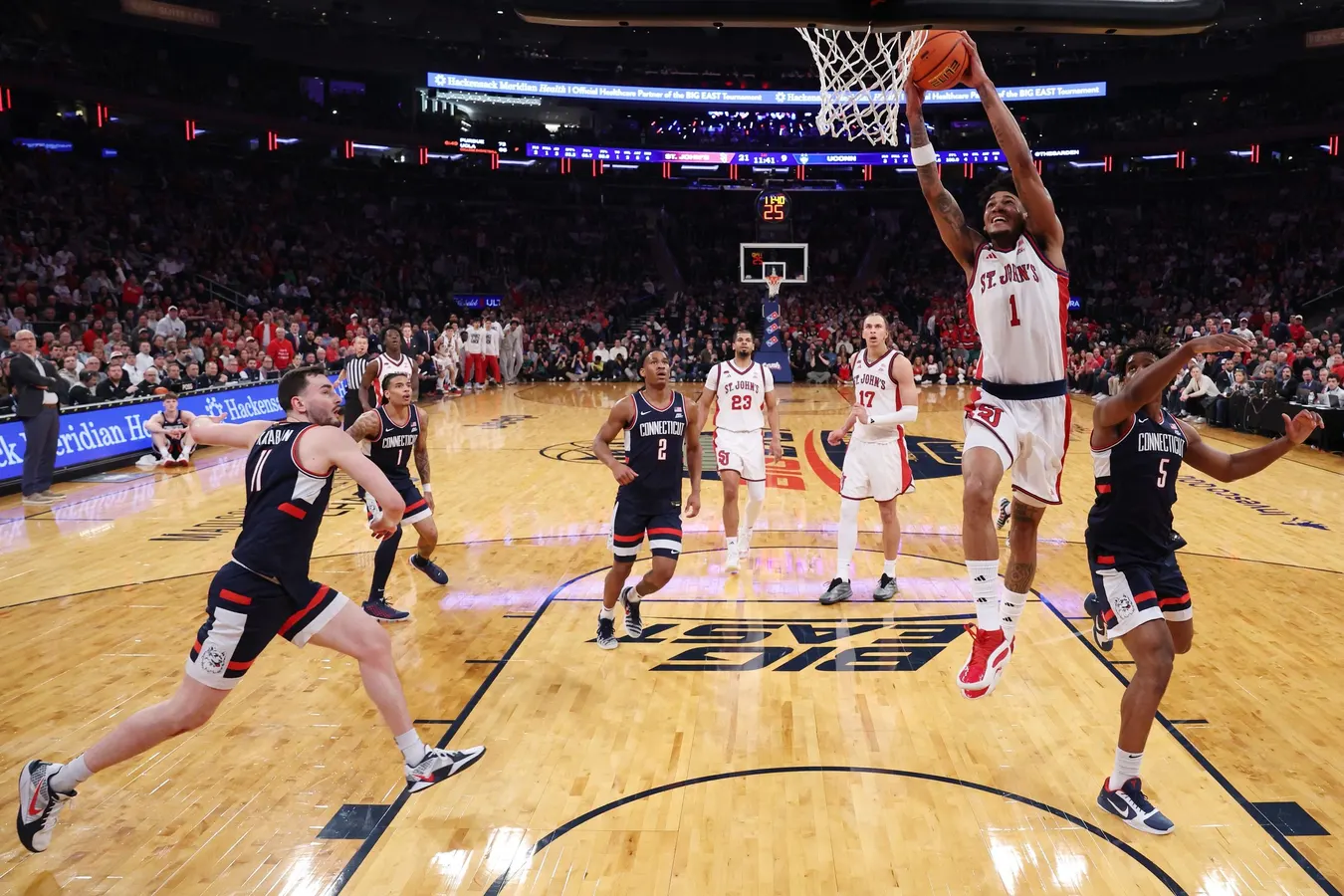

NEW YORK, NEW YORK – MARCH 14: Dillon Mitchell #1 of the St. John’s Red Storm goes to the basket as Tarris Reed Jr. #5 and Alex Karaban #11 of the Connecticut Huskies defend during the 2026 Big East Men’s Tournament Championship game against the Connecticut Huskies at Madison Square Garden on March 14, 2026 in New York City. The Red Storm won 72-52. (Photo by Sarah Stier/Getty Images)
Getty Images
For nearly 25 years, Tim Brosnan was an executive at Major League Baseball, including leading business operations and serving as chief operating officer before departing in January 2015. He then spent the next decade running his own sports consulting company and helping at Georgetown University, his alma mater. Now, Brosnan is the in the early days of his new role as commissioner of the Big East Conference, a basketball-focused league that has remained competitive in a football-dominant college athletics landscape but still faces challenges.
During the Big East’s media day on Thursday, Brosnan stood at the dais in a ballroom at the Marriott Marquis in Manhattan, about 30 blocks from where he grew up in the city’s East Village neighborhood. He laid out his vision for the league at a time when the federal government seeks to pass legislation impacting college sports and where multiple courts are considering eligibility challenges to the NCAA’s rules.
“I come from the most tradition-bound of all professional sports,” Brosnan said. “To make things go over the years, I developed the saying: Tradition is not a business. Times change, and successful businesses recognize that. The good news here is that the Big East knows that over our history, time and again, we found ways to thrive in challenging and often chaotic environments. We didn’t run from the change. We embraced it. And right now, chaotic is probably the best word to describe our industry.”
Brosnan took over as Big East commissioner on Sept. 1, replacing Val Ackerman, who had been commissioner since the league was reconstituted in 2013. Back then, the Big East split into two, with the schools with Football Bowl Subdivision programs forming the American Athletic Conference and the seven basketball-focused schools keeping the Big East name and adding Xavier, Butler and Creighton.
Since then, the Big East has remained among the best men’s basketball conferences in the nation, while Villanova (2016 and 2018) and Connecticut (2023 and 2024) have each won two NCAA tournaments. But in 2023 and last season, only three Big East teams made the NCAA tournament, which Brosnan doesn’t want to happen again.
“How many teams need to be in the (NCAA) tournament for me not to be disappointed? Five,” Brosnan said. “How many teams would I like to see in the (NCAA) tournament? More than five, like six or seven.”
He added: “Here’s what I do know: the investment that our schools have made in their basketball clubs this year has never been stronger across the board, and so if you believe that investment leads to results, I’ll be disappointed if it’s anything less than five, and I’m optimistic that it’ll be more than that.”
Brosnan said that multiple athletics directors have spoken with him about mandating a minimum spending on revenue sharing and Name, Image and Likeness for Big East schools. However, he said he needs to give the idea more thought.
“There are a lot of guys who believe that we should have a minimum to keep everybody competitive, but those are the guys that aren’t running another school’s balance sheet,” Brosnan said. “I haven’t made a decision on whether I favor that or not. I know it’s an issue that we’re going to have to address in the offseason.”
Another major issue in the Big East is the future for UConn, which on Thursday was picked to finish first in the Big East men’s and women’s coaches poll. The Huskies, an original Big East member in 1979, left for the American in 2014 before rejoining the Big East in 2020. The move helped raise the profile of the men’s and women’s programs and the league itself. But the Huskies’ football program became an independent, which is an unenviable situation as the Power 4 football conferences of the ACC, Big Ten, Big 12 and SEC become dominant. On3 and The Athletic recently reported that UConn has had discussions with the American about having its football program rejoin the league, although nothing is imminent, and it would not involve the basketball programs.
Although Brosnan said he has spoken with UConn president Radenka Maric and athletics director David Benedict about the Big East wanting the Huskies’ basketball teams to remain in the Big East, he said “that’s not a decision for me to make.” He added that “we all know there’s been back and forth” with UConn thinking about a home for its football team, at the least.
“Listen, what they need is adequate funding for their athletic programs,” Brosnan said. “Period. And one of the things I’m doing at the Big East is trying to up the commercial activity of the Big East, which will obviously help their basketball program. How they manage their football program, that’s not my concern.”
Brosnan also said he gave a “full-throated endorsement” of the Protect College Sports Act, a bipartisan bill that the U.S. Senate passed by a wide margin on Monday night. The bill, which still must pass the House of Representatives, increases the revenue sharing cap for athletics departments but seeks to crack down on NIL deals that don’t meet certain criteria. The bill would also codify the “five in five” rule, where athletes have a five-year window to play. The NCAA passed that rule, which went into effect on Aug. 1, but there are currently several lawsuits where players in the high school class of 2022 are seeking an extra year of eligibility.
“It’s exactly why there is a need for legislation,” Brosnan said. “More particularly, what you could end up with is players who are eligible to start the season, and appeals get made, and sometime in the middle of the season, players are removed from rosters. That’s just nuts.”
Brosnan added: “We can take issue with when the five in five rule was implemented. Lots of people have issue with that. I think that things like that are why I believe there’s a better chance than what’s being prognosticated for now that we get something in the lame duck session because people are realizing this is unsustainable.”
While the Big East media rights agreements with Fox Sports, NBC Sports and TNT Sports runs through the 2030-31 season, Brosnan is seeking to get more promotion from the television partners. He also plans on working with those networks on improving the Big East’s television schedule and having marquee non-conference games that could increase revenue.
The Big East will increase marketing and promotion of the men’s basketball tournament, which has been held at Madison Square Garden each year since 1983, and the women’s basketball tournament, which has been at the Mohegan Sun Arena each year since 2021. And the league will increase its focus on social and digital media platforms, which Brosnan said is a “real revenue opportunity.”
“We’re going to lean into commerce and better monetize our Big East assets,” Brosnan said. “We’ll also take better advantage of the non-commercial assets that our Universities possess, that are part of our history, which will in turn generate greater performance and opportunity for our conference.”
He added: “It’s early in my tenure, but I see tremendous opportunity to better exploit all these assets to produce a better outcome financially.”
St. John’s president Rev. Brian Shanley, the chair of the search committee for the new commissioner, said the league was seeking someone with extensive professional sports experience and who had success in a revenue-generating role. Brosnan fits that description. He helped MLB negotiate record television contracts, launched the MLB Network and created the World Baseball Classic.
Brosnan has strong ties to the Big East, too. He played baseball at Georgetown for four years and took an eight-hour bus ride to Providence, R.I., for the first Big East men’s basketball tournament in 1980, his senior year. His three children are Georgetown graduates, as well.
In 2021, Brosnan started working with then-Georgetown president John DeGioia to explore how the Hoyas would operate in the Name, Image and Likeness Era. Brosnan founded and ran “Hoyas Rising,” an NIL collective for Georgetown that shut down in June 2025, as the Hoyas decided to run it in-house following the settlement in the House v. NCAA case that allowed athletics departments to share revenue with athletes for the first time.
“What won him the job — I have never said this to him — is that when we interviewed him, what was clear about Tim was not only did he have all this professional sports experience, but he had a passion for the Big East,” Shanley said.
Brosnan is adapting to his new position. Still, after a long career as a sports business executive, he has found a role that challenges and invigorates him.
“This assignment that I’ve accepted, it’s not a job for me,” Brosnan said. “It’s a passion, and I want to cap my career knowing that the greatness that is the Big East is secure for years to come. I believe that the Big East can and will prosper in the years ahead, and that its legacy and traditions will endure far beyond my years.”













Leave a comment