


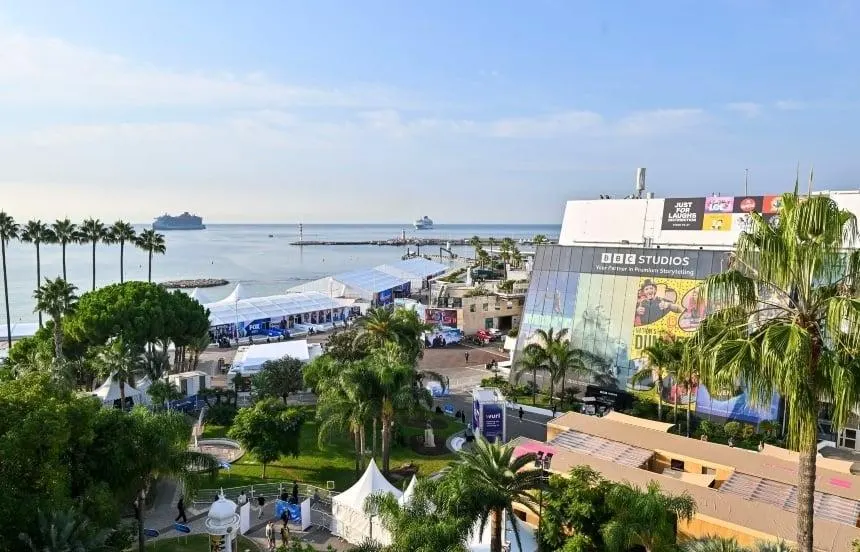

An overhead view of Mipcom Cannes.
Mipcom Cannes, 20265
The international television industry gathers in Cannes this week for MIPCOM 2026, with the business of selling finished programs and financing new productions sharing the spotlight with a rapidly changing digital entertainment landscape.
Running Oct. 12–15 at the Palais des Festivals, the market brings together broadcasters, streamers, distributors, producers, creators, brands and technology companies at a time when traditional television businesses are rethinking how content is financed, discovered and monetized. Organizers project more than 10,600 attendees, 1,500 exhibitors and 3,300 buyers from more than 100 countries.
The central question is no longer simply which shows will travel internationally, but how intellectual property can generate value across streaming, social video, branded entertainment, licensing and new formats.
Netflix, YouTube and artificial intelligence are prominent themes in this year’s program, reflecting the growing overlap between established entertainment companies and platforms that have developed outside traditional television.
Netflix and YouTube reflect a changing distribution landscape
Netflix Chief Content Officer Bela Bajaria is scheduled to receive the Variety Vanguard Award on Monday, followed by a conversation on Netflix’s global content strategy and the international appeal of locally produced programming. Banijay Entertainment chairman Jeff Zucker and CEO Marco Bassetti will also discuss the group’s next phase of growth.
YouTube, meanwhile, is expanding its presence with sessions examining distribution, monetization, connected-TV viewing and partnerships with traditional media companies. An opening-day discussion between YouTube EMEA vice president Pedro Pina and RTL Deutschland chief executive Stephan Schmitter will focus on their partnership, while NBCUniversal and YouTube executives will examine their own collaboration.
The expanded program reflects an increasingly important question for broadcasters and studios: how to work with digital platforms that compete for viewers’ attention but also offer new routes to audiences and revenue.
AI moves from experimentation to business strategy
Artificial intelligence receives a dedicated platform through the inaugural MIP AI Entertainment Forum, which will bring together technology companies, studios, producers, streamers and intellectual-property owners.
The discussions are expected to cover AI-assisted production, dubbing and subtitling, content discovery, licensing and workflow efficiencies. Utopai Studios co-founder Cecilia Shen and CJ ENM Studios executive Ken Oh are among the participants exploring the potential of AI-enabled entertainment.
Alongside the promise of lower costs and new creative tools, the forum will confront questions about rights ownership, permission, training data and compensation. Those issues are becoming increasingly consequential as media companies assess how to deploy AI without undermining the value of the intellectual property on which their businesses depend.
Microdramas, creators and new financing models
Short-form vertical storytelling is another major focus. MIPCOM has added dedicated programming and matchmaking opportunities for microdrama businesses, connecting producers, platforms, distributors and buyers interested in mobile-first series.
The market is also broadening its focus on creator-led businesses. Entrepreneur and filmmaker Dhar Mann headlined Sunday’s pre-opening program, marking the first time MIPCOM has opened its schedule with a creator. The expanded Creator Economy program and the new MIP BrandWorks initiative are designed to connect creators, brands, agencies and studios around financing, partnerships and new intellectual property.
For producers, the appeal is practical: projects may now be developed with several distribution outlets and commercial partners in mind, rather than relying exclusively on a conventional broadcaster or streaming commission.
Spain and international co-production in focus
Spain’s production sector is also looking to capitalize on the market. Nearly 50 Spanish companies are preparing to attend Cannes, while the program includes a Canada–Spain co-production session on Oct. 14.
More broadly, international collaboration remains central to MIPCOM’s business agenda. Latin American companies including Globo, Caracol Televisión, TelevisaUnivision and TV Azteca are among the participants, while Asian groups such as CJ ENM, Nippon TV and JioStar represent the region’s growing role in international content development and distribution.
The screening program adds a showcase dimension to the dealmaking. Among the highlights are the world premiere of Honey, a BBC and ZDF series set in 1980s East Berlin, and the premiere of Beta Film’s Queen Silvia on Oct. 13.
The bigger picture
MIPCOM 2026 arrives as entertainment companies navigate tighter economics, fragmented audiences and a growing range of competitors for both attention and advertising. Traditional distribution and co-production remain essential, but the market’s expanded digital, AI and creator-focused programs show how much the industry’s definition of a content business is changing.
The measure of success in Cannes will ultimately be the deals struck: which projects secure financing, which formats find international buyers, and which partnerships turn emerging technologies and audiences into sustainable revenue.
For an industry under pressure to make existing intellectual property work harder while discovering its next global hit, MIPCOM is as much a marketplace for new business models as it is a showcase for new programming.














Leave a comment