


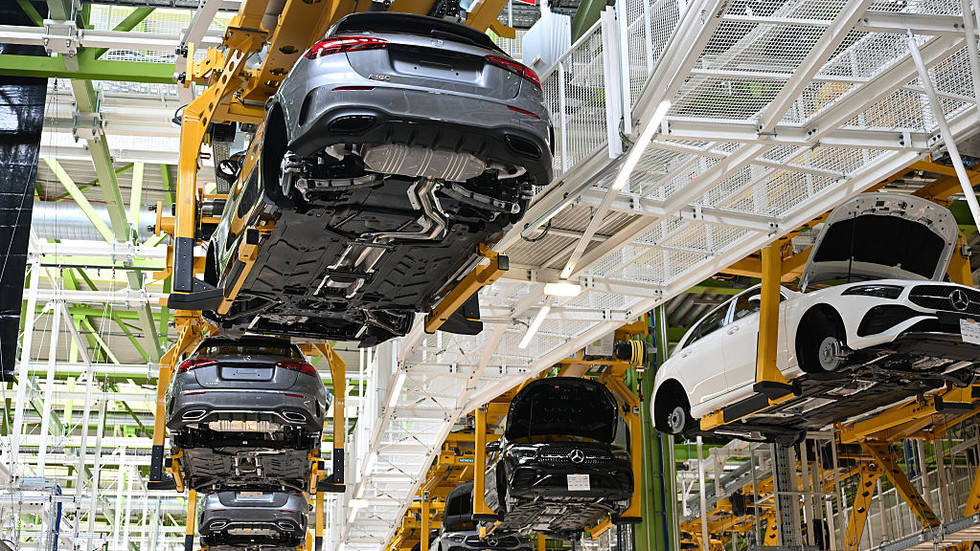
The auto giant is struggling with high production costs, falling sales in China, and stalled talks over labor cuts
German auto giant Mercedes-Benz has frozen investment in its domestic factories and is considering plant closures, according to an internal memo cited by multiple media outlets. The decision comes as high production costs and fierce competition from China squeeze Germany’s struggling car industry.
In the memo published on the company’s intranet on Thursday, production chief Michael Schiebe reportedly said current cost structures make further investments in Germany impossible.
Manufacturing labor in the country can cost up to five times as much as at Mercedes’ Eastern European facilities, according to industry data.
Months of negotiations with employee representatives over proposed labor-cost cuts have failed to produce an agreement.
Britta Seeger, the board member in charge of human resources, warned that the company is now “forced to examine, in concrete and detailed terms, which sites in Germany we can still afford to maintain.” According to the memo, she said management wants to avoid plant closures at all costs but must consider the option more seriously.
The investment freeze could affect factory upgrades, expansion, and preparations for future car models. It does not mean an immediate halt to production, but casts doubt on the long-term future of the plants.
Germany’s manufacturing sector has struggled to recover from the EU-wide energy crisis that followed the loss of Russian pipeline gas supplies in 2022. Although energy prices have fallen from their peaks, they remain high compared to other markets such as the US and China, and a major burden for German manufacturers, undermining their competitiveness.
Mercedes has also suffered a sharp sales slump in China, the world’s largest car market, where it faces fierce competition from Chinese automakers. Its sales in the Asian country plunged 31% year on year in the third quarter of 2026, compared with increases of 5% in Europe and 6% in the US. In October, the company cut its annual profit-margin forecast, citing worsening conditions in China and higher costs.
Mercedes is the latest German automotive giant to scale back domestic investment. On Wednesday, Reuters reported that Volkswagen abandoned a major manufacturing modernization project at its flagship Wolfsburg plant. The decision comes as the company pursues a sweeping restructuring plan involving 100,000 job cuts across the group and an uncertain future for four German factories.
Due to its heavy reliance on exports and manufacturing, Germany is particularly vulnerable to energy price shocks, trade barriers, and supply chain disruptions, the Bundesbank warned in a report on Thursday. Economic uncertainty remains near historic highs and could further discourage investment and production, the regulator said.
You can share this story on social media:
















Leave a comment