


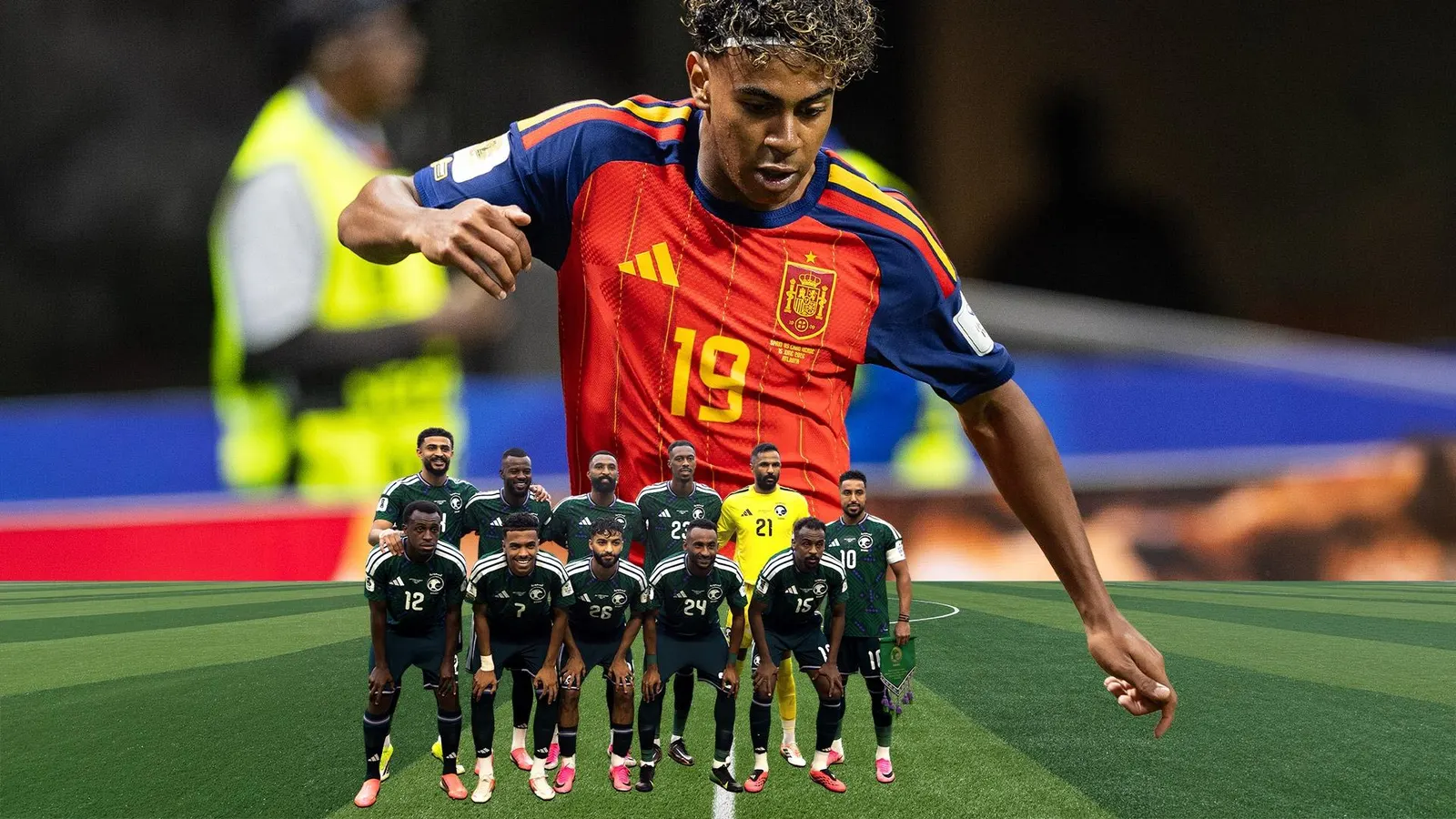
Saudi Arabia opened the World Cup with a surprising 1-1 tie against Uruguay, and as the Green Falcons enter their second game of group-stage play against Spain on Sunday, they will be looking to produce another shocking result—perhaps even bigger than Spain’s own draw last week against tiny Cape Verde.
It won’t be easy. Spain, one of the tournament favorites, is No. 3 in FIFA’s ranking of national teams while Saudi Arabia is No. 59. And the difference is even starker when comparing the value of their rosters. Transfermarkt, a German website that assigns a “market value” to each professional player, projecting what a transfer would cost in the club soccer world, estimates the 26 players on Spain’s World Cup squad are worth €1.22 billion, or $1.4 billion at the current exchange rate—the third-highest total in the tournament. Saudi Arabia, meanwhile, has a total market value of less than $47 million, ranking 41st at the World Cup.
In fact, all 26 Saudis combined are worth only about a fifth of one Spanish star: Lamine Yamal, the 18-year-old winger who is tied with Norway’s Erling Haaland for first among all players with a Transfermarkt value of $229 million.
At the World Cup, where soccer’s Davids and Goliaths are jumbled up in groups before the top teams advance to the knockout stage, it’s not an unprecedented situation. Yamal, for instance, was worth 3.7 times the entire roster of small but mighty Cape Verde, and France heads into Monday’s game led by star forward Kylian Mbappé, worth $206 million—8.5 times the roughly $24 million value of Iraq, the third-lowest figure for a squad in the tournament.
The greatest disparity in this year’s group stage, however, came on Tuesday, when Iraq also had the misfortune of facing off with Haaland. Ultimately, the 9.4x ratio between top player and opposing team value was borne out in the box score, with the 25-year-old Norwegian striker scoring two goals in a 4-1 victory.
The gaps may be more glaring this year after the World Cup expanded to include 48 teams, from the 32-team format that had been in use since 1998. The change helped open up the field to underdogs such as Haiti and first-time qualifier Curaçao—and allows 32 teams to advance to the knockout stage, up from 16—but it also forces the minnows to take the field against soccer’s most fearsome sharks. On Transfermarkt, six national team rosters are valued at more than $1 billion: France ($1.7 billion), England ($1.6 billion), Spain ($1.4 billion), Portugal ($1.2 billion), Germany ($1.1 billion) and Brazil ($1.1 billion).
On the other hand, 23 countries’ World Cup squads are worth less than the $229 million market value of Yamal or Haaland individually, including tournament co-hosts Canada ($228 million) and Mexico ($220 million). That is nearly half the field. And last week, even with Yamal limited to a substitute role as he recovers from a hamstring injury, Spain actually had three other players take the field whose Transfermarkt value exceeded Cape Verde’s total, with midfielders Pedri and Dani Olmo and center back Pau Cubarsí.
Of course, market values don’t necessarily decide World Cup matches.
In addition to the Spain-Cape Verde and Uruguay-Saudi Arabia draws, Portugal and Belgium were held to ties by the Democratic Republic of the Congo and Egypt, respectively, in matchups that sported Transfermarkt value ratios of 7x and 4.7x (comparing the two full teams).
It’s not just a matter of luck, either. Transfermarkt values are not strictly a measure of each player’s talent; they also factor in the player’s age, contract status, club performance and future potential.
And while they may be a good prediction of a transfer fee, they don’t always have a strong correlation to a player’s earnings. For example, Cristiano Ronaldo—not only the highest-paid player at the tournament but also the world’s top-earning athlete across all sports, with an estimated $300 million over the past 12 months before taxes and agent fees—trails 20 of his Portugal teammates with his Transfermarkt value. And his longtime rival Lionel Messi, who hauled in an estimated $140 million over the past 12 months, is 15th on Argentina’s roster by Transfermarkt’s count.
It’s just a reminder that there are many ways to measure value. Yamal and Haaland may lead the way in the transfer market, but there are just two billionaires playing at this World Cup—Ronaldo and Messi.















Leave a comment