


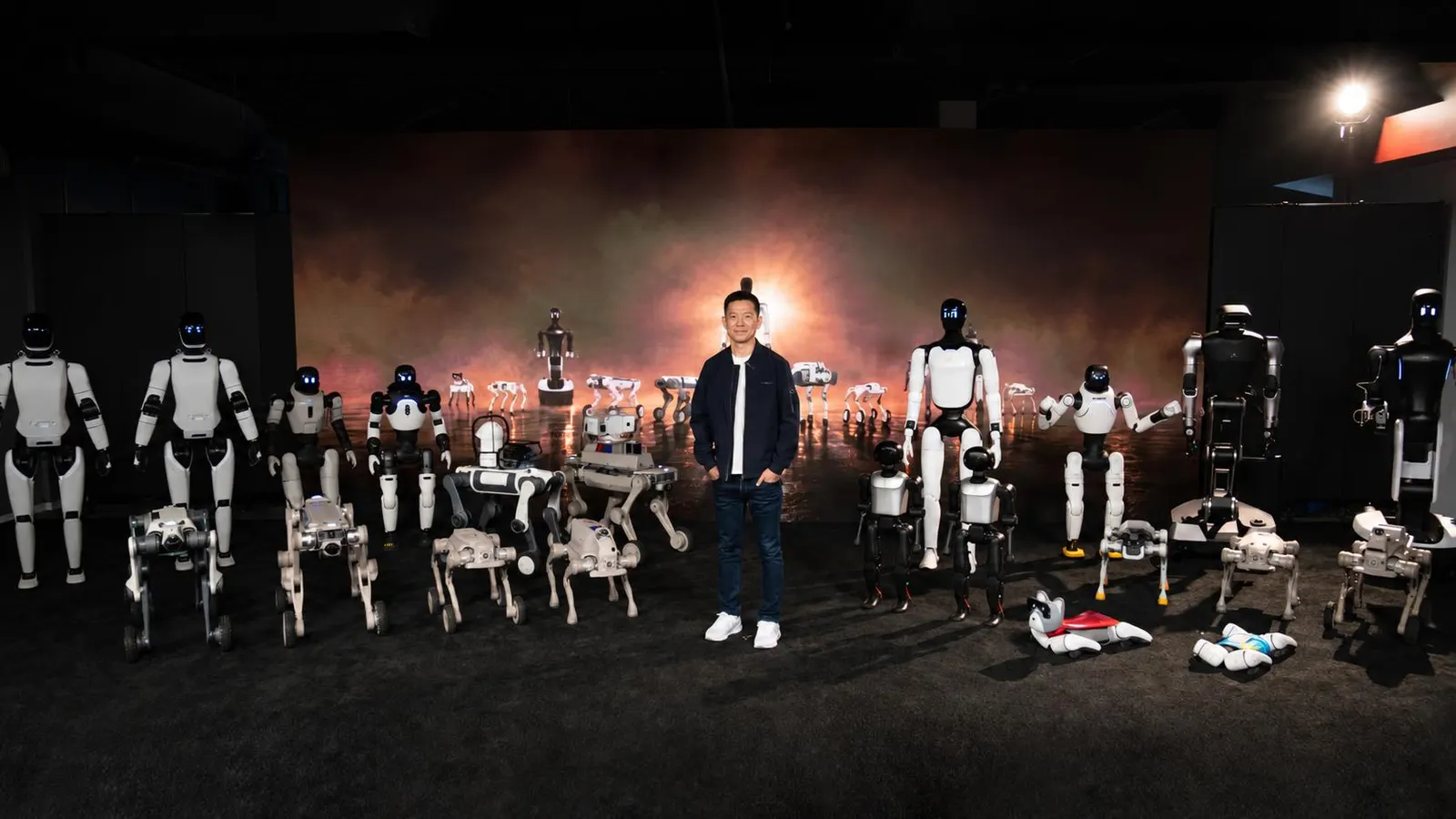

Faraday Future global CEO YT Jia with the company’s new robots.
Faraday Future
Faraday Future launched five new robots in nine configurations over the weekend. They range from a $9,990 hip-high humanoid built for classrooms and robot soccer to a $137,900 wheeled-legged industrial machine designed to walk into the places you’d rather not send a person. Add them to what Faraday Future already sells and the company’s catalog now runs to three form factors, five product series, 11 models and 24 products.
Why so many? Different jobs, global CEO YT Jia told me in a conversation last week.
“We’re coming from automotive industry … the main purpose for the car is to move people from point A to point B,” he said. “So with this one simple task, how many shapes of car do we have? There’s more than 10, the sedan, MPV, SUVs, sports, van, bus, truck.”
Based on that logic, we need many more types of robots than cars, he adds. “[There are] probably thousands of [tasks], if not tens of thousands of them,” he said. “So think of covering like 10,000 tasks, how many form [factors] do we need?”
Here are the new models, briefly:
- FF Futurist Standard: a full-size humanoid for $89,900. (There’s also a new FF Futurist Ultra with extra features for$129,900)
- FF Master Mini (also Master Mini Pro, Master Mini Ultra): these are compact humanoids starting at $9,990.
- FX Aegis Ultra-W: 50-pound wheeled-legged quadruped starting at $12,990.
- FX Aegis Mega (and Mega D): a larger wheeled-legged quadruped with over a 100-pound payload for $74,990.
- FX Aegis Hyper: a very sophisticated wheeled-legged quadruped with multiple industrial sensors for $137,900.
Aegis Mega, a wheeled-legged quadruped robot by Faraday Future.
Faraday Future
Three new wheeled-legged quadrupeds
The quadrupeds and wheeled-legged robots probably matter more commercially right now, and there’s a bunch of them. FX Aegis Ultra-W is $12,990, weighs about 22 kilograms, and is specced at more than 5.5 meters per second with 65-centimeter obstacle clearance and 40-degree slopes. Aegis Mega is $74,990 with a 50-kilogram payload. Aegis Hyper, the industrial flagship, starts at $137,900 and takes thermal imaging, gas detection, 3D scanning and comms relay payloads.
Faraday Future likes a wheeled-legged model for its quadrupeds, which simple means wheels mounted at the ends of articulated legs. On flat ground it rolls, which is both fast and energy-efficient. When it hits stairs, a hill, rubble, or a curb, the legs take over and it walks or hops over the obstacle.
Essentially you get speed and off-road capability in a single machine: Aegis Ultra-W claims more than 5.5 m/s (about 12 mph, far faster than any walking quadruped) while still clearing 65-centimeter obstacles and 40-degree slopes. A pure quadruped can’t hit anywhere near that speed, and a pure wheeled robot can’t clear that kind of obstacle.
Two new humanoids in five configurations
The cheapest one is interesting one, but not for anyone doing real work.
Faraday Future’s Master Mini is a 95-centimeter, 19.5-kilogram humanoid that starts at $9,990 with a $1,000 Skill package included. It ships in three configurations — Mini, Pro and Ultra — and walks, turns, picks itself up after a fall, dances and plays soccer.
This is pretty a development and research platform: Faraday Future opened its motion, perception and application interfaces to developers. It’s also interesting to hobbyists, and perhaps has entertainment uses for anyone who wants dancing robots.
At the top of the Faraday Future range is a high-end humanoid robot with “full-body mobility, multimodal perception, high-compute AI capabilities and an expandable skill architecture,” the company says. The Futurist Standard is $89,900 with a $10,000 Skill package bundled in; the Ultra configuration is $129,900. The Ultra is built around NVIDIA’s Jetson Thor for up to 700 TOPS, with 51 active degrees of freedom, expandable to 71 with advanced dexterous hands, and a 1,152 Wh dual-battery system the company says supports roughly eight hours of work with rapid pack swaps.
Faraday Future’s Futurist humanoid robot being worked on by technicians.
Faraday Future
Humanoids will eventually take care of about half the tasks we want robots to do, CEO Jia told me.
“I believe that human-like will cover more or less around 50% of the tasks, because the world is designed for human like us,” he said. “But on the other hand, there’s still 50% of the other tasks might be more efficient to have non human-like robot to perform.” He named Tesla and Figure as the humanoid-first examples and was complimentary about both, while also suggesting they’ve picked one body for a world that needs many.
His example is a burning building.
“There is a fire scene, and before sending a firefighter, why not send a robot to get in and see what’s going on?” Jia said. “It’s very efficient. It’s much more safer as well.” Instead of an expensive humanoid walking unsteadily into a fire, he said, send something cheap: “just send a small dog, has camera, has sensor, connect to your phone… and just cost us a couple of thousand dollars.”
And if it doesn’t come back out?
“It’s burned. It’s okay.”
Skills and abilities
About the humanoids: Faraday Future is pretty open that there’s room to grow in capability. When I asked if a “Skill” – the company’s name for trained robot capabilities – that a customer develops for one warehouse transfers to another warehouse that’s 10% or 20% different, he says no.
“As of this stage, no,” he said. “Maybe long term, for sure, 100%. But as of this stage, no.” The general capability isn’t there, he said, “and I don’t think that we will be there in the next one year or so.”
Faraday Future’s smaller humanoid robots.
Faraday Future
In other words, warehouse deployments today will need one-off training for most tasks. If tasks are similar enough, the company has an app-store-like platform for making, distributing, and potentially selling new skills.
Jia was equally blunt on the gap between the body and the brain. The hardware, he said, is “capable of doing like 60-70% of the task human is able to do. But it’s because of lack of skill, lack of training, lack of data that it’s not able to perform really, really well certain tasks yet.”
What works now, per Jia: conversation, companionship, LiDAR-based surveillance, walking, and dancing.
Made in the USA? Soon … ish
Clearly, the FCC decision to ban foreign robots is on Faraday Future’s product development roadmap. The company recently announced a plan to build in the United States, but it will take some time to realize.
“Right now we rely on offshore manufacturing for the hardware, but we’ll make all the software, operating system, AI, skill, training, data, every software and data related activities onshore in the United States as a U.S. company,” Jia told me.
Phase two is U.S. assembly, which he hopes to reach “in one year or so.” Phase three — more than half the component value sourced domestically — is three to five years out. The company’s August roadmap targets a robotics factory online by the end of this year, the first device off the line in February 2027, and “Made in USA” by Q4 2028, backed by a pledge of no less than $5 billion in the U.S. over ten years.
The timeline is simply due to economics and supply chain capability.
“If you want all the parts manufacturing in the United States as of today, you’re not able to make robots,” he said. “Even at like 10X the cost, we’re not able to do it, because it’s certain supply chain [components are] not available in the United States.”
Jia says the Faraday Future’s shipments are growing fast from a small base.
“We just launched this business half a year [ago],” he told me. “We delivered more than 500.”
Faraday Future’s 2026 target is 2,000 units, and August was a record month at 158.
















Leave a comment