


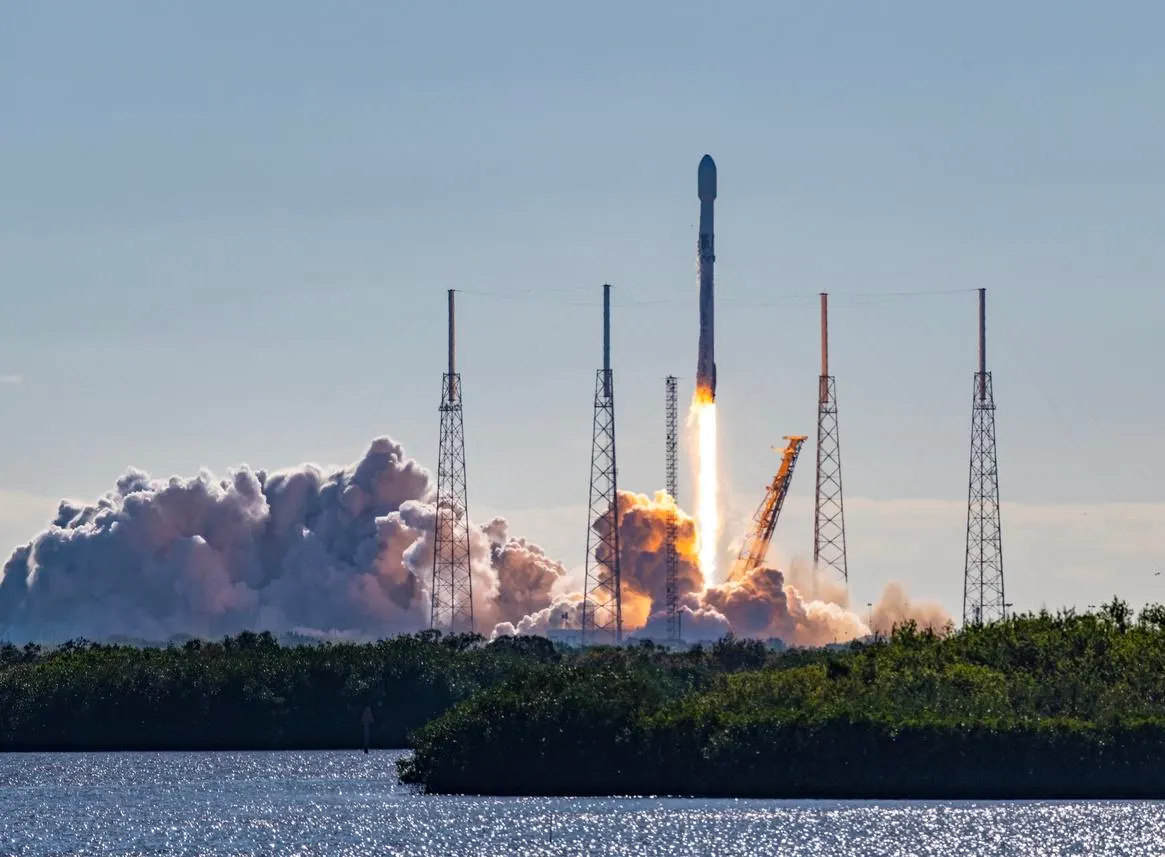
A SpaceX Falcon 9 rocket and satellite payload launch in Florida.
getty
Tesla’s biggest problem may no longer be Chinese competitors, slowing demand for its EVs or the still-theoretical payoff from robotaxis and humanoid robots.
It might be SpaceX.
If Elon Musk’s rocket and satellite-internet company goes public at anything close to the rumored $1.75 trillion valuation, it will not just be one of the biggest IPOs in history. It will give Tesla investors tired of waiting for the CEO’s promises to materialize something they haven’t had in a while: a potentially bigger, more exciting way to invest in the Musk myth. Certainly, SpaceX, with its reliable and steady leadership under long-time president Gwynne Shotwell, is shaping up to be a shinier proxy — with fewer close competitors or awkward quarterly questions about exactly when Tesla can take on Waymo in self-driving tech or actually deliver its C-3PO-style robot.
“There are many Tesla investors who perceive SpaceX to be a better investment for many reasons,” Ross Gerber, a Tesla investor and CEO of Santa Monica, California-based Gerber Kawasaki, which manages over $4 billion, told Forbes. “If I sell my Tesla shares, nobody’s going to argue that it’s not overvalued. And if I want to buy the sizzle, I’m going to buy SpaceX. And that’s what people want to do. A lot of people think this is going to be easy money.”
For the latest in cleantech and sustainability news, sign up here for our Current Climate newsletter.
That’s largely because, despite Tesla’s continued profitability, it’s undergoing a fundamental shift from the business that built the brand–electric vehicle sales–which have plateaued as it waits for new AI-oriented ones to kick in. That was underscored this week with the Austin-based company’s first-quarter results. Net income rose to $477 million, up 16% from a year ago when the brand was stung by anti-Musk protests and reduced Model Y SUV production as it shifted to an updated version. But that’s far below profit in the three previous quarters, including $844 million in 2025’s final three months. The company’s battery business, a bright spot last year, contracted in the first quarter, down 12%. Overall revenue rose 16% to $22.4 billion, but that was also below the level of the past three quarters.
“What we’re seeing with Tesla is a brand where belief is doing more work than strategy–and the real test is how long that dynamic can hold”
Tesla didn’t report any revenue from its tiny robotaxi fleet, which operates mainly in Texas with human safety drivers at the wheel. Likewise, it had no revenue from Optimus robots in the quarter, another hoped-for revenue stream, as they’re not yet in production.
Tesla Cybertrucks outside SpaceX facilities in Hawthorne, California.
© 2026 Bloomberg Finance LP
“What we’re seeing with Tesla is a brand where belief is doing more work than strategy–and the real test is how long that dynamic can hold,” Gonzalo Brujó, CEO of Interbrand, which compiles an annual ranking of the appeal of global brands, told Forbes. Tesla’s brand value plunged 35% in 2025, due in large part to Musk’s unpopularity, arising from his DOGE role in the Trump administration and support for far-right European politicians.
“The brand lost momentum as its leadership became a source of distraction rather than differentiation. With [Musk] now less dominant in the public conversation, some of that pressure has eased. But it hasn’t sparked a comeback. It’s simply stopped things getting worse,” Brujó said.
SpaceX, in some ways, could be a “carbon copy” of what happened with Tesla after its 2010 IPO, said Dan Coatsworth, head of markets for U.K.-based investment adviser AJ Bell, which doesn’t rate either company. “Tesla had a first-mover advantage with electric vehicles. It made a really good name for itself and shareholders made a lot of money. Now, the competition’s catching up, overtaking it arguably in certain areas,” he said. “It might be that someone who’s been in Tesla for ages might say, ‘Well, I’ve made my money, and what SpaceX is doing is trying to get a first-mover advantage in the space economy–and the gap between itself and rivals is so big at the moment.’”
Musk’s success in creating the modern EV market, Tesla’s growth since the release of its Model S sedan in 2012 and his persistent claims of technical wonders that are just around the corner help the stock trade at nearly 200 times projected earnings. Likewise, the “Musk effect” is why its market cap is 12 times the company’s estimated revenue this year of about $100 billion.
“It’s a better meme stock because you can’t quantify space”
Compared with SpaceX, however, that looks conservative. The rocket company’s projected $1.75 trillion IPO valuation is about 80 times its estimated revenue of $22 billion this year, mainly from the Starlink internet business. And while new businesses like the space-based data centers Musk has promised sound exciting, they might not be viable anytime soon. “Our initiatives to develop orbital AI compute and in-orbit, lunar, and interplanetary industrialization are in early stages, involve significant technical complexity and unproven technologies, and may not achieve commercial viability,” according to an excerpt of its S-1 filing seen by Reuters.
Musk’s large fanbase among retail investors has spurred excitement for the SpaceX IPO, but Morningstar analyst Seth Goldstein, who thinks Tesla shares are fairly valued at the current level, doesn’t see that as a negative for Tesla.
“I don’t necessarily see it as people trading out Tesla for SpaceX,” he said. “I think from an institutional standpoint, we’re likely to see maybe some Tesla shares but also other positions trimmed, likely to make room for SpaceX in the portfolio.”
Likewise, Ben Kallo, a senior research analyst for Baird who’s covered Tesla since the company’s IPO and has an Outperform rating on the shares, expects only a minority of investors to swap Musk stocks.
“I think there will be some individual investors that raise cash from [Tesla] share sales to buy SpaceX but I think the larger trend will be private investors holding both TSLA and SpaceX. So the individual investor expands investment in the overall Elon complex,” he said. “Our view is that ultimately the companies are likely merged for many reasons.”
He’s not alone in the expectation that ultimately the companies will be combined, something that’s been expected for well more than a decade. But that possibility raises a concern for some large institutional investors that hold Tesla and will also have a position in SpaceX, resulting from past investments in the former Twitter and xAI, which Musk is wrapped into the offering: Board independence and the ability to maintain guardrails for the often controversial Musk.
Tesla’s Optimus humanoid robot at AWE2026 in Shanghai on March 15, 2026.
NurPhoto via Getty Images
“The reality is that the governance issues that we’re seeing at Tesla and a formal relationship between Tesla and SpaceX means that the same governance issues will continue at SpaceX,” a board member of a public fund that holds Tesla and will almost certainly buy SpaceX post-IPO, told Forbes, speaking on background as it’s against the fund’s policy to comment on specific investments. The person was most concerned about “material risk” stemming from a history of governance issues in the xAI part of SpaceX.
Gerber, whose investment firm will hold SpaceX shares through past investments in the former Twitter and xAI which are wrapped into the offering, also expects an eventual combination of the Musk companies–and problems until they do. “You can’t really run two public companies and not have conflict of interest lawsuits constantly, especially with companies that sell each other products.”
And because xAI, Musk’s artificial intelligence company, is wrapped into SpaceX, “you’ve got the brains of Tesla and Grok and [Optimus] all run by SpaceX. That doesn’t make a lot of sense. It never did,” he said. “They have to come together. And if SpaceX IPOs before they come together, it’s messy when they do come together.”
For now, Gerber expects more near-term excitement for SpaceX. “It’s a better meme stock because you can’t quantify space. If you’re going to be a meme stock, you want to be in an industry you can’t really quantify.”
Phoebe Liu contributed reporting.











Leave a comment