


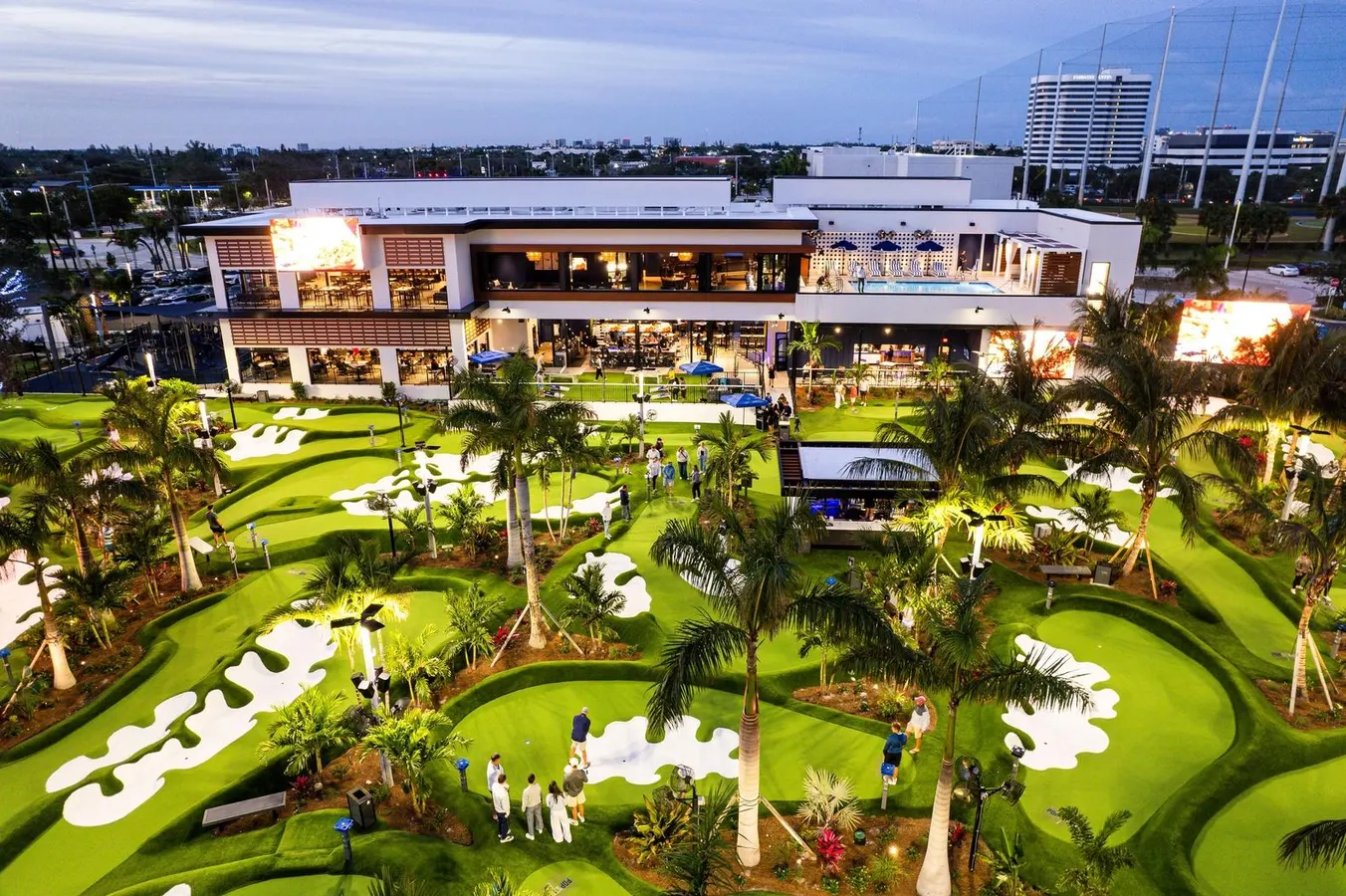

PopStroke’s facility in West Palm Beach, one of nine locations in Florida.
PopStroke
When former Wall Street executive Greg Bartoli began acquiring several properties in South Florida in the early 2010s, he and his wife had three kids – ages 1, 3 and 4 at the time. They thought, admittedly somewhat selfishly, that it would be fun to have a sports bar combined with a playground, a place where parents could hang out and watch sporting events and socialize while the kids played safely nearby. The original concept, Lighthouse Cove Adventure Golf in Jupiter, Florida, boasted two traditional 18-hole miniature golf courses and an ice cream parlor in addition to the popular sports bar and secure playground.
Lighthouse Cove did “phenomenally well,” giving rise to two other Florida locations under the same brand.
But it was a modest first step that revealed an opportunity to build something bigger. After leaving JP Morgan, Bartoli in 2013 had founded JEM Capital, an investment firm that specializes in leisure, hospitality and real estate, and those early seeds grew into PopStroke, which launched its first location in 2019. Today, PopStroke is one of the fastest-growing concepts in the broader golf-adjacent entertainment space, with 21 locations and counting spanning seven states.
“We’re only five or six years old now, so it’s been pretty rapid growth,” Bartoli said just ahead of the debut of PopStroke’s newest location in Austin, Texas. “But I think the next six years will be significantly faster.”
PopStroke combines professionally designed putting courses with a strong F&B component that includes multiple bars as well as a kids’ playground, TVs throughout the property and a variety of backyard games.
PopStroke
The company’s name pays homage to Bartoli’s dad (known to the kids as PopPop), who at one time was a scratch golfer, played at Rutgers University in New Jersey, and later introduced his son to the game.
Blending golf with social entertainment and a strong food and beverage component, PopStroke has found success through an appeal that spans generations – whether that’s a 4-year-old picking up a putter for the first time, young professionals in their 20s and 30s, moms and dads, grandparents, or seniors looking to get in their putting fix for a few hours.
Polished and professionally designed putting courses created to replicate real-world conditions are the brand’s signature. But there are also multiple bars with a dedicated mobile app for ordering drinks, a kids’ playground, an ice cream parlor, large TV screens throughout, and backyard games like cornhole, foosball and ping pong.
“At the end of the day, there’s some something for everybody, regardless of your age,” said Bartoli. “That’s why PopStroke has differentiated itself from a lot of the other concepts, not just in the golf entertainment space, but the entertainment category in general, because there’s no other brand that resonates from a 3-year-old up to a 90-year-old.”
PopStroke’s Place in the Golf Ecosystem
An overhead of some of the holes on a putting course at a PopStroke venue.
PopStroke
Tiger Woods joined the company as an investor in 2020 and TaylorMade teamed with PopStroke in 2023 as an investor as well as an equipment partner (supplying all putters and balls at the various locations).
Design and buildout of the putting courses is overseen by Shane Robichaud, who worked with Tom Fazio and Beau Welling, and today oversees a team of about 80 shapers and construction team members. “We build and shape all of our courses the same way you would a traditional golf course, but just on a micro scale,” says Bartoli.
Early on, PopStroke experimented with indoor golf simulators but quickly moved away from them, focusing instead on the elevated putting experience.
Putting courses and miniature golf aren’t counted by the National Golf Foundation as off-course participation – a category that encompasses simulators, driving ranges and golf entertainment venues like Topgolf where people hit a golf ball in the air with a golf club and a full swing. But Bartoli sees PopStroke’s role as both complementary and distinct within the golf world.
Guests taking putts at a PopStroke venue.
PopStroke
“We unequivocally think there’s a big role for PopStroke in the future for both the game of golf and also for introducing people to beginning golf,” he said, noting that putting is often overlooked (or not practiced enough) despite the putter being the most frequently used club in a golfer’s bag. “If you looked at a person that two-putts every hole, they used the putter 36 times. They probably used their 5-iron three times. The putter is the most valuable skill in the game of golf.”
Perhaps more importantly, PopStroke’s format lowers barriers to entry — particularly for beginners who might find traditional golf intimidating — while offering enough challenge to engage experienced players.
“We’re simulating real putting environments with real breaks,” Bartoli said. “If you’re a beginner, you can get lucky and bang it off a mound and it might happen to come back. But if you’re a seasoned golfer, you’re looking at the lines, you’re reading the breaks. It does have a big future in a game of golf because we’re going to have 4 million visitors this year and that’s growing as we open new stores.
PopStroke has a team of 80 shapers and construction members building the putting courses at its venues.
PopStroke
“You have that connection point with young children and beginners in a way that you don’t really feel intimidated,” he adds. “So you hit a bad putt. It’s not the same as swinging and missing a 7-iron or dribbling a 7-iron three feet in front of you when a lot of people are looking.”
That said, Bartoli sees PopStroke within a category all its own within the golf space.
“Seventy-five percent of our guests are just looking to rock to the music, have a bunch of cocktails and spray the putter everywhere,” he says, “And 25% I would call avid golfers.”
Technology as a Differentiator
A digital scoreboard at a PopStroke property.
PopStroke
As the PopStroke concept has scaled, technology has become increasingly central to its evolution.
The company has invested heavily in proprietary technology, including a vertically integrated platform developed through Bartoli’s separate venture, Heard Technologies. The system powers everything from mobile ordering and loyalty programs to real-time operational data like digital menu boards and kitchen display screens.
“It’s basically a mobile app that controls the entire experience,” says Bartoli. “Both on the guest side and team member side… all controlled by one digital touchpoint. “We don’t have to rely on any third-party integration, so it allows us to capture data and insights on our guests. That’s very unique and differentiated from what our competitors would be able to gather.”
An on-course bar at a PopStroke location.
PopStroke
One of the most notable upcoming innovations is a partnership with TaylorMade to develop a golf ball embedded with a chip that enables automatic scoring populated within the PopStroke app. That rollout is expected later this year, once existing venues are retrofitted with the necessary infrastructure (including technology underneath the courses themselves).
Also being added are hole-in-one cameras to capture spontaneous celebrations that can be shared with participants as well as through PopStroke’s social media channels. Competitive mini tours – with prize money up for grabs — are in the works as well.
Ambitious Growth Plans
PopStroke’s Las Vegas location. The company has venues in Alabama, Arizona, Florida, Nevada, South Carolina, Tennessee, and Texas.
PopStroke
Looking to the future, Bartoli sees the potential for as many as 250 U.S. locations across three core formats. These include the original outdoor Sun Belt venues, indoor climate-controlled facilities (such as the one that opened recently in Nashville, Tennessee), and a smaller and “more nimble” Pop 60 concept for secondary markets that isn’t as heavy on the F&B and bar experience but instead may have food trucks to complement the putting courses.
“We should be at 50 by the end of 2028,” Bartoli said, noting the company is following trends on where people are moving in identifying new sites.
PopStroke’s rise comes amid a broader surge in experiential entertainment concepts, many of them tied to sports and other social activities. As the brand continues to scale and expand, the original idea – gathering different generations together – remains at the center of its growth plans. And not only does Bartoli see PopStroke as being in a category all its own, but that it benefits from a repeatable business, with a “huge membership platform” that provides unlimited monthly play and F&B discounts.
PopStroke’s Dallas area location at The Colony.
PopStroke
International expansion is on the horizon, likely through a franchise model.
In five years, Bartoli envisions 70 to 80 domestic locations, maybe five to 10 overseas, and as many as 15 to 20 million annual visitors.
“Five years ago, we had one,” he said. “To go from one to 21 is harder than going from 21 to 50.”












Leave a comment