


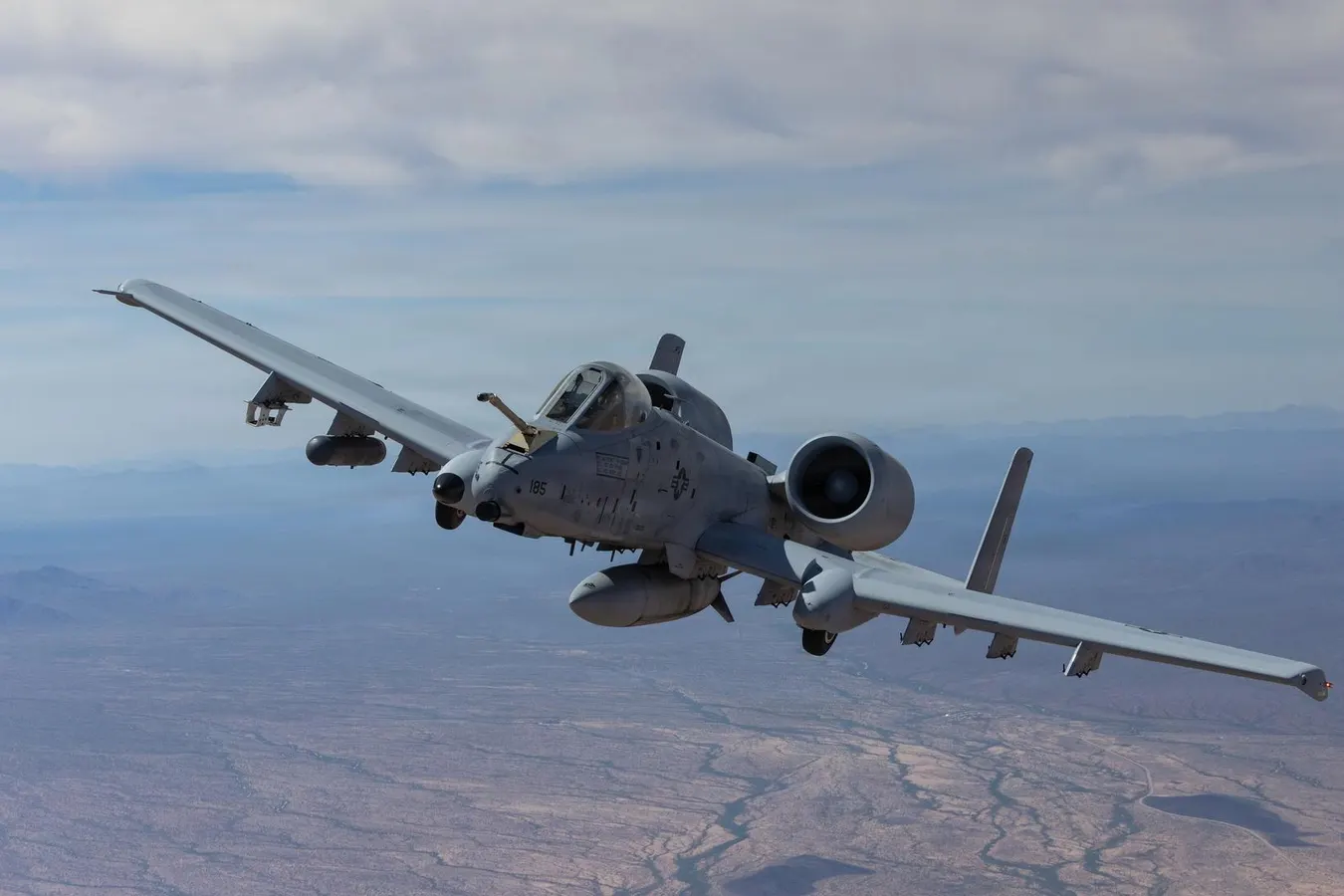

The A-10 Thunderbolt II has been in service for more than five decades and could keep flying for a few more years
U.S. Air Force 162nd Wing
The United States Air Force has attempted to retire the Fairchild Republic A-10 Thunderbolt II close-air-support aircraft for decades, dating back to 1984. Service officials have repeatedly argued that A-10, also known as the “Warthog” by those who fly and maintain it, was unsuitable for high-end conflicts against near-peer adversaries, notably China and Russia.
In addition, the Air Force wanted to retire the aging aircraft to pave the way for more modern platforms, notably the Lockheed Martin F-35 Lightning II.
However, critics of the plan to sunset the airframe countered that no newer aircraft can fill the close air support role as effectively as the A-10.
They could have a point.
The rugged attack aircraft first entered service in the early 1970s and was employed with success in air support missions in Afghanistan and Iraq during the Global War on Terror. The Air Force has increasingly deployed the A-10 to hotspots in the Middle East, where it has proven highly capable and effective. In the ongoing Operation Epic Fury air campaign against Iran, A-10 Warthogs have been actively deployed to target and destroy Iranian fast-attack boats and other small armed vessels in the Strait of Hormuz. A-10s were also involved in the search and rescue mission of the crew of a downed F-15E Strike Eagle earlier this month.
As a result of the effectiveness of the Thunderbolt II, Secretary of the Air Force Troy Meink confirmed this week that the A-10 will remain in service until at least 2030.
“In consultation with @SecWar, we will EXTEND the A-10 ‘Warthog’ platform to 2030. This preserves combat power as the Defense Industrial Base works to increase combat aircraft production,” Meink wrote in a post on X.
The announcement is a reversal for the service, as the fiscal year 2026 National Defense Authorization Act had called for just 103 A-10s to remain in active service through the end of this September, with full retirement to be completed by 2029.
The A-10’s Final Class Of Pilots
Even as the A-10 may have received a reprieve, it is a brief one, extending the eventual retirement by perhaps just a year. It is unclear whether the service life will be extended further or how long the aircraft might remain operational.
U.S. Air Force Lt. Col. Rutter, 357th Fighter Squadron commander, speaks and congratulates the graduating class at Davis-Monthan Air Force Base, Ariz., April 3, 2026.
(U.S. Air Force photo by Airman 1st Class Samantha Melecio)
Just this month, the final class of A-10C pilots graduated from their training program. Although no new additional pilots will enter the A-10 pipeline, the majority of A-10s are in the Air National Guard or Air Force Reserve, which have high pilot retention rates.
Retired Air Force Col. John Venable, a senior resident fellow at the Mitchell Institute for Aerospace Studies, told Air and Space Forces magazine that the existing A-10 squadron could even remain operational by converting it into a combined training and operations squadron.
Moreover, the report added that as the fleet decreases in size “the need for new pilots declines and the number of spare parts available in the ‘Boneyard’ at Davis-Monthan Air Force Base increases.”
It is worth noting that Davis-Monthan AFB, Tucson, Arizona, is home to the 309th Aerospace Maintenance and Regeneration Group, which maintains the “Boneyard,” a facility that stores, maintains, and salvages parts from decommissioned aircraft. It is also the longtime home of the A-10 Thunderbolt II.
Politics Have Helped Keep The A-10 Flying
Numerous political considerations have kept the A-10 in service. Chief among them is that Davis-Monthan AFB is very important to the local economy in battleground Arizona, where lawmakers on both sides of the aisle would like to see the Thunderbolt II remain in service.
Maintenance of the A-10 fleet supports a large workforce, including aircrews, maintainers, and support staff.
“In 2021, Arizona Sen. Mark Kelly successfully pushed back against a Biden administration proposal to retire dozens of the planes, securing language in defense legislation that blocked any retirements,” Reuters reported, adding that Kelly argued against the A-10’s retirement due to a lack of “suitable replacement.”
The A-10 Was Designed To Fight Soviet Armor
Development of the A-10 began in the early 1960s when the United States military was still relying on the Korean War-era Douglas A-1 Skyraider for its primary ground-attack aircraft.
Between 1963 and 1969, extensive studies gradually refined the specifications for the new aircraft, and several prototypes were considered. In December 1972, the Fairchild Republic A-10A Thunderbolt was deemed the winner, while GE was chosen to produce the aircraft’s 30mm tank-busting GAU-8 gun, a powerful weapon with a very high muzzle velocity 20 times that of the 75mm gun fitted to some B-25s in World War II.
In addition, the 30mm gun, which used rotating barrels, offered an unparalleled rate of fire for an aircraft weapon. Able to fire up to 4,200 rounds per minute, no attack aircraft in history has ever mounted a gun with the tank-killing capability of the GAU-8.
The Thunderbolt II can loiter near battle areas for extended periods and operate at 1,000 feet (304.8 meters) or less with 1.5 miles (2.4 kilometers) of visibility. The A-10’s short takeoff and landing capability also enables it to operate from austere airstrips near the front lines.
Production of the A-10 Thunderbolt II began in 1972, and the aircraft officially entered service with the United States Air Force in 1977.
Combat History Of The A-10
The Thunderbolt II was first deployed during Operation Urgent Fury, the 1983 American invasion of Grenada. The A-10 provided air cover for U.S. forces, where it proved effective at operating close to the front lines. Yet, it faced no resistance and didn’t fire its highly capable main gun in anger!
It wasn’t until the Gulf War in 1991 that the aircraft took part in combat operations and performed better than expected. A-10 Thunderbolt IIs successfully shot down two Iraqi helicopters with the GAU-8, and the CAS aircraft took part in numerous sorties against Iraqi Republican Guard units.
Although six A-10s were shot down by surface-to-air missiles, around 70 other Warthogs sustained battle damage, yet were able to return to base. Many underwent field repairs and returned to service. The A-10s performance record, with a 95.7 percent mission-capable rate, led the Air Force to abandon a plan to replace the A-10s with a close air support version of the F-16 Fighting Falcon.
Despite decades of calls for its retirement, the A-10 remains in the fight, finding a new role in targeting the small watercraft in the Strait of Hormuz. That could ensure the Thunderbolt II can keep striking the enemy for at least a few more years.
















Leave a comment