


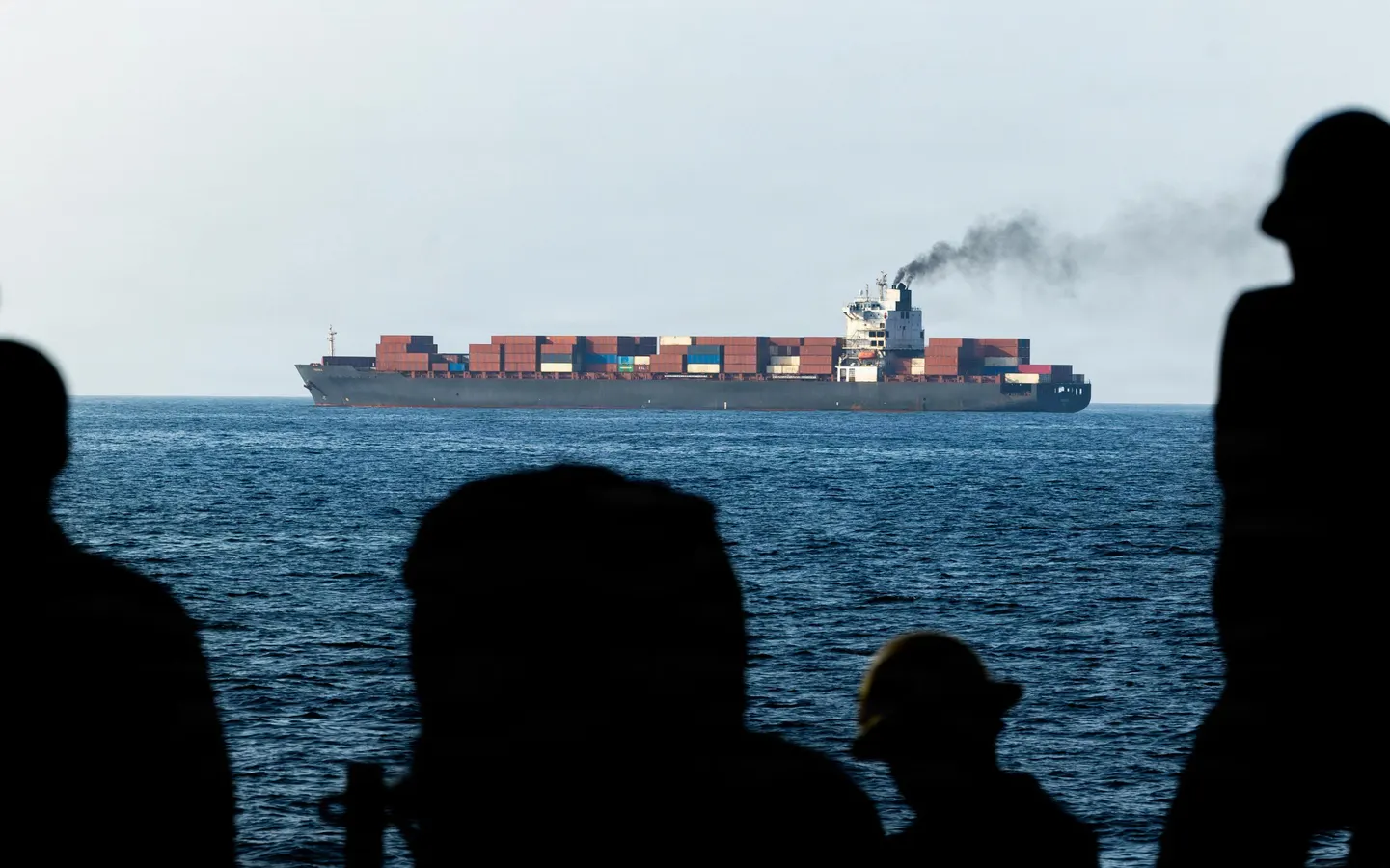

ARABIAN SEA – APRIL 20: (EDITOR’S NOTE: This Handout image was provided by a third-party organization and may not adhere to Getty Images’ editorial policy.) In this handout photo provided by U.S. Central Command, U.S. forces patrol the Arabian Sea near M/V Touska on April 20, 2026, after firing upon the Iranian-flagged vessel that the U.S. accused of attempting to violate the U.S. naval blockade of Iranian ports near the Strait of Hormuz. (Handout Photo by the U.S. Navy via Getty Images)
Getty Images
Prize and booty sound like pirate talk. For lawyers and sailors, the terms have a technical meaning—although they have not been commonly used since World War II. On April 19, United States Marines seized the Iranian-flagged M/V Touska for violating the U.S. blockade on Iranian ports. The ship and its crew are now in United States custody. What happens to the ship now turns on whether the United States invokes a centuries-old body of law that has not been applied for 80 years—and has huge implications for the future of war.
The Touska makes for a compelling case for the use of prize law because of its ties to both Iran and China, and the legal justifications for its capture. The ship has been sanctioned by the United States since 2018. At the time of capture, it was en route from Port Klang, Malaysia to Bandar Abbas, with its last port call made in Zhuhai, China. After failing to heed six hours of warnings in the Gulf of Oman, the ship was boarded and seized by U.S. Marines. The ship is currently in U.S. military custody and analysts expect the vessel to be brought to a port for inspection. President Trump has speculated that the cargo included a “gift from China,” an assertion China has rejected. Iran said it will retaliate against “armed piracy by the U.S. military.”
ARABIAN SEA – APRIL 20: (EDITOR’S NOTE: This Handout image was provided by a third-party organization and may not adhere to Getty Images’ editorial policy.) In this handout photo provided by U.S. Central Command, U.S. forces patrol the Arabian Sea near M/V Touska on April 20, 2026, after firing upon the Iranian-flagged vessel that the U.S. accused of attempting to violate the U.S. naval blockade of Iranian ports near the Strait of Hormuz. (Handout Photo by the U.S. Navy via Getty Images)
Getty Images
How Prize Law Could Apply to the U.S. Blockade on Iran
Some analysts have recently raised the possibility of applying prize law to captured ships during armed conflict. Prize law is the body of maritime law and the law of armed conflict that applies to captured neutral or enemy merchant vessels. Prize law applies to civilian merchant vessels, distinct from enemy warships or aircraft, which automatically become booty of war when captured. Prize law only applies during armed conflict, making it distinct from routine maritime interdictions or sanctions enforcement, which can occur outside armed conflict and are not necessarily belligerent acts. Eight specific grounds make a neutral state’s vessel capturable, including breaching a blockade, carrying contraband, and resisting visit and search. Contraband consists of goods destined for an enemy of a belligerent and susceptible to use in armed conflict, a definition that was has not been broadly applied since World War II. According to U.S. policy, a blockading state has the right to stop vessels bound to or from blockaded ports anywhere on the high seas and apply prize law. Although the U.S. has recently interdicted other Iran-linked vessels outside the Strait of Hormuz, the U.S. has invoked maritime interdiction and sanctions enforcement for those interdictions, not for blockade violations.
Although the Touska was a sanctioned vessel, the U.S. has explicitly invoked the blockade breach ground for the Touska, perhaps as a warning to other ships not to breach the blockade, or as a signal that the blockade is effective and being enforced. This justification also opens the door for the application of prize law. Once vessels are captured, they can be escorted to a port under belligerent jurisdiction for inspection and adjudication by a prize court. That court would determine whether the capture was lawful. If so, the court may condemn the vessel and cargo as prize, and award title to the capturing state.
Why Prize Law Could Apply to the Blockade-Running Iranian Ship M/V Touska
While the Touska’s current location is not publicly known, the United States appears to be following appropriate procedure. In the U.S., federal district courts have jurisdiction as prize courts, but no prize courts have been established since 1956. If adjudication is impracticable, a state may destroy the prize after all possible measures are taken to ensure the safety of its passengers and crew.
ARABIAN SEA – APRIL 20: (EDITOR’S NOTE: This Handout image was provided by a third-party organization and may not adhere to Getty Images’ editorial policy.) In this handout photo provided by U.S. Central Command, U.S. forces patrol the Arabian Sea near M/V Touska on April 20, 2026, after firing upon the Iranian-flagged vessel that the U.S. accused of attempting to violate the U.S. naval blockade of Iranian ports near the Strait of Hormuz. (Handout Photo by the U.S. Navy via Getty Images)
Getty Images
The Strategic Case for the Use of Prize Law in the Iran War
It is unclear whether the United States will apply regular sanctions enforcement procedures to the Touska, which would produce a similar practical result of giving the United States title to the ship and its cargo. The United States may wish to signal to its adversaries that it will aggressively enforce its rights as a belligerent in naval warfare. Invoking prize law would also send a strong message to non-sanctioned, neutral merchant ships bound for Iranian ports not to violate the U.S. blockade anywhere in the world. Prize law enforcement might help convince flag of convenience states, which sometimes sell their flags to illicit vessels, to stop doing so rather than be drawn into a complicated legal process within a messy war. Prize courts could also force flag state officials and ship owners to appear in court, enabling discovery and unraveling the complex—and often corrupt—business operations that underlie adversary war efforts. It would establish the architecture for prize law enforcement in a future conflict with China.
How Prize Law Might Shape Markets – and Future Conflict with China
Prize law could also be a useful tool for the United States in any future conflict with China. China is actively building dual-use merchant vessels that can also be used for military purposes. China has the world’s largest merchant fleet by tonnage, and is heavily dependent on seaborne energy and materials. Prize law would allow the capture of Chinese merchant ships wherever they are located, beyond neutral territory, providing a legal framework that could disrupt China’s dual-use strategy.
The fate of the Touska will ripple through global insurance markets and affect the risk exposure of merchant ships in wartime. Whether the centuries-old doctrines of prize and booty will reemerge could also shape the future of conflict. Iran’s own shipping restrictions on the Strait of Hormuz do not comply with international law. However, Iran may choose to invoke the language of prize and booty in its interdictions of vessels, complicating U.S. messaging about the legality of its own actions. Application of prize law in the current conflict between the United States and Iran could also open the door for China to apply prize law against the United States—a dangerous proposition for U.S. and neutral merchants in any war with China. The fate of the Touska is one to watch. If the U.S. invokes prize law for the Touska and sets up a prize tribunal, it could rebuild the institutional muscle memory it needs for future conflict. It could also give U.S. adversaries the opportunity to flex.















Leave a comment