


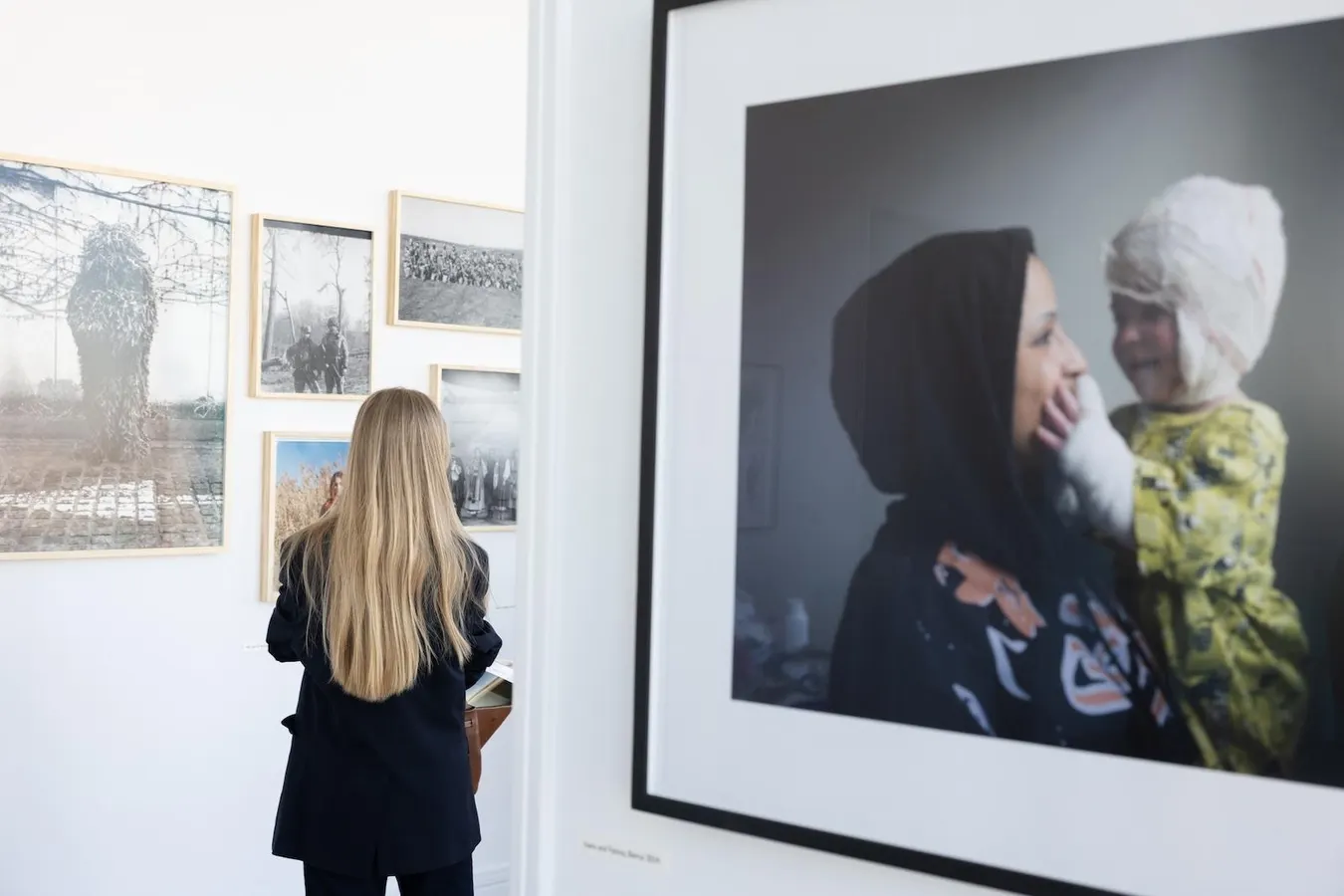

New York, May 2026. “Distortion / Memory / Resilience,” the exhibition by British photographer and humanitarian Giles Duley.
Tanya Nikolaenko
British photographer Giles Dudley brought an immersive pop-up exhibition, Distortion / Memory / Resilience, to the U.S., showing that wars are closer to us than we might think.
“War is not far from us, both generationally and geographically,” said Duley, a British photographer and humanitarian, about his new project Distortion / Memory / Resilience — an immersive exhibition he brought to New York in May. He said, “Many of us in this city have a grandparent who probably fought in World War II or fought in some conflict. It’s connected to our story.”
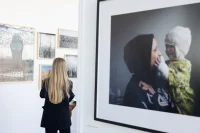
Set high above New York, overlooking Manhattan and the East River, in a massive penthouse inside Sutton Tower, the exhibition is about war but almost doesn’t show combat directly. It is less a photography show than an immersive meditation on memory and trauma that highlights how conflict repeats across generations.
“The whole project really is very autobiographical,” said Duley, who lost both legs and his left arm after stepping on an landmine in Afghanistan in 2011. For more than two decades, Duley has documented conflicts, often focusing on communities overlooked by mainstream coverage. “I always said I’m not a photojournalist,” he says. “I’m an angry man with a camera.”
Duley says his earlier work was driven by the need to draw attention to conflicts that received little international focus. He recalls first traveling to Ukraine in 2010 and returning in 2014, when fighting in eastern Ukraine remained largely absent from broader European political discourse.
“Even in 2014, when I first went to Ukraine to cover the war, nobody in Europe was really talking about the fact that there was a war happening within Europe,” he says.
Awareness of military conflicts and wars has changed with the rise of social media and constant exposure to global crises. Now, people are overwhelmed, Duley says: “When people are overwhelmed, they become inactive.”
The exhibition reflects what he describes as his transition from photographer to artist — using not only images but also physical space, sound, and historical juxtaposition to create emotional continuity between past and present conflicts.
In one room, he has reconstructed a bedroom inspired by a young Ukrainian woman sheltering in the bathroom during Russian attacks. A live air-raid alert connected to Kyiv sounded periodically throughout the installation. The penthouse window had been transformed into a camera obscura, projecting an inverted image of Manhattan into the darkened interior.
“It’s the sense of how everything is taken away from you and distorted,” Duley says. “And yet your eyes start to adjust. In many ways, people become accustomed to conflict and war.”
Another room centers on childhood trauma. The drawings made by Ukrainian children affected by the war were offered to visitors to touch and look through while listening to recordings of their stories. “The paintings are done by some of the most traumatized kids in Ukraine,” Dudley said. This highlighted the contrast between the peaceful New York skyline outside and the testimonies inside the room.
Historical layering runs throughout the exhibition. Duley pairs photographs from contemporary Ukraine with imagery from the Second World War, World War I, and conflicts in the Middle East. One pairing connects a famous 1940 photograph of a British girl injured during the Blitz with a portrait Duley made of a young Lebanese girl in Beirut in 2024.
“I looked at her and said, ‘That’s the photograph I grew up seeing,’” he says. “It’s the same story. It’s the same person.”
The idea emerged partly from Duley’s own family history. His mother worked as a nurse in London during the Blitz, and many of the stories he heard growing up now echo what he encounters in Ukraine.
Throughout the exhibition, repaired ceramic objects reference the Japanese practice of kintsugi, where cracks are repaired with gold rather than concealed. For Duley, the concept became central to the exhibition’s understanding of resilience.
“We should not hide our trauma. We should not hide our scars,” he says. “But celebrate them, mark them with gold, and say, ‘I’m proud of who I am.’”
Duley speaks openly about his own injuries. In 2011, while working in Afghanistan, he stepped on a IED landmine and lost both legs and his left arm. He spent nearly a year in the hospital and underwent 37 operations.
“I was broken, my body, by hatred,” he says. “But I was rebuilt by love.”
That experience now informs both his artwork and his humanitarian work through the Legacy of War Foundation, which operates medical and rehabilitation programs in Ukraine. The organization has provided healthcare support in Ukraine, rehabilitation assistance for injured veterans, and grants for local Ukrainian organizations.
Doing the show in New York had special importance for an artist from Europe. “What I’m trying to do is show people that all these wars interconnect, that actually wars are only one generation or one nation away,” Duley said.
Ukraine remains the central focus of Duley’s current work. He says the country’s struggle cannot be separated from broader European and global history.
“The ideas, the values that our grandparents fought for,” Dudley said, “are exactly the same as what Ukrainians are fighting for each day. These are the reasons I believe we should stand with Ukraine.”







Leave a comment