


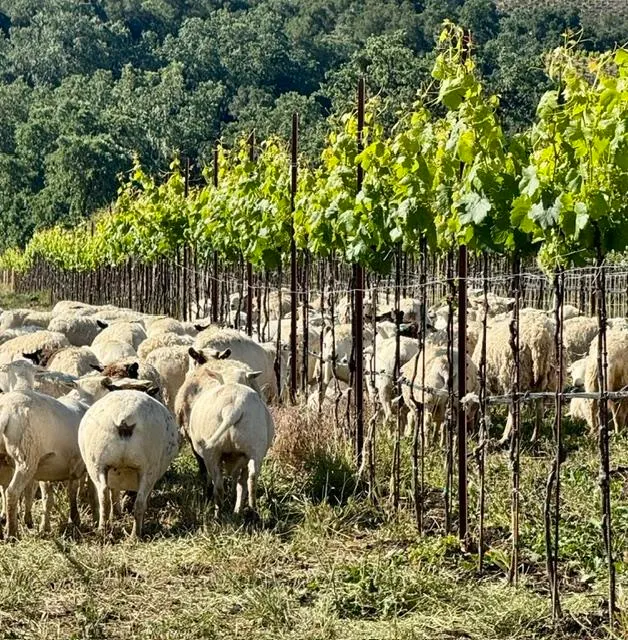
“When guests come and see grass in the rows, they think we have a dirty vineyard,” says Kevin Sass, Halter Ranch’s winemaker. “They are used to conventionally farmed clean vineyards. That’s not what we do here.”
Michelle Williams
On a cool spring morning at Booker Vineyard in Paso Robles, California, a drone hums low over the Syrah block. Inside its rotating cartridges are lacewing eggs — roughly 30,000 per acre — calibrated to drop into the canopy through a series of holes. The lacewing larvae feed on the leafhoppers that have plagued vineyards on the Central Coast for years. As adults they remain, feeding on the pollen and nectar of cover crops growing between the vine rows.
“One great thing about regen is creative problem solving,” says Hilary Graves, Booker’s vineyard manager, watching the drone work. “It’s the touchstone of every farming decision we make. It’s really more of a mindset.”
The mindset is spreading. Booker is one of six wineries in Paso Robles now Regenerative Organic Certified® — Robert Hall, Tablas Creek, Halter Ranch, Booker Vineyard, MAHA Estate and Le Cuvier. The certification, launched in 2017 by the nonprofit Regenerative Organic Alliance, builds on USDA Organic by adding two pillars the organic standard does not address: animal welfare and farmworker fairness. It is third-party audited at three tiers — bronze, silver and gold. And unlike most sustainability programs in wine, it requires producers to document measurable improvement in the health of their soil, not merely follow an approved process.
What the measurements reveal continues to surprise those farming the vineyards and making the wine.
The Wine They Didn’t Expect
Tablas Creek Vineyard converted its first 20-acre block to regenerative farming in 2010, after a visit to Grgich Hills Winery in Napa Valley. The Tablas Creek team — a partnership between California’s Haas family and the Perrin family of Château de Beaucastel — assumed the benefits would be slow. Maybe vine longevity. Maybe healthier soil over a decade. Maybe a small lift in fruit quality eventually.
“Instead, the wines from those blocks floated to the top of our blind tastings the very first year,” says Jason Haas, Tablas Creek’s general partner. “When it happened again in 2011, we decided to transition the entire vineyard.”
A second surprise came with dry farming. Tablas Creek’s first dry-farmed, head-trained, wide-spaced blocks were planted in 2000. Haas expected dry farming to produce denser, more powerful wines — the conventional wisdom about water-stressed vines.
“I think we were originally expecting, with dry farming, that the wines were gonna be denser and more powerful,” he says. “And instead, maybe because we were planting it lower density and leaving a little more crop per vine, what we found is this freshness and brightness and elegance, and a little more expression of soil.”
The vineyard now has 55 acres planted that way. Almost every new block goes in with the same architecture.
At Booker Vineyards in Paso Robles, they grow edible flowers and root vegetables between the vines.
Michelle Williams
What The Soil Is Doing
Erin Mason, Tablas Creek’s regenerative specialist, manages the gold-tier protocol the winery adopted in 2022 — the first ROC® winery in the world to reach gold. Gold requires baseline soil sampling, ongoing measurement of bulk density and water-holding capacity, and no-till on at least 75% of the property.
A few years in, Mason started running split-block trials on a single Mourvedre parcel. The top third is crimped with a heavy roller. The middle third is mowed. The bottom third is spaded — cover crop chopped and incorporated into the soil. She tracks physical, chemical and biological measures of the soil under each treatment.
One summer afternoon she went out with a thermometer.
“The difference between the tractor row and under vine, between the crimped and the spaded, was, like, 40 degrees,” Mason says.
The crimped sections hold a living carpet of plant material on the surface. The spaded sections are bare. The vines, the microbes and the water cycling beneath each are experiencing different climates entirely.
Mason has since started a second trial in the same block, testing nutrient cycling in the plant itself. The premise: a vine that is properly cycling nutrients is more resistant to pests like leafhoppers, because the plant’s own sugars become harder for sucking insects to metabolize. Soil and vine, in her framing, are in conversation.
“From a chemical standpoint, the soils pretty much have everything they need,” Mason says. “It’s the biology that we’re relying on to speak with those plants.”
At Booker, Graves and her vineyard team partnered with a beneficial-insect company to develop the lacewing drone program. A conventional foliar spray across the property takes about 80 man-hours. The drone covers the same ground in four.
Michelle Williams
The Math No One Expected To Work
The economics of regenerative farming surprise the people doing it too.
At Booker, Graves and her vineyard team partnered with a beneficial-insect company to develop the lacewing drone program. A conventional foliar spray across the property takes about 80 man-hours. The drone covers the same ground in four.
“This is cheaper than spraying,” Graves says. The insects cost roughly the same as a spray application; the labor savings are dramatic. And the program avoids every cost a tractor pass imposes that does not show up on the invoice. “Every time we put a tractor into the field, we are burning fossil fuel, putting carbon into the atmosphere, and compacting the soil. We are not doing any of that with this piece of equipment.”
The goal of the lacewings is not to wipe out the leafhopper population. Graves and her team aim for what entomologists call the economic threshold — the level at which damage no longer justifies intervention. The leafhoppers stay in the system. Their predators stay with them.
The Things That Look Wrong, Until You Look Again
The work is changing what these vineyards look like. Visitors to Halter Ranch sometimes mistake the cover crop growing under the vines for neglect.
“When guests come and see grass in the rows, they think we have a dirty vineyard,” says Kevin Sass, Halter Ranch’s winemaker. “They are used to conventionally farmed clean vineyards. That’s not what we do here.”
The challenges have been concrete. Halter Ranch introduced 104 Dorper sheep to graze the cover crop and had to raise its trellis system after the sheep happily ate vine leaves alongside the grasses. Tablas Creek learned the hard way that sheep on wet clay soils cause compaction that takes years to remediate.
Booker tills selectively to manage gophers and weed pressure, which keeps it at silver rather than gold. The MIT cost-of-living wage that ROC® gold requires — currently $26.44 an hour in Paso Robles — is not feasible across the region’s vineyard management economy overnight, and the certification asks wineries to demonstrate progress on a three-year horizon.
“The social component was most intimidating because we didn’t know what it meant,” said Clay Selkirk, Le Cuvier’s winemaker. “We had to ask questions from our peers and our certifiers. Turns out, it’s easier than I thought.”
What It Tastes Like
Robert Hall ran the most ambitious side-by-side trial. In 2021, the winery converted 43 acres of Cabernet Sauvignon to regenerative organic and kept five acres in conventional sustainable as a control. By October 2023, the regenerative block had absorbed 192% more carbon dioxide than the conventional block and out-yielded the control in three of four vintages. The wines from regenerative fruit, the team reports, show greater complexity, freshness and varietal character.
“The increase in organic matter we’re seeing in our vineyards is a big win for us,” says Amanda Gorter, Robert Hall’s winemaker. The regenerative blocks hold water differently too: “The precious resource that is water in Paso is staying in the soil longer.”
In April, in time for Earth Month, Robert Hall released the first wines from those blocks: a 2024 Cabernet Sauvignon and a 2025 Sauvignon Blanc, sold exclusively at Whole Foods Market for $29.99 each. The Regenerative Organic Certified® and B Corp seals sit on the front of the label.
The freshness Haas describes in his dry-farmed Mourvedre. The clarity Mason is reading in her soil temperature data. The complexity Gorter is tasting in the trial blocks. The lacewings doing the work the spray rig used to do at Booker. All of it points in the same direction.
“We haven’t arrived,” Mason says. “We’re still on the evolution and trying to understand how it all works, and we certainly don’t have all the answers. But we’re open.”
For wine drinkers, the lever is on the shelf. Looking for the ROC® seal — or asking for it at a restaurant and wine shops — is the most direct signal a consumer can send to a vineyard owner weighing whether the certification is worth the work. Cris Cherry, MAHA Estate’s owner, put it more bluntly.
“Cert up or shut up. You are what you eat and what you drink.”
















Leave a comment