


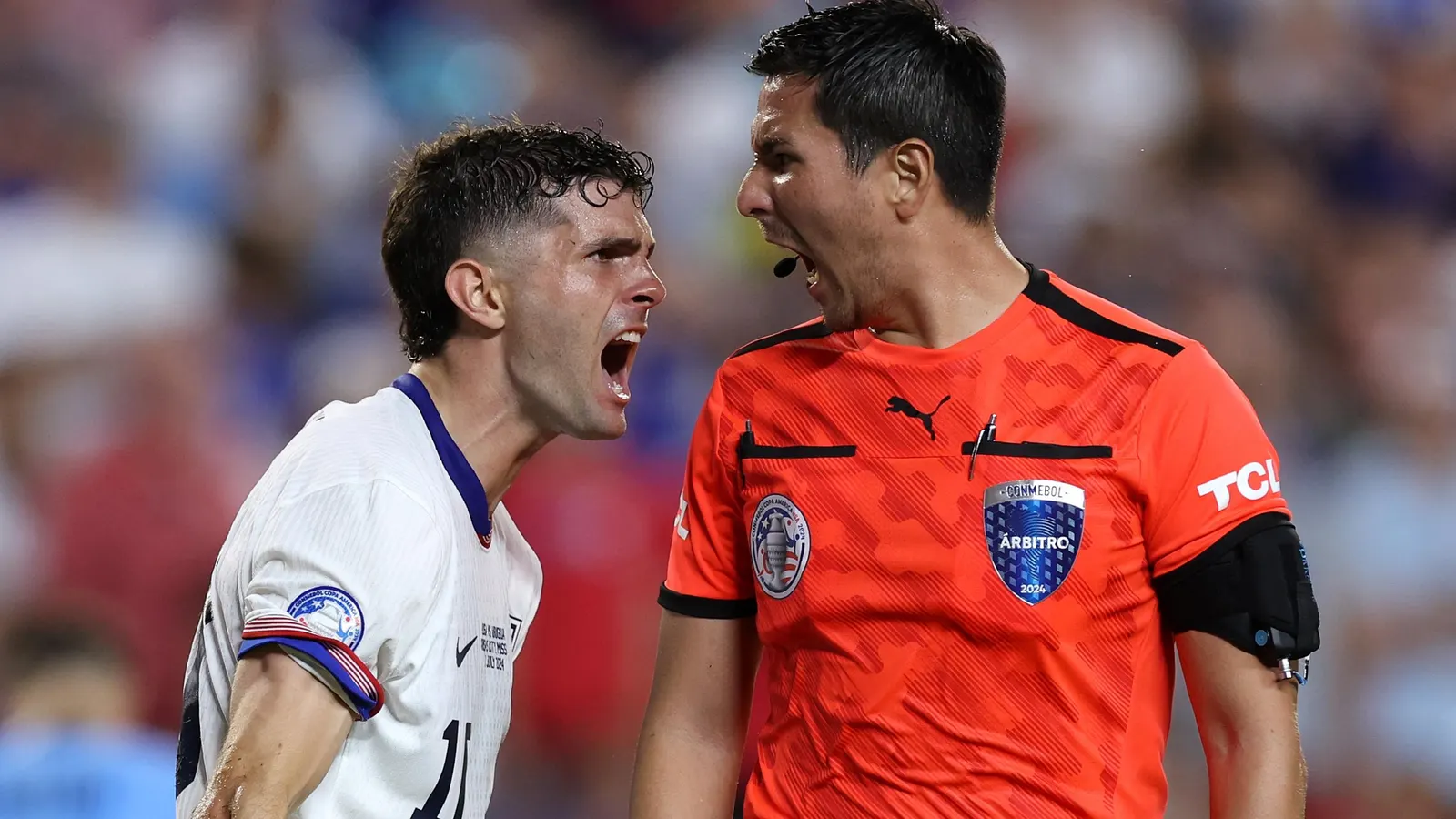

Christian Pulisic argues with referee Kevin Ortega during the Copa America 2024 match between the United States and Uruguay.
Getty Images
The U.S. audience loves a good underdog.
The 1980 “Miracle on Ice” hockey team. Lower seeds in the NCAA Tournament. Buster Douglas vs. Mike Tyson.
Two documentary series pegged to the upcoming men’s soccer World Cup posit the U.S. team, if not the U.S. soccer community as a whole, as Rocky Balboa vs. Clubber Lang and Ivan Drago put together.
Perhaps this depiction seems obvious, but this is a team whose image has taken a battering over the last few years. Viewed in the moment, this team hasn’t lived up to its “Golden Generation” hype, showing more talent than preceding generations but not as much heart.
“You are a soccer generation that has been given everything,” Alexi Lalas said in a memorable rant during the team’s ill-fated World Cup qualifying campaign in 2017. “You are a soccer generation who’s on the verge of squandering everything.”
Can some documentarians change the narrative? Yes and no.
The broad view comes from Soccer’s American Dream, produced by VICE and narrated by Saturday Night Live alumnus Alex Moffat. It delves back into U.S. soccer history to show the breathtaking high of the NASL — think Pele and the New York Cosmos — and the doldrums that followed.
On YouTube, the title of Episode 1 is straightforward: Why Soccer Failed in America. That title isn’t hyperbole. Soccer failed in this country, then failed again, then failed again. The sport has had more failures here than a short series can even mention in detail.
A series like this could start with the collapse of the American Soccer League, which was one of the top leagues in the world in the 1920s and a black hole by the mid-30s. Producers opted to tell the stories for which they had video and firsthand sources. NASL veterans such as Rodney Marsh are still around to tell their colorful anecdotes, but there’s no one who can tell the ASL’s story.
“The postwar period gave us the strongest combination of archive, cultural resonance, and contributors who could speak firsthand about the game’s growth in America,” said Joe Ingham, Head of Development at VICE Studios, and one of the series’ creators. “Once you move back into the ASL era and the collapse of the game in the 1930s, it becomes a much harder story to tell visually and personally, even though it’s historically important.”
Through more recent decades, especially since the U.S. national teams broke into the public consciousness in 1994 (men) and 1996-99 (women), the struggle evolved. Instead of the sport fighting for respect within the United States, players fought for respect within the sport. At times, the focus on labor strife gets a bit tedious, but covering several decades and noting the men’s struggles as well as the women’s makes it more illuminating than, say, the one-sided “equal pay” documentary “LFG.” And at several points in the not-too-distant past, the sport’s survival was at stake, and players knew they had to persevere just to keep playing.
Ingham was surprised by “the genuine commitment and determination both the men’s and women’s teams, especially in the 1970s-1990s, had in making the sport work,” Ingham said. “It made me realize just how much these players sacrificed personally and professionally to establish the sport and make it a success.”
Behind The Scenes
The other major documentary series leading up to the World Cup is the HBO series “U.S. Against the World,” which focuses on the U.S. men’s team from the 2022 World Cup until the present day.
Filmmakers had unprecedented access over that period. Viewers are transported into hotel conference rooms for strategy sessions. They go into the locker room for pregame, halftime and postgame talks.
Players also allow film crews into their homes, giving filmmakers a chance to further humanize the players by showing them with their kids. Such scenes run the risk of being treacly, and some of the players are too young themselves to say anything perceptive about parenthood. But the producers handle the scenes well for the most part. Only the most callous of viewers would fail to sympathize with goalkeeper Matt Turner after seeing an injury compounding the personal tragedy of his partner’s miscarriage. On the lighter side, we meet everyone in Tim Ream’s household, including the dogs.
Where the series falls flat is in the search for villains. We see complaints about referees not just after games but before them as well, trying to do some foreshadowing of controversies that may or may not materialize. More perplexing is the contrived conflict between past and present players when former national teamers in the media criticize Christian Pulisic and a few other players for taking themselves out of consideration for the Gold Cup, the regional tournament held every two years.
“When these former players criticize the performances and things like that, no problem if that’s your job and you want to do that,” Pulisic says in the series. “But when it starts talking about commitment, I think you’re just kind of looking for clicks and for headlines, for whatever reason.”
Anyone who has spent any time with any of the former players knows this statement is simply absurd. These are people who would say exactly the same thing with no cameras and no microphones.
Viewers might therefore complain that the series is too sympathetic to its subjects in exchange for access. But the series producers make great use of their access with a powerful scene that catches the team at its most downbeat, having crashed out of the Nations League with a loss to Panama. Coach Mauricio Pocchetino, still relatively new to the job, frankly tells the team that they weren’t good enough. He doesn’t raise his voice, and his calm demeanor surely made his words sting that much more.
“For them it was the World Cup,” he says. “For us, it was only a game.”
The team files silently out of the room. A couple of players notice the camera and quickly turn away.
It’s not a classic “underdog” moment. Against Panama, the United States should be Goliath, not David.
But every athlete’s biggest enemy is within. Today’s U.S. men’s team makes more money and plays for glitzier clubs than their predecessors, but everything comes down to reaching within oneself when it truly matters.
And the series makes a compelling case for fans to hope that these players win that struggle. That’s an achievement.












Leave a comment