


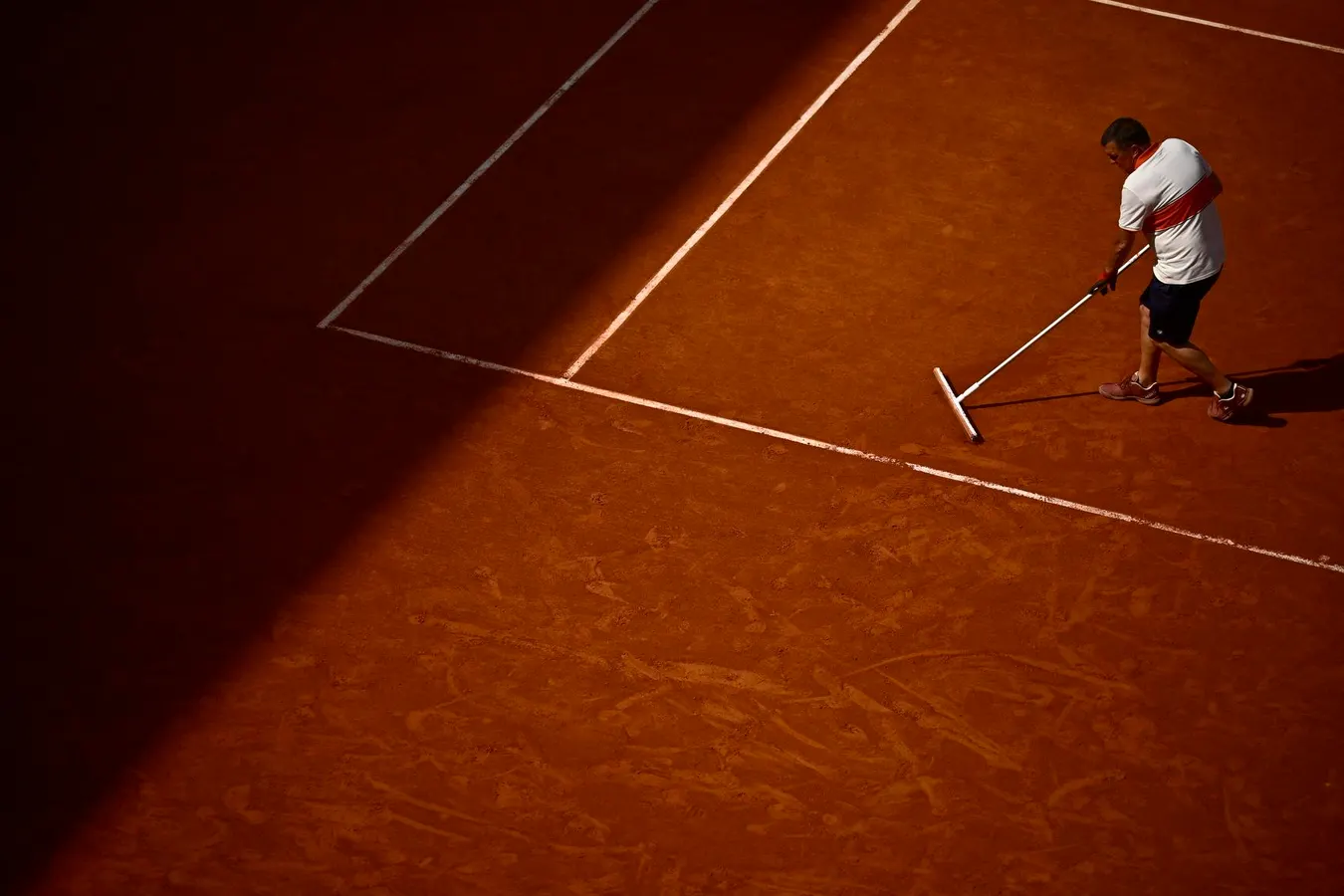

Sweeping the clay on Court Suzanne-Lenglen at Roland Garros in Paris. (Photo by JULIEN DE ROSA/AFP via Getty Images)
AFP via Getty Images
What we call the clay of Roland Garros offers a slightly more complex definition. Each of the courts at the Paris tennis major feature five distinct layers and none have any actual clay involved in the crafting of the famous red-hued tennis court surface.
The courts of Roland Garros have been roughly the same since their initial creation in 1928 and now each of the 18 courts feature five layers: a layer of stone, a layer of gravel, clinker, limestone and all topped with a dusting of crushed red brick.
Each of the courts features the same construction to ensure consistent play across the site. And each layer serves a distinct purpose. The bottom two layers of stone and roughly a foot of crushed gravel allow for proper drainage. The middle layer of about three inches of clinker—a coal or volcanic residue—helps retain moisture so the top layers don’t crack. The second layer from the top of 2.5 inches of crushed limestone offers stability for the players. It is all topped with just over half an inch of crushed red brick that not only provides the playability of the courts that slow the ball but also give the surface its famous red color.
Bruno Slastan, who has spent 36 years prepping the playing surface at Roland Garros, once told me that getting the facility’s competitions and practice courts ready for the tournaments requires special attention to the top two layers. Each year, crews rework the white limestone layer and haul in 88,000 pounds of broken brick, but only during completely dry weather, to refresh each of the courts.
A staff member prepares the surface of the Court Philippe-Chatrier at Roland Garros in Paris. (Photo by JULIEN DE ROSA/AFP via Getty Images)
AFP via Getty Images
“The thickness of materials are respected,” he said. “That is very important. We strive our hardest to achieve perfection.”
Care for the courts is constant throughout the tournament. It takes eight staff to prepare a court for play and the roughly 100 members of the crew caring for the courts maintain them during matches. Courts are continually dragged, swept, brushed and lightly watered during the day. In the evening, when play has finished, each court is thoroughly watered.
MORE: How Does Wimbledon Maintain Its Grass Courts?
By watering the court, the brick retains its color and doesn’t blow away. Slastan said the courts need the water and after the nightly dousing, the courts are covered for the night. Each morning, when the crews peel back the covers, courts are scraped to “standardize the broken brick” and calcium chloride is added to the surface to encourage the brick to stay wet and retain its red color.
Each tournament, the brick slowly fades from the courts, blown about by the wind or tracked back to the lockerroom on the shoes, socks and clothing of the players. Roland Garros crews use another roughly 11,000 pounds of the brick during the tournament to fill in gaps as needed across the tournament site.
The careful care of the Roland Garros courts ensures there’s plenty of crushed red brick on hand, even if clay gets all the credit for the work of limestone and brick.















Leave a comment