


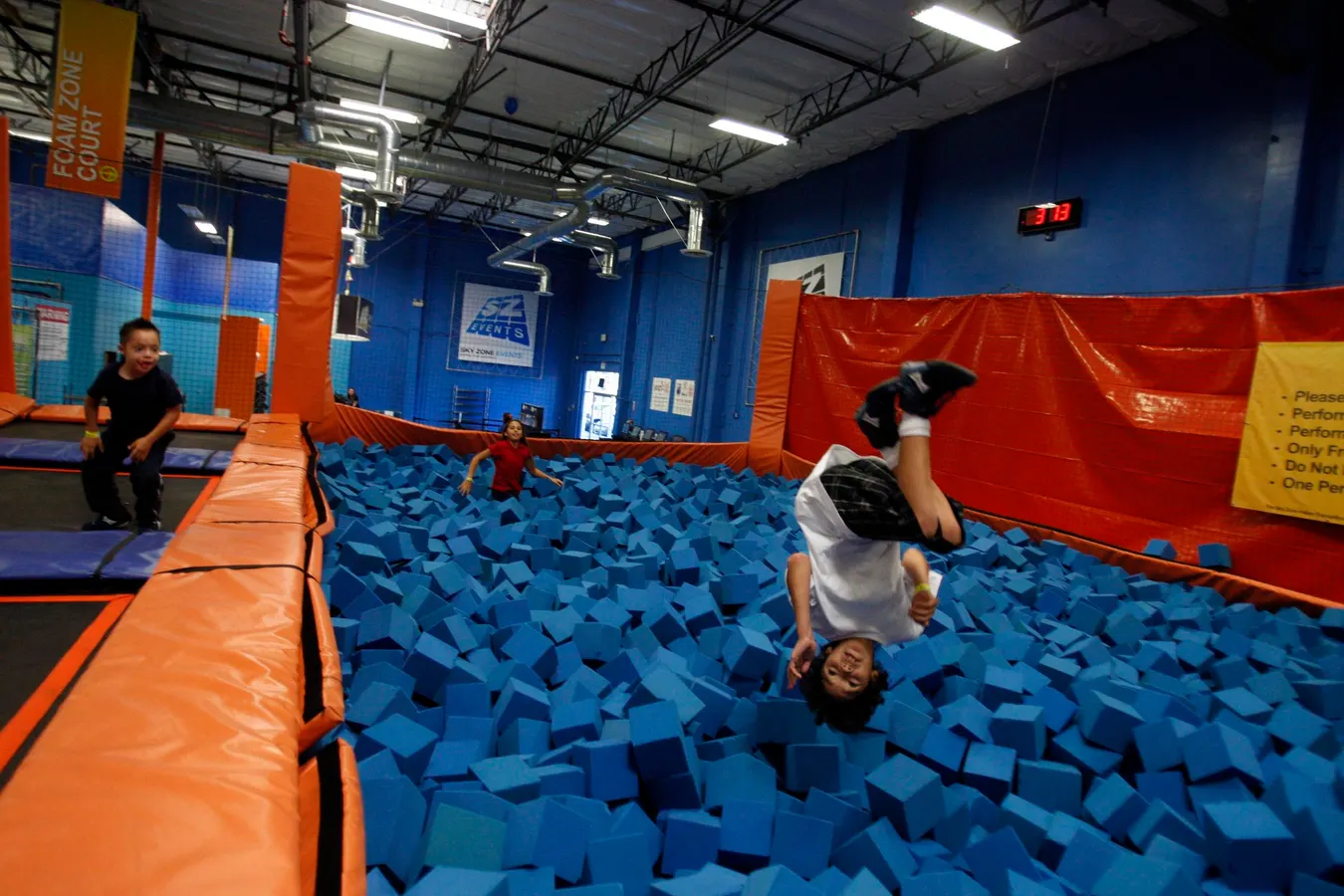

Kids play in the foam pit in the Foam Zone area of Sky Zone Indoor Trampoline Park in Anaheim, CA. (Photo by Allen J. Schaben/Los Angeles Times via Getty Images)
Los Angeles Times via Getty Images
Americans are spending more on fun. That might sound counterintuitive given where things stand in today’s economy, with inflation hitting a 12-month high of 3.3% in March, a sharp spike in energy prices, and lower- and middle-income households together feeling the heat. A family of four pricing out a three-day Disney World trip would find themselves looking at nearly $2,800, not counting flights or a hotel. Theme park vacations are, for a growing number of families, simply out of reach.
And yet consumer spending on experience grew in 2025. According to JLL’s 2026 entertainment tenant study, foot traffic across 20 tracked entertainment concepts has fully recovered from the pandemic and now stands roughly 12% above 2019 levels. The fact is that people still want to get out, get together, and do something. They’re just doing it closer to home — and the retail industry is being reshaped around that fact.
The study tracked 207 concepts operating 4,746 locations across the U.S. and Canada. Another 721 locations are planned or announced. That’s 16.5 million square feet of demand — and a signal that location-based entertainment has crossed from amenity to primary tenant category.
The big-box vacancy that became an opportunity
The same wave of retail closures that left landlords scrambling — Big Lots, Bed Bath & Beyond, Party City — created an abundant supply of exactly the right kind of space for entertainment concepts: 25,000 to 50,000 square feet, suburban, accessible, and vacant.
Entertainment tenants in that size range now account for 38% of all planned new locations, representing roughly 10.8 million square feet of demand. Trampoline parks and kid hotspots like Sky Zone and Urban Air are the clearest expression of this fit: large footprints, family-oriented, and built around repeat visits rather than one-off novelties.
A separate opportunity is taking shape at the smaller end of the spectrum. Escape rooms, challenge rooms, and competitive socializing venues like Puttshack and Flight Club typically occupy 5,000 to 10,000 square feet and account for another 30% of planned new locations, mapping neatly onto former mall junior anchors and inline lifestyle center storefronts.
The repeat-visit model matters more than it might seem. Birthday parties. Saturday-morning routines. Group outings that get booked again. These are the habits that generate durable foot traffic, helping justify a long-term lease and keeping a center alive between weekends — and they run across both ends of the size spectrum.
Where the growth is going
The growth numbers reflect that durability. Escape and challenge rooms have surged 247% in existing locations since 2023, with their planned-and-announced footprint up nearly 600%. Competitive socializing venues grew 84%. Trampoline parks and kid zones have 354 announced new locations, representing nearly half of all planned openings in our database.
The suburbs are where most of these tenants are landing. Close to 80% of entertainment move-in activity between 2019 and 2026 happened outside urban cores, and median venue size jumped nearly 50% over the same period — a reflection of how dominant the larger-format concepts have become in markets where both the space and the customer base exist.
Center type tells its own story
Power centers and lifestyle centers roughly doubled their share of entertainment move-ins since 2019. That’s notable given the longstanding assumption that malls are the natural home for these concepts. Malls didn’t lose ground, for the record, but the bigger shift is how broadly the category has spread. Operators are now actively finding opportunity across formats: Netflix House, Meow Wolf, and Level99 have each absorbed former anchor and theater spaces in both mall and open-air settings, turning high-profile vacancies into a recognizable new asset class.
There’s a price-point geography at work as well. More expensive, highly-themed concepts tend to cluster in CBDs and Class A malls. The concepts expanding fastest into open-air centers and power centers skew more affordable. Here, admission typically runs anywhere from $30 to $60, versus thousands of dollars for a long weekend in Orlando — which means they’re reaching more of the market, more consistently.
Families just want something to do on Saturday
The space is there, and so is the demand. Q1 2026 transaction volume topped $15 billion — the strongest first quarter since 2023 — as institutional investors moved aggressively toward retail assets. The structural scarcity that’s kept vacancy near historic lows continues to reward landlords with quality inventory, and entertainment tenants are proving to be among the more motivated, creditworthy takers of that inventory.
The 16.5 million square feet in the pipeline isn’t a bet on novelty. It’s families looking for something to do on a Saturday that doesn’t cost $2,800.














Leave a comment