


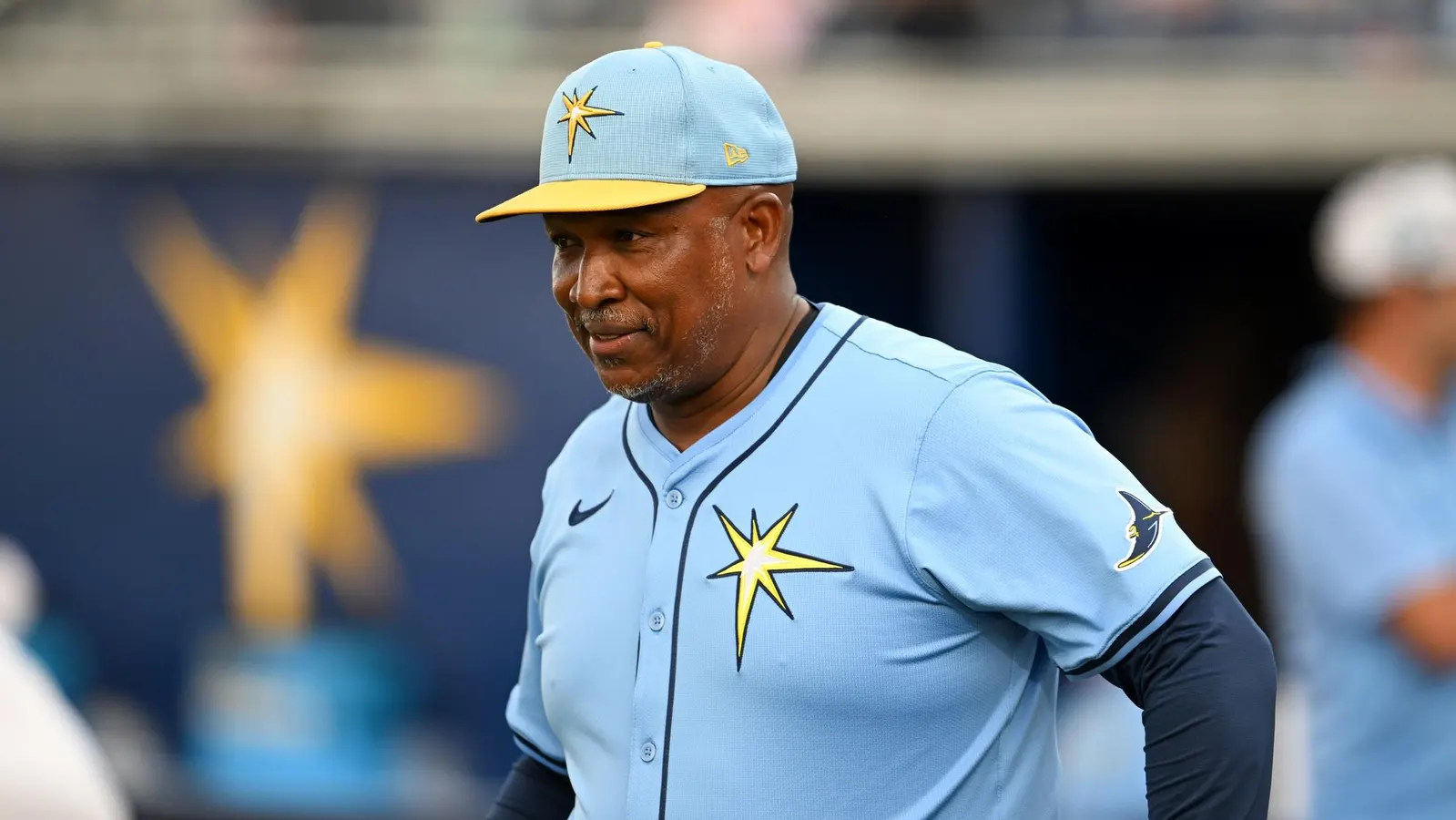

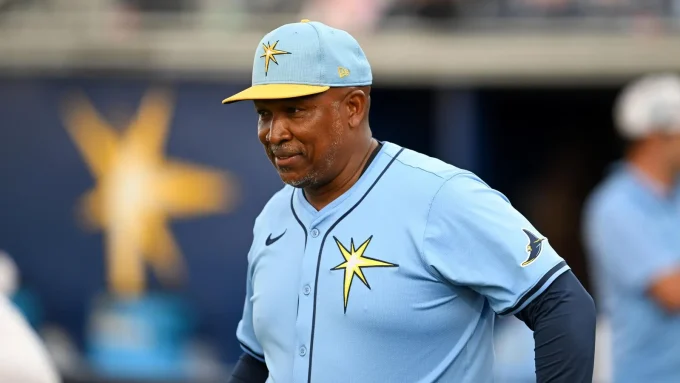
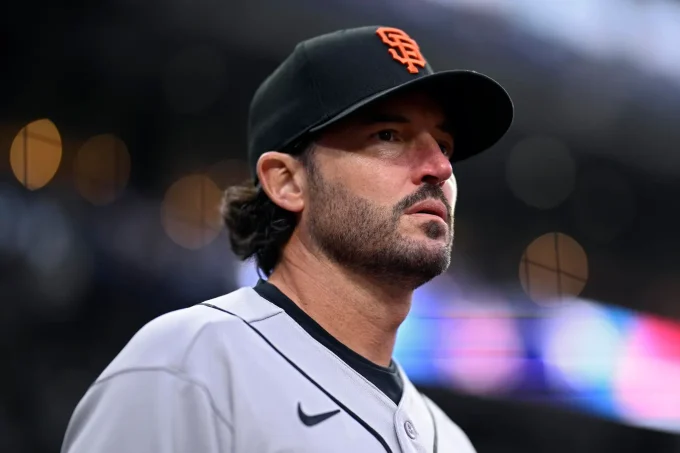
PORT CHARLOTTE, FLORIDA – Ozzie Timmons of the Tampa Bay Rays is introduced prior to a spring training Spring Breakout game at Charlotte Sports Complex on March 13, 2025 in Port Charlotte, Florida. (Photo by Nick Cammett/Diamond Images via Getty Images)
Diamond Images/Getty Images
Thirty-five years after he was selected in the fifth round of the MLB draft by the Chicago Cubs, Ozzie Timmons remains very much a part of the University of Tampa baseball family. Someone who knows him very well, Spartans coach Joe Urso, can attest to that.
“It’s amazing that at the end of the major league season, which as we know is a nine-month grind with spring training and the regular season, he is here the next day for fall practice,” said Urso. “I am like, ‘Oz, take a break. You just had a long season.’ He loves giving back to the kids and this university.”
Timmons would have it no other way. The 55-year-old Tampa native’s playing career at UT overlapped with Urso’s as well as that of associate head coach and pitching guru, Sam Militello. The latter, a sixth-round pick of the Yankees in 1990, has been alongside Urso in guiding the program for the last 26 seasons.
“Joe, Sam and I played together, so it is easy to go back,” said Timmons, who throws batting practice and works with the outfielders, among other tasks. “I always volunteer because Joe makes it easy to volunteer. I volunteer in the fall and in the winter until I have to leave for spring training.”
Timmons needs no introduction when it comes to baseball in Tampa Bay. He is part of a seemingly never-ending list of players and coaches who have been developed in the region. He has also had the opportunity during his career to return home to play and coach.
Timmons a part of Tampa’s rich baseball heritage
Timmons graduated from Brandon High School, about 15 miles east of the University of Tampa. He was a two-time All-American at the Division II powerhouse, which in addition to Timmons has produced a handful of big-league players, including Militello and Tino Martinez.
It was an easy decision for Timmons to attend college close to home. The fact the Spartans, who this season became the first D-II program to win three straight national titles, played at a lower level did not matter. They routinely scheduled Division I programs at that time and several professional players, alumni or not, often assisted at practice.
“Half our schedule was against D-I teams, so I did not need to go to a D-I school,” said Timmons. “When I help out at UT, I tell the players what it takes if they are thinking about going pro. When I was at UT, you had Tino Martinez, you had Fred McGriff, Gary Sheffield, Darnell Coles, all those guys working out with the players. I always tell people when I got the pro ball, I had an advantage because I knew what to expect and how to act.”
Growing up in Tampa, Timmons had plenty to choose from in his backyard when it came to players for him to track.
“We didn’t have (an MLB) team, so I followed all of the players from Tampa,” he said of a time before the Rays came into existence in 1998, and rattled off names such as Gooden, McGriff, Ty Griffin, Mike Heath, Floyd Youmans, Vance Lovelace and fellow Brandon High product Jody Reed. “I followed those guys and I played against Gary (Sheffield) in Little League. So, I gravitated toward all of the locals. You followed those from the neighborhood and the community.”
Tampa Bay Devil Rays Ozzie Timmons is congratulated by coach Billy Hatcher after hitting a two-run home run in the second inning off the Yankees’ Roger Clemens at Tropicana Field in St. Petersburg on September 28, 2000. AFP PHOTO/PETER MUHLY (Photo by PETER MUHLY / AFP) (Photo by PETER MUHLY/AFP via Getty Images)
AFP via Getty Images
Timmons, who is giving of his time with Little League programs and other youth activities in his hometown, hit .235 in 186 games with the Cubs, Reds, Mariners and Devil Rays, as the team was known in 2000. He compiled a 1.062 OPS in a dozen games at the end of that season, his last in the big leagues. He hit his 20th and final MLB homer off the Yankees’ Roger Clemens at Tropicana Field.
Two decades after Timmons’ playing career came to an end in the Mexican League, he is in his second stint on manager and Tampa native Kevin Cash’s staff. Currently the Rays’ assistant hitting coach, Timmons initially joined the organization in 2007 and had various roles in the minor league system and with the parent club. He was also the Milwaukee Brewers’ hitting coach for three seasons (2022-24) prior to returning to the Rays.
Dishing advice to aspiring college players
Timmons noted there were instances in the not-too-distant past when at least 10 scouts showed up at UT with radar guns, stopwatches and note pads in hand. During intrasquad games in the fall!
Urso, who has guided the Spartans to eight titles, pointed out the program has produced the fourth-most draft picks in the state (behind Florida, Florida State and Miami) the past two decades despite having a maximum of nine scholarships to offer per year. Those facts serve as exclamation points when it comes to educating young players who may feel committing to a D-I power is the only path to a professional career.
“So many guys who want to play D-I get there and don’t play,” said Timmons. “I always tell kids they need to go where they are going to play, whether it’s DI or DII. It doesn’t matter. Sometimes the (major programs) have guys sit and wait a year or two. I ask them, ‘Are you willing to wait? Or are you going somewhere where you can compete for a job?’”
A scout can only assess a player in person or on video if the player in question is receiving at least some time on the mound, in the field or at the plate.
“You are going to be seen, especially in Florida,” Timmons emphasized. “That’s the whole point about needing to go someplace where you are going to play.”
Those who learn the hard way and transfer down a level after a couple of years are not guaranteed a thing. That is the way it should be. That is that way it is at UT under Urso, which is something Timmons appreciates immensely.
“Joe makes it a competition regardless of who comes on board,” he said. “No matter where you come from you are not guaranteed a job. Guys that come to UT and think because they are transferring from D-I means they are going to start? Well, no. You still have to earn it. There’s always competition (at UT) and that’s the beauty of it.”
Having someone who has been there and done that is the beauty of it for Urso, who served as a coach in the Angels’ system for a few years before returning to his alma mater where he was a .332 career hitter and a member of UT’s first (of 11) championship squad 1992.
“The boys love Ozzie,” he said. “They get perspective from an experienced major league player and coach. He’s a great friend and he loves giving back. He was one of our best players and a captain that we all looked up to.”









Leave a comment