


Topline
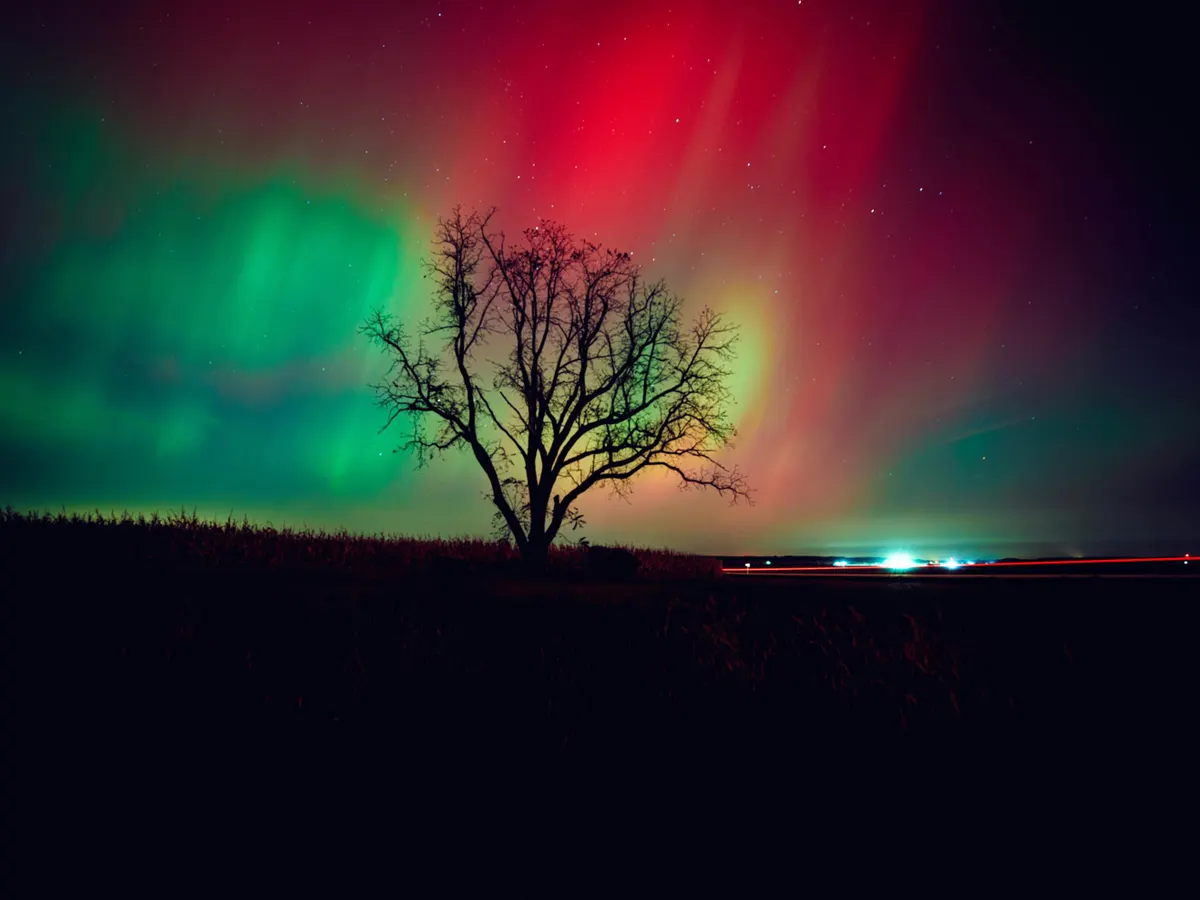
The northern lights could be visible from some northern states on Monday night, according to a forecast from the National Oceanic and Atmospheric Administration, as a burst of material from the sun approaches the Earth and threatens to cause stronger geomagnetic storms than usual.
The northern lights have a chance to be visible again from states along the U.S.-Canadian border on Monday night.
NurPhoto via Getty Images
Key Facts
NOAA is predicting a Kp index of five out of nine for Monday, meaning the northern lights could appear visible from some parts of the Lower 48 states.
The Earth could also see geomagnetic storms, up to a G3 on NOAA’s scale out of five, on Monday night, as a coronal mass ejection that left the Sun on Saturday passes by the Earth.
What Are Coronal Mass Ejections?
Coronal mass ejections are large bursts of plasma and magnetic field that escape from the sun’s corona, or outermost layer of atmosphere. When this material reaches the Earth, it can interact with the planet’s own magnetic field and cause geomagnetic storms. The storms expected on Monday night into Tuesday morning are likely to be mild to moderate, according to NOAA’s most recent three-day forecast, but periods of strong storming could occur on Monday evening. These storms can cause problems for satellites and spacecraft in the Earth’s orbit, but they also cause the northern lights to appear in the contiguous U.S. During some periods of strong geomagnetic storms, the northern lights can be seen as far south as Illinois and Oregon, according to NOAA, and the largest northern lights displays in recent years involved visibility in all 50 states.
Where Could the Northern Lights Be Visible?
The best chance in the Lower 48 is along the predicting a lower chance to U.S.-Canadian border in the West and Midwest. North Dakota, the Michigan Upper Peninsula, northern Minnesota and much of northern Montana, along with a stretch of northern Washington and the northernmost parts of South Dakota, Idaho and Wisconsin. NOAA forecasts a generally low chance of visibility in these areas, in contrast with much of Alaska, which the forecast shows has a “high” chance of catching the northern lights Monday night.
What’s the Best Way to View the Northern Lights?
Experts at NOAA recommend prospective viewers travel as far north as possible, toward Earth’s magnetic north pole situated in northern Canada. Viewers should then find a suitable vantage point, ideally a hill or elevated position with a clear view of the sky facing north and away from other light sources. The lights are typically most active around midnight, according to NOAA, especially between 10 p.m. and 2 a.m.
What’s the Best Way to Photograph the Northern Lights?
Smartphone cameras are more than capable of taking quality photos of the northern lights, according to experts who spoke to National Geographic. Viewers should remember to switch their devices to night mode, turn off flash and shoot in RAW image format if possible. Cameras should be held still for longer amounts of time in order to capture the aurora, so experts recommend investing in a tripod and a remote timer.
















Leave a comment