


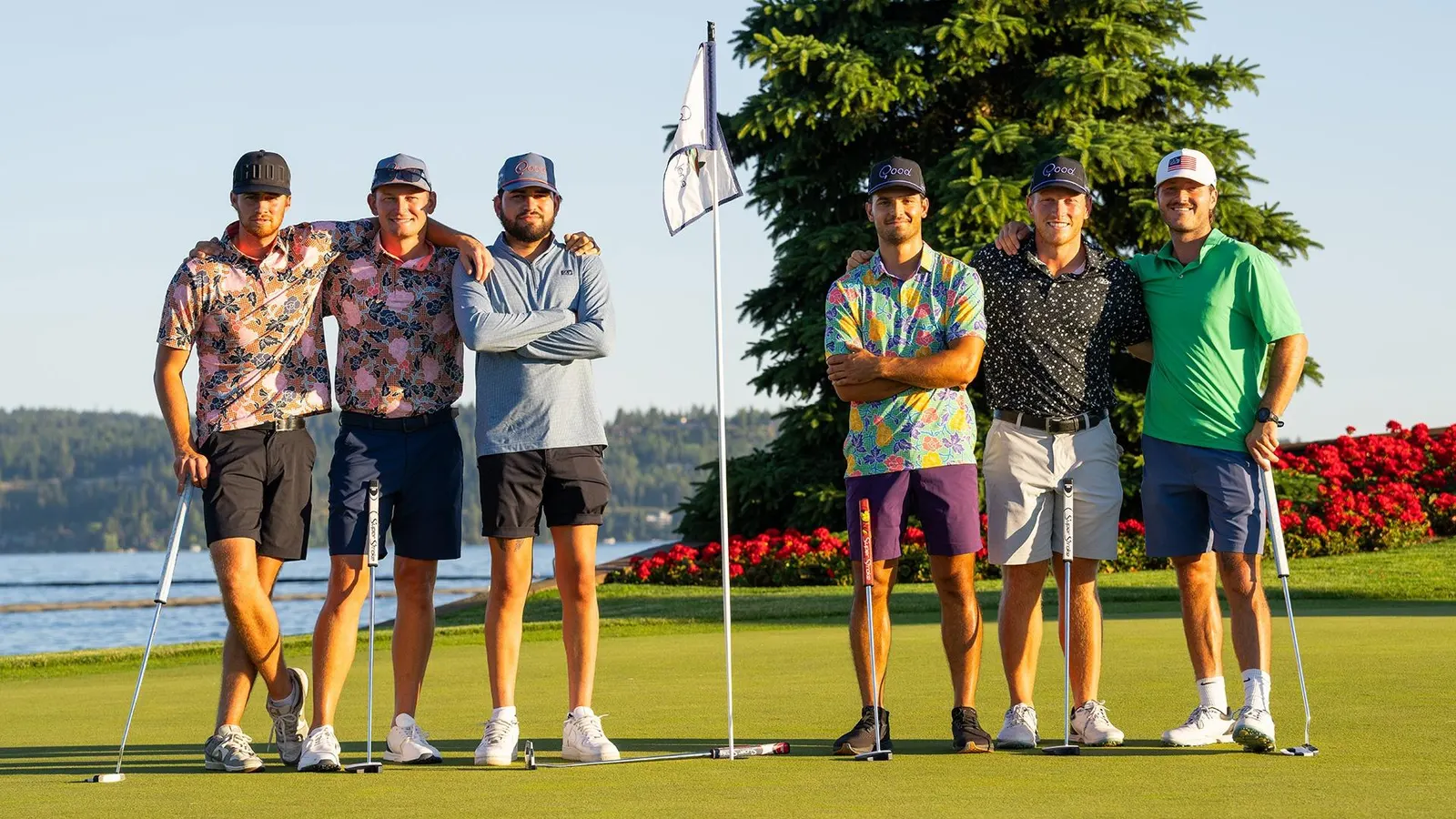
For a glimpse of both golf’s past and its quickly approaching future, one need only look at Austin, Texas. When the city last hosted a PGA Tour event, in 2023, the tournament’s title sponsor was Dell, the Texas-based computer manufacturer that made its fortune in a previous tech boom. Now the tour is set to return there with the Good Good Championship, named after and hosted by a group of content creators.
The November event is the clearest signal to date of the growing influence of “YouTube golf,” a content category that exploded on the streaming platform in 2020 thanks to pandemic-era spikes in digital video consumption and recreational golf participation—the latter up 41% in the U.S. since 2019, according to one study by the National Golf Foundation. That rise has minted a new class of everyman golf stars, including Grant Horvat, the Bryan Bros and Bob Does Sports, who are not only riding the wave but also working to remake the sport in their own image: younger, looser and less stodgy. Their progress can be measured in the millions of viewers they attract—among them celebrity fans like LeBron James and Travis Kelce—and the millions of dollars from sponsors and investors that have followed close behind.
Good Good Golf, one of the first and most successful YouTube golf channels, began in Frisco, Texas, in 2020 with a group of college-aged friends (including Horvat) goofing around on the course and has since expanded into a content-to-commerce company that recorded more than $40 million in revenue last year, according to Forbes estimates. It now has a talent roster of 15 creators and 3 million subscribers across multiple channels—Good Good Girls, Good Good Pros and Good Good Mini Golf among them—all of which fuels its apparel and products business, which accounts for about 75% of the company’s earnings.
In March 2025, the company secured $45 million in funding in a round that was led by Los Angeles-based investment firm Creator Sports Capital and featured more than 50 other participants, including Peyton Manning’s Omaha Productions. Good Good has used that money to beef up its sales team and eye potential acquisitions, as well as secure the PGA Tour title sponsorship in Austin, with Forbes estimating naming rights for the average tour stop to be worth $12 million to $15 million per year.
World’s Highest-Paid Golfers 2026
VIEW THE FULL LIST
“It is a big investment, and it’s a risk for us, for sure,” says Matt Kendrick, Good Good’s CEO. “But we’re working with a professional sports organization, running a professional tournament. I think that is a huge moment for all creators and a validation for everybody that this content creator business is real and it’s not going to go anywhere.”
The creator brand of golf—where blindfolds, budget clubs and other reality TV-inspired challenges dominate—is a major departure from traditional 18-hole competition, but its popularity has forced the golf establishment to try to adapt, rather than risk being left behind. Bryson DeChambeau, a two-time major champion and one of the faces of LIV Golf, has posted more than 100 videos in the past three years on his own YouTube channel, often playing recreationally with celebrities like Tom Brady and Donald Trump. PGA stars Scottie Scheffler and Rory McIlroy also regularly appear in creator-style videos for brand partners like TaylorMade.
In 2024, the PGA Tour established a Creator Council, consulting with top personalities directly on how it can embrace golf’s counterculture. The tour has since set up official Creator Classic competitions and allowed creators to make content inside the ropes at its courses, play in its pro-ams, use its highlights in video clips, sell apparel at its tournament merchandise tents and even earn a share of the revenue from certain sponsored on-site content activations.
“I think there’s a collective understanding of the value of this group and the weight of their voice,” says Alex Dorsch, the PGA Tour’s vice president for demand marketing. “We’re trying to figure out a way to harness it and provide the right access in the right way for them to be able to create the content that we know is going to go further with our younger fans.”
The mainstream attention and credibility further raise the profile of top creators, but their appeal for many sponsors is the very fact that they’re not pros. They can partner with brands that don’t normally work with tour players—nearly every prominent channel has a major gambling partnership, for instance—while also providing a new audience for the big equipment and apparel companies looking to sell to weekend warriors. For that target demographic, a group of creators trash-talking one another and occasionally shanking a ball into the woods might offer a different level of relatability than a highly ranked pro, at a fraction of the cost.
Full Swing: Manolo Vega has an Instagram account with more than a million followers and also sells protein bars, cigars, polo shirts made by Criquet and a wine brand imported from Spain.
Courtesy of Manolo Vega
Manolo Vega, for example, was scraping by as a wine salesman, caddy and part-time teaching pro before he began harnessing his boundless enthusiasm into Instagram content in September 2020. He’s as well known for his catchphrases like “dassssit” or “nasssti” as for the instructional tips he posts on his account @ManoloTeachesGolf, but the combination has helped grow his following to more than a million on the social media platform, plus another 120,000 on YouTube. He now has signed partnership deals with blue-chip brands like BMW, Cisco and AT&T, appearing in a commercial for the telecommunications giant with LPGA legend Annika Sorenstam, and he has a cameo in the upcoming Will Ferrell-led Netflix series The Hawk. Forbes estimates he earned about $1.5 million over the past year.
The goal for the 45-year-old Vega, as with many creators, is to build businesses that don’t rely entirely on sponsors, given YouTube audiences’ history of eventually moving on to the next hot category. He has launched Manolo-branded protein bars, cigars hand-crafted from a plantation in Nicaragua, polo shirts made by Criquet and a wine brand imported from Spain.
“You’re not going to see anything that I wouldn’t wear or taste or eat or speak,” Vega says. “I’ve got to look everybody I see in the eye and say: ‘I use this. I love this.’”
Other creators are betting they can carve out a competitive niche that can permanently coexist with the traditional golf tours. In 2025, Barstool Sports and YouTube channel Bob Does Sports hosted an Internet Invitational for 48 top creators with a $1 million purse, accumulating more than 29 million views across six episodes, and the prize pot is being upped to $4 million for the 2026 edition—matching the purse at a handful of PGA Tour events and surpassing most tournaments on Europe’s DP World Tour. The Bryan Bros and Horvat, who left Good Good in 2022 to pursue his own channel, recently announced their own creator-only tour offering a $1 million prize, backed by Wynn Las Vegas.
Good Good, meanwhile, does not want to disrupt golf’s establishment so much as become a part of it. In addition to the Good Good Championship, the company is reviving a reality show on linear TV, The Big Break, for the Golf Channel, which will reward the winner of the Apprentice-style competition with a sponsor’s exemption into the field of the tournament in November.
“There’s a lot of people that don’t consume YouTube golf,” says Kendrick, the Good Good CEO. “It’s easier for us to put our product in front of them in the places they watch golf than to try to convince them to come to a place where they don’t already consume that content.”
The strategy reflects Good Good’s ultimate business goal, which is to sell products even to those who don’t watch every video it produces. By the time the next technological revolution comes, they want to be part of the firmament.
It’s ambitious, given the entrenchment of golf brands like TaylorMade and Callaway, which generated $685 million in net sales from its “apparel, gear and other” segment in 2025. But golf has seen companies rise and fall over the years. MacGregor Golf, which sponsored Jack Nicklaus in the 1980s, and hybrid club specialist Adams, which peaked at $100 million in sales in 2008, were swallowed by ascendant rivals. And Nike, once a dominant player, had nearly $800 million in golf revenue in 2013 but completely abandoned its equipment line three years later in the midst of declining sales. Meanwhile, brands like Malbon and PXG are less than 15 years old and already boast well over $100 million in sales.
“Our goal is to build one of the biggest brands in golf, not just one of the biggest content brands,” Kendrick says. “We use content as a main tool for us, for sure, and we want to build entertaining products, but at the end of the day, we’re doing everything we can to be, in ten years, when people think about golf, Good Good is at the top of that list of companies.”




Leave a comment