


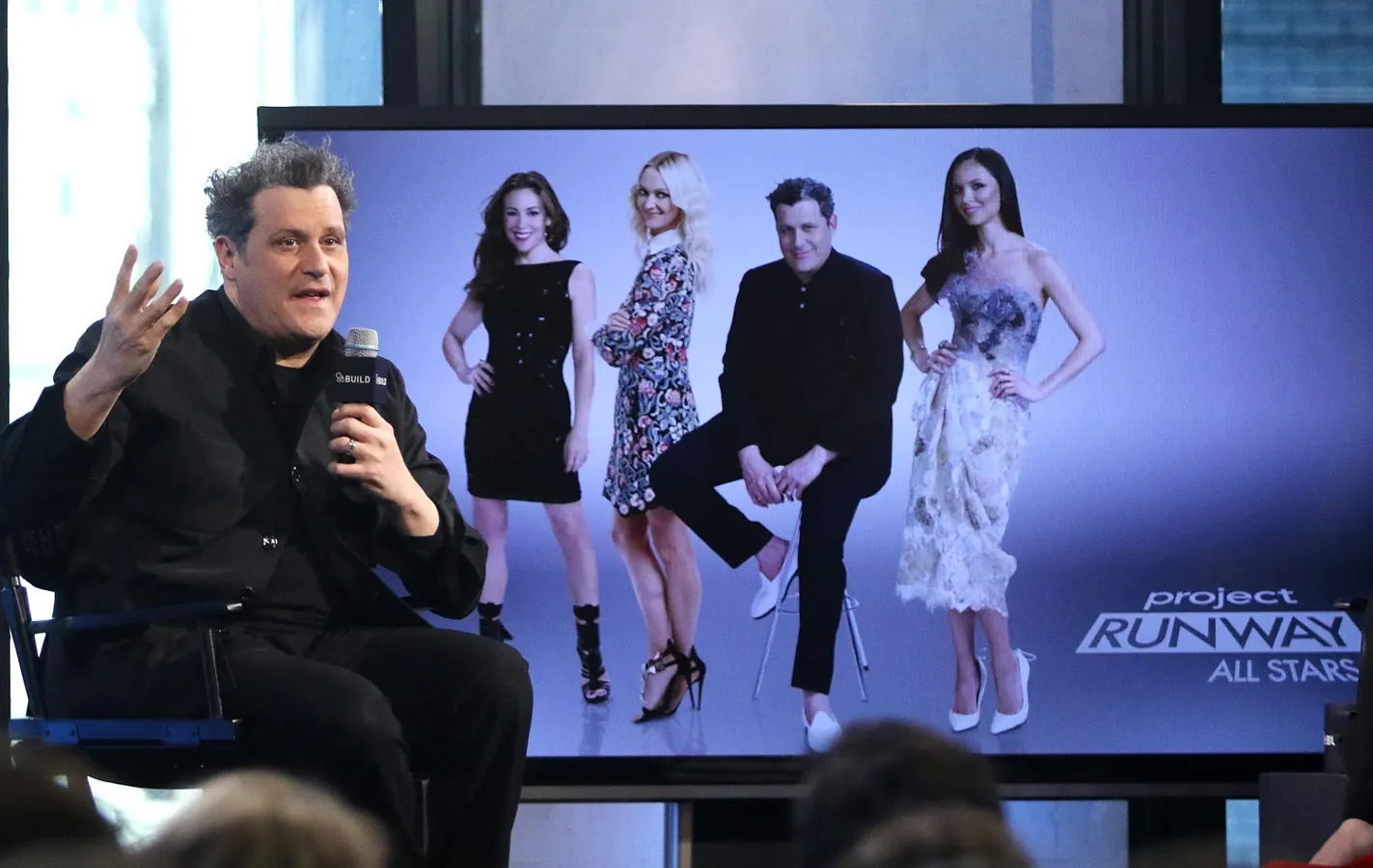

Isaac Mizrahi, “Project Runway All Stars” (Photo by Laura Cavanaugh/FilmMagic)
FilmMagic
To paraphrase Heidi Klum: one day you’re a luxury designer, and the next day you’re working for a mass retailer. This week, Target announced the appointment of Isaac Mizrahi to a newly created role of Creative Director at Large. This announcement follows an ongoing trend of recruitment of fashion icons to the masses, now for internal roles. Walmart, Gap, Zara, and Uniqlo have all deployed similar strategies. The recent surge is in direct response to the emergence of a K-shaped economy and the war against ultra-fast-fashion. Retailers positioned in the middle are looking to further distinguish themselves. This signals increased competition for luxury players as icons have switched sides, obscuring the definition of luxury.
K-Shaped Economic Paradox
The timing of the collaborations and appointments coincides with what economists and analysts are describing as the K-shaped economy. Following the pandemic, the economy became increasingly bifurcated. Upper-income households, whose wealth is tied to appreciating assets like stocks and real estate, kept growing and spending. Lower and middle-income households faced sustained inflation, rising debt, and pulled back. The letter K models the diverging paths of consumer segments.
Dior Storefront (Photo by Joe Raedle/Getty Images)
Getty Images
The luxury segment was quick to react to post-pandemic demand by raising prices. Between 2023 and 2025, approximately 80% of luxury market growth came from price increases rather than volume gains. This eventually reached its limit as value was called into question, sparked by supply chain scandals such as the case of Dior’s labor exploitation. Although select ultra-luxury players like Hermès have continued to succeed, the luxury segment overall has declined.
The consumers who abandoned these brands did not abandon spending but migrated to channels whose design signals matched those of value. This created a paradox that brands now face. Despite the continued wealth trajectory, upper-income aspirational consumers were shopping in the middle market.
Shein shoppers (Allen J. Schaben / Los Angeles Times via Getty Images)
Los Angeles Times via Getty Images
Relocated demand however is only part of the story. Mass retail and mid-market brands were already under pressure from the other direction and were looking to reposition. The rise of ultra-fast-fashion platforms like Shein, Temu, Wish and even Amazon Haul have been proliferating. Large mass retailers were already at a disadvantage with speed due to their scale. Now their price positioning was being challenged, with margins being eroded in a race to the bottom. Design and brand authority became the only exit from that race as you can dupe a handbag, but you cannot dupe an Isaac Mizrahi.
Luxury’s Attrition
Against this backdrop, the appointments make strategic sense. Collaborations have been a long-term tactic in retail to leverage trickle-down fashion cycles to capture the coveted high-household income customer. These appointments are different as they signal a concrete relationship, not a temporary commitment. The goal is to signal the retailer as a permanent destination for luxury rather than using scarcity as the tactic.
Designer Brandon Maxwell (Photo by Fernando Leon/Getty Images for Brandon Maxwell)
getty
Of the mass merchants, Walmart was the first to escalate a collaboration to a staff position, a distinction that matters. In 2021, Brandon Maxwell was appointed as Creative Director for brands Scoop and Free Assembly.
The Scoop acquisition itself was a major signal, but bringing in Brandon Maxwell to guide both the acquired contemporary brand and a new private brand was a strategic bet. Walmart’s appointment was made on the heels of COVID. It has acted as a strategy to safeguard and maintain the higher-household income consumer it drew in during the pandemic. So far, this strategy has paid off, with Walmart reporting share gains led by upper-income households across multiple consecutive earnings periods.
Although Gap’s foray into the home category in a partnership with Walmart was unsuccessful, it still seems to have taken inspiration from the retail giant’s playbook. In 2024, Gap made its own move by appointing Zac Posen as EVP and Creative Director of Gap Inc. and Chief Creative Officer of Old Navy. The results have been sizable, reporting its first quarter results of 2026 as “one of the brand’s strongest performances in over two decades”.
Designer Clare Waight Keller walks the runway during the Chloe show (Photo by Pascal Le Segretain/Getty Images)
Getty Images
Also in 2024, Uniqlo appointed Clare Waight Keller as Creative Director. This is notably different from the existing collaborations which Uniqlo is known for. J.W. Anderson is currently the Creative Director at Dior, yet maintains a simultaneous partnership with Uniqlo.
Now Isaac Mizrahi returns to Target, 23 years after he launched his first capsule collaboration at the mass retailer, now in a bigger way. Whether this assignment, or John Galliano’s two-year creative assignment at Zara, announced earlier this year, will follow the same path of success is still to be determined. As history tells us, partnerships have the potential to go both ways if the timing and the execution aren’t right.
Masstige Gone Wrong
The first major American masstige partnership was in 1983 between JCPenney and Halston. JCPenney has often been ahead of its time in retail innovation. The mall-like launch of Sephora shops in-store is a recent example, launching in 2006 it never found its footing there, but the concept launched successfully at Kohl’s. The same pattern held true for JCPenney’s earlier collaboration with Halston.
Designer Roy Halston presents Halston III for J.C. Penney (Photo by Amy Meadow/WWD/Penske Media via Getty Images)
Penske Media via Getty Images
While European designers like Pierre Cardin and Yves Saint Laurent had explored diffusion lines and licensing since the 1960s, the Halston III deal was the first of its kind with an American designer putting their name on a mass retailer’s rack. Despite branding the collections as a diffusion line Halston III, the deal received significant backlash from other retailers who felt it devalued the brand. Halston was subsequently dropped from Bergdorf. The line eventually faltered, and a series of ownership changes ultimately cost Halston the rights to his own name. This is the cautionary tale of brand dilution in fashion.
The 2004 collaboration between Karl Lagerfeld and H&M is another example of risks. Although the capsule was widely successful, the relationship between the brands was not. Karl Lagerfeld openly criticized the execution of the collection and lack of inventory. It did, however, inspire the designer to relaunch his brand in 2012, focusing this time on more accessible price points to lean into the masstige demand. H&M continued on to partner with other names, using the buzz as a way to elevate its presence.
Next On The Runway
With so many appointments having been past judges on Project Runway, it is easy to speculate who could be next. Christian Siriano, a former winner of Project Runway has stepped in to fill the role of mentor to contestants, replacing the legendary Tim Gunn. Although temporary, he did act as Creative Director and Curator at Macy’s for the 40th anniversary of its private brand I.N.C in 2025. Long-term original host Michael Kors could reemerge as a prominent figure given his recent struggles with the failed sale of Capri Holdings to Tapestry. The roster of former guest judges also included names such as Jason Wu, Vera Wang, Cynthia Rowley, Sergio Hudson which are each excellent candidates.
Perhaps the most strategically compelling play involves Vera Wang. WHP Global represents both the Vera Wang and Isaac Mizrahi brands. With Mizrahi now deployed at Target, deepening an already strong brand presence at Kohl’s, a retailer in need of a credibility refresh, could follow the same logic.
The Audemars Piguet x Swatch ‘Royal Pop’ Collection (Photo by Beata Zawrzel/NurPhoto via Getty Images)
NurPhoto via Getty Images
Regardless of who the next designer is to decide: “if you can’t beat em, join em”, the signals are the same. Fashion collaborations and the tactic of scarcity have been overplayed. The success seen in the Swatch x Audemars Piguet Royal Pop is now the exception to the rule as the model that once generated buzz through limited runs and sold-out launches has been replicated too many times to retain its power.
Mass merchants are now making institutional commitments, permanent roles rather than capsule partnerships, betting their fashion futures on the names of former luxury leaders. In a K-shaped economy with luxury value mistrusted, following the customer is playing out as a smart move for these designers while leaving the retailer well positioned to benefit from the reshaped economy.














Leave a comment