


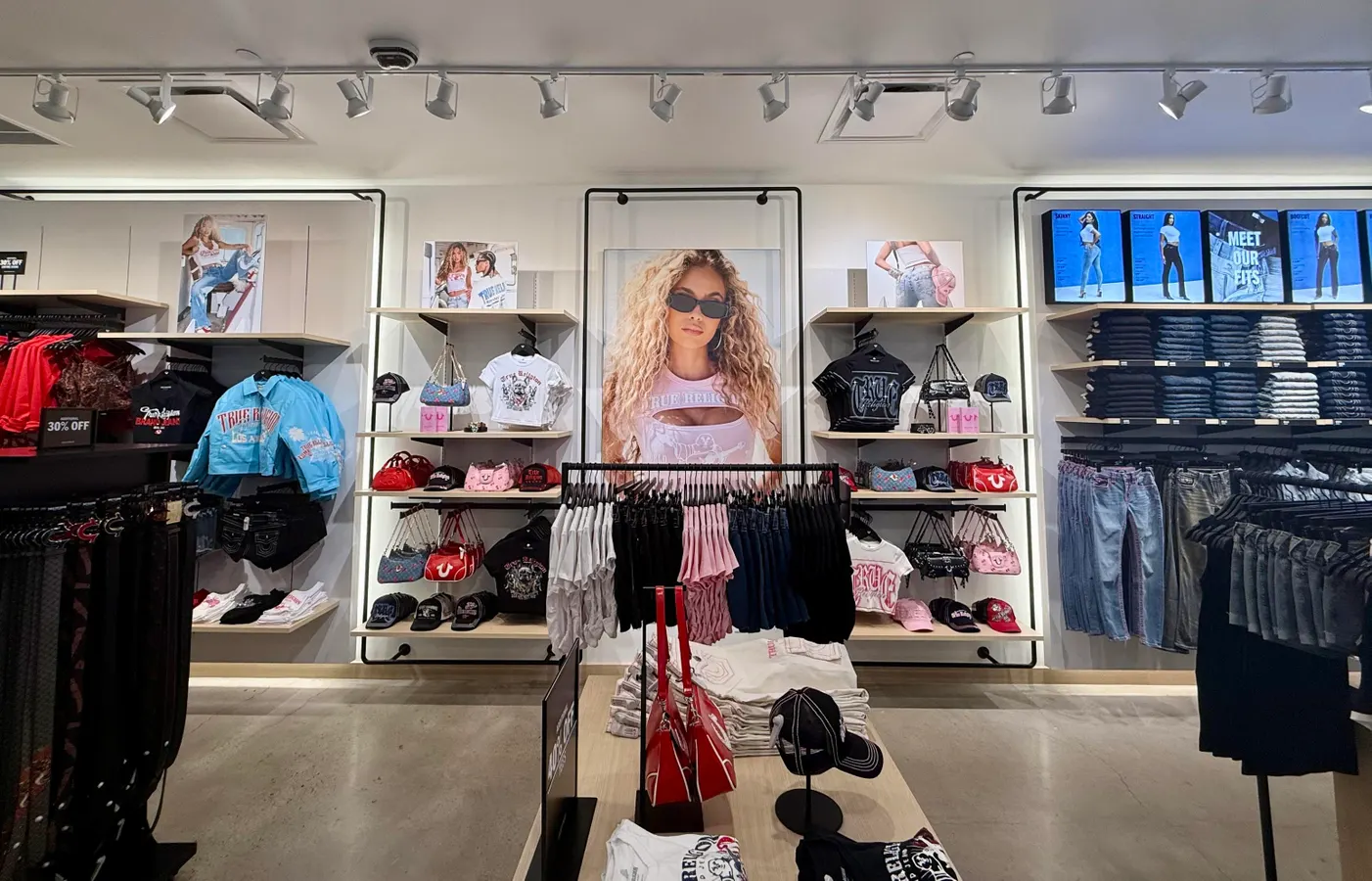

True Religion’s Boston store interior
Courtesy of True Religion
Fashion is a graveyard of flash-in-the-pan brands. It is littered with labels that burned bright for a season only to quickly fizzle out. Some go out of business entirely, like Wet Seal, Delia’s and Gadzooks. Others survive as ghosts of their former selves, hanging on under asset-light licensing models, like BCBG Max Azria, The Limited, Forever 21 and Aéropostale.
Very few come back from a near-death experience— and almost none return stronger than before. True Religion is one of the rare exceptions: a fashion brand that refused to die. Over its 24-year lifespan, it has survived two bankruptcies, multiple owners, shifting consumer tastes and a generational reset.
True Religion started as a brand that defined early-2000s premium women’s denim—$200+ price point with distinctive horseshoe stitching on the back pockets, an aspirational Buddha logo and an impressive celebrity following. After revenues peaked at $467 million in 2012, it slipped into retail purgatory, only to be revived in 2020 with a new identity: as an affordable streetwear label riding Gen Z’s nostalgia wave and winning over young urban men.
Now fully resurrected, True Religion reached $470 million in sales last year, growing over 20% year-over-year, and will expand its footprint with six new stores this year to bring its total to 61 by year’s end. The company has its sights on $1 billion in sales and 150 stores in the near future.
“My mission is to take it from this year in 2026, when we’ll do between $520 million and $550 million in revenue and be super profitable, to a billion dollars in five years,” shared CEO Michael Buckley. “To do it, we had to totally transform the company from the ground up.”
Cultural Shift
True Religion was founded in 2022 by entrepreneur Jeffrey Lubell and designer Kym Gold. It embodied California cool with a new-age vibe rendered by its smiling Buddha logo.
According to the company website, the brand name represents “authenticity, individuality, and staying true to your personal style,” and reflects a core belief that denim jeans are universal transcending “boundaries of faith, class, ethnicity, and orientation.”
The brand rode the premium denim wave through 2012 and started trading on NASDAQ in 2005. Not long after, Buckley did his first tour of duty as company president through 2010—during his tenure, revenues grew from $100 million to over $300 million.
Then in 2011, he became CEO of luxury men’s fashion brand Robert Graham Designs, which merged with Joe’s Jeans and Hudson Jeans in 2016 to become Differential Brand Group with Buckley as CEO.
In the meantime, True Religion was taken private in a 2013 acquisition valued at $824 million by TowerBrook Capital Partners, followed by a 2017 bankruptcy and sale to Global Brands Group, an investment holding company that specialized in fashion brands.
In late 2019, with True Religion slipping into irrelevance, the company called him back and he returned as CEO. Buckley’s mandate was clear: cut costs and zone in on the customers it actually had, not the ones it used to serve. A subsequent restructuring following in 2020 and the closing of more than half of the company’s 150 stores.
To set the company’s direction, Buckley immediately undertook consumer research. The findings revealed a dramatic shift: nearly half of True Religion customers were African American and Latino, with moderate household incomes—a demographic he estimates encompasses about 110 million customers and some $100 billion TAM.
“It’s a much more moderate customer than our original customer in the $250,000+ range who’d pay $250 for our jeans,” he continued. “That group at the top two-to-three percent represents only a couple million people and $1 billion in volume potential.”
Rather than chase the premium-denim elite, Buckley zeroed in on the broader customer base that was embracing the brand. But he didn’t break ties with the high-end retailers that first supported the brand, like Nordstrom, Neiman Marcus, Saks and Bloomingdale’s—wholesale remains an important distribution channel bringing in just under 40% of sales.
Instead, he expanded the product line across t-shirts, hoodies, joggers and jackets for men and women, while knocking some jeans prices down to the $100 range and keeping select premium styles at higher price points to preserve the brand’s allure.
“People have described us as the ‘Ralph Lauren’ for the urban casual customer,” he observed. “The True Religion horseshoe means status in much the same way as the Ralph Lauren pony does. Our customers want the horseshoe on everything.”
Today, sportswear and accessories account for about 60% of revenues, with jeans making up the remaining 40%. Sales are equally divided between men’s and women’s, but Buckley’s goal is to get women’s back to 60%—“where it should be,” he said, adding that upon his return in 2019, women’s was only 30% of the mix.
True Religion 2.0
Having gotten the company’s finances in order—adjusted EBITDA was $124 million on $470 million in sales with gross margin at about 70% last year—True Religion has entered its next growth phase. It now has backing from heavyweight partners ACON Investments and SB360 Capital Partners, which acquired the company in January 2025. SB360 is chaired by Jay Schottenstein, also CEO of American Eagle Outfitters, a retailer with deep roots in denim jeans and a track record of navigating generational shifts.
“True Religion has built a unique and powerful brand with a loyal customer base and a deep connection to its core values of authenticity, quality and self-expression,” said Suma Kulkarni, managing partner of ACON, in a statement.
SB360 president Aaron Miller added, “We seek out brands with a strong core identity and a passion for leading a market segment. The growth since 2020 is unprecedented. Our investment reflects our belief in the Company’s growth potential and continued innovation in the fashion industry.”
This year’s priorities are to keep the brand’s edge among its core customers. “We’re going after Gen Z and younger millennials,” Buckley shared. “To get that younger customer, you’ve got to have the right celebrities and influencers pushing us across that audience.” He added that about 10% of company revenues are invested in marketing.
The strategy is working. Numerous pop stars, hip-hop artists and influencers have embraced the brand, including Megan Thee Stallion, GloRilla, Key Glock, Flo Milli, NLE Choppa and Zara Larsson. Notably, Kylie Jenner and Alix Earle are fans, with Glamour declaring “True Religion Jeans Are So Back, Baby.”
New Stores Reach Next-Gen Customers
Store expansion is also in the playbook. More than 60% of revenues are generated direct-to-consumer, and the current fleet of over 50 established retail stores is “highly profitable,” generating an average 45% four-wall EBITDA margins.
Following an opening in Orlando last month, True Religion just landed in Boston’s South Shore Plaza. And further openings are planned this year in Indianapolis, Sacramento, Tampa-adjacent Brandon, FL, and Cherry Hill, NJ, a close-by Philadelphia suburb across the Delaware River.
“We’re going into centers that attract our target demographic in modest-sized stores with rents that make sense,” he said, noting that each store generates $1.5 million to $3 million in volume.
To manage retail expansion from 61 this year to 150 stores over the next five years, True Religion has hired Kristen Jones as vice president of retail. She joins from Sketchers where she managed over 300 stores and brings three decades of retail experience with Target, Ross Stores and Levi’s.
“True Religion is in a stage of growth with lots of whitespace opportunity ahead,” Jones said in a statement.
True Religion has already proven it can turn whitespace into growth. The next test is filling it with fashion the next-generation customers crave.
See Also:











Leave a comment