


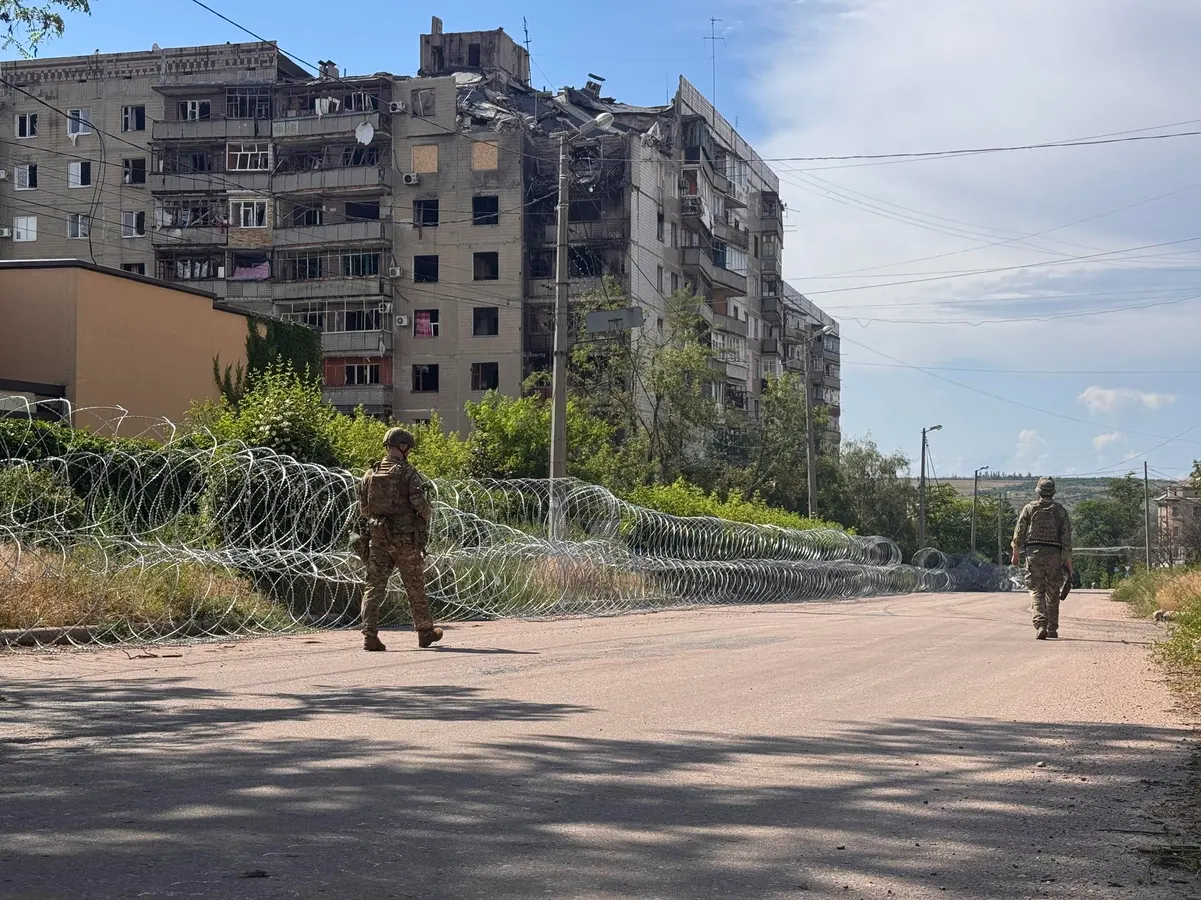

DRUZHKIVKA, UKRAINE – JUNE 13: Ukrainian soldiers walk a road along a barbed wire defensive barrier in front of an apartment building partially destroyed by shelling on June 13, 2026 in Druzhkivka, Ukraine. (Photo by Alex Nikitenko/Global Images Ukraine via Getty Images)
Global Images Ukraine via Getty Images
While drones and other advanced technologies have shaped the Russia-Ukraine battlefield, warfare remains fundamentally a human endeavor. Territory is ultimately seized and held by soldiers on the ground. Russia’s current offensive therefore requires its troops to advance through the increasingly lethal Ukrainian defenses. However, over the course of the war, Russia’s ability to conduct successful ground assaults has steadily declined. Recent reports indicate that the Russian military has struggled to sustain its advances and, in some areas, has ceded ground to Ukrainian counterattacks.
In response, Russian forces have experimented with a variety of assault tactics in an effort to regain momentum. In particular, over the past few months, they have tried both small-unit infiltrations and limited mechanized assaults. The former seeks to avoid detection by dispersing soldiers into small teams, while the latter relies on speed, mass, and armored protection to push troops through Ukrainian defenses. Despite these adjustments, the results have been largely the same. Russian forces are detected during their approach, disrupted by Ukrainian drones, and prevented from achieving meaningful gains.
The Russian Military Attempts Infiltrations With Two-Person Teams
Ukrainian drones have forced the Russian military to move away from the large-scale, massed armored assaults common in Soviet doctrine. Instead, Russian forces are now relying on small-unit infiltrations conducted by dismounted troops or using light commercial vehicles such as motorcycles and ATVs. The size of these groups has gradually decreased over the past year. Initially, these infiltration units were platoon-sized, but the larger formations were readily detected by Ukrainian drones. As a result, Russian forces shifted to squad-sized units and then to fire teams. Russian forces now appear to be conducting these infiltrations in two-person teams, with several teams moving forward simultaneously in the expectation that at least some will get through.
Image captured from a video posted on Telegram by the Russian Ministry of Defense on June 21, 2026. The video shows assault detachments of the 27th Separate Guards Motorised Rifle Brigade performing training exercises on 2-soldier infiltration tactics.
Social Media Capture
A recent video released by the Ukrainian “Wolfhound” unit of the 57th Separate Motorized Infantry Brigade shows that Russian forces are struggling to conduct infiltrations even with two-person teams. The video shows a Russian motorized rifle platoon broken into two-person teams attempting an infiltration in the Vovchansk direction. The soldiers move cautiously, using woods and buildings for cover and concealment. Wolfhound drone operators detected the teams as they carried out the mission. Some of the soldiers attempted to run, some sought shelter inside buildings, and others tried to shoot down the drones. Despite these efforts, the Ukrainian drones succeeded in killing or wounding 26 Russian soldiers.
Even when Russian forces are successful, these infiltration tactics achieve only temporary gains. If a Russian team establishes a forward position, it requires a constant flow of drones, food, water, and ammunition. These resupply missions are frequently targeted by Ukrainian drones, gradually weakening the position. Over time, these positions are either abandoned or degraded to the point that they can be easily cleared by Ukrainian forces. In May 2026, Ukrainian forces launched a counteroffensive that cleared approximately 250 square kilometers of territory held by these small Russian infiltration teams.
The Russian Military Attempts Hybrid Mechanized Assaults
With infiltration tactics generally failing, Russia has recently attempted to return to limited massed assaults. Similar to the tactics on which Russian forces have traditionally trained, these attacks rely on speed and momentum supported by artillery and drones. Although the assault force often suffers significant losses, the larger number of soldiers involved can allow some troops to penetrate Ukrainian defenses. Additionally, the use of armored and unarmored vehicles provides greater mobility and protection than small infiltration teams.
A recent video released by the Ukrainian APACHI Unmanned Systems Battalion shows a Russian hybrid mechanized assault in the Sloviansk direction. The Russian assault force consisted of approximately 50 soldiers mounted on 28 motorcycles, supported by a tank, three infantry fighting vehicles, and five additional vehicles. The assault was divided into two groups, both advancing rapidly along roads in an attempt to minimize their exposure time. However, Ukrainian drones detected the assault force, and within minutes a large number of strike drones appeared overhead. The Russian soldiers on the motorcycles dismounted and ran into the dense woods for cover as drones destroyed their vehicles. Meanwhile, the larger vehicles attempted to continue advancing along the roads, but repeated drone strikes eventually disabled them. According to the Ukrainian unit, the entire assault was destroyed before it could even pass the Russian front lines.
Image captured from a video posted on Telegram by the Russian Ministry of Defense on June 12, 2026. The video shows assault detachments of the Sever Group training on supporting mechanized movements with motorcycles.
Social Media Capture
Russia has attempted similar hybrid mechanized assaults with different combinations of armored and unarmored vehicles. This includes a Russian assault in the Kupyansk direction on May 7 that involved one armored fighting vehicle and 12 all-terrain vehicles. In March, Russian forces also launched an assault against Kostiantynivka supported by two “sewn-up” tanks. In both cases, the assaults ended very quickly after being detected and countered by Ukrainian drones.
The primary challenge with this approach is that Russian forces are largely constrained to roads, which are persistently monitored by Ukrainian reconnaissance drones. Once an assault is detected, Ukrainian forces swarm the area with strike drones that are kept on standby and ready to launch. Although the assault force may be moving quickly, Ukrainian units are often able to launch enough drones to disrupt the attack before it can make meaningful progress. While this may require a large number of drones, Ukraine does not appear to face a shortage of them.
The Russian Military Has Limited Options Given These Tactical Challenges
With both small-unit infiltrations and mechanized assaults failing, the Russian military finds itself in a precarious position. While Russian forces have historically tolerated high casualties in exchange for operational gains, they are increasingly unable to capture and secure new ground. Heavy losses without forward progress create an inherent challenge for any military conducting offensive operations.
Given this situation, Russia appears to be shifting into a more defensive posture. Russian forces are fortifying their current lines with obstacle belts and logistics corridors while implementing counter-drone measures to protect rear positions from Ukrainian drone attacks. In effect, these efforts are buying time until battlefield dynamics change in a way that supports renewed offensive operations. Such a change would most likely come from the introduction of a new technology that limits the effectiveness of Ukrainian drones or from a broader shift in Russian strategy.
Images posted on social media by the Russian Ministry of Defense announcing the capture of Yurkovka on June 19, 2026 and Rai-Aleksandrovka on June 18, 2026.
Social Media Capture
These battlefield challenges also create pressure on the Russian military to demonstrate progress, even when territorial gains are limited. As a result, the Russian military appears to be relying on information operations, claiming to have captured Ukrainian towns despite evidence indicating otherwise. While most infiltration attempts fail, a small number of soldiers are often able to establish temporary footholds. Although these forces lack the mass necessary to hold their positions, the Russian military claims to have “liberated” the town. These announcements are often accompanied by drone footage of a single soldier raising a Russian flag. Between June 17 and June 20, the Russian MoD’s Telegram channel reported that its forces had gained control of Yurkivka, Novyi Donbas, Rai-Oleksandrivka, Kutuzivka, and large portions of Kostiantynivka. However, the Institute for the Study of War and similar military analysis groups have found little evidence that Russian forces actually control these settlements.
The Russian military has repeatedly adapted its assault tactics in an effort to restore offensive momentum. It has shifted from platoon-sized assaults to two-person infiltration teams and from small infiltrations to hybrid mechanized assaults. Each approach was successfully countered by Ukrainian drones, which detected and disrupted the Russian assaults before they could achieve meaningful gains. Until Russia finds a way to move troops through Ukraine’s drone-supported defenses, it is likely to remain trapped between costly assaults that fail to produce results and a defensive posture that sacrifices the initiative.















Leave a comment