


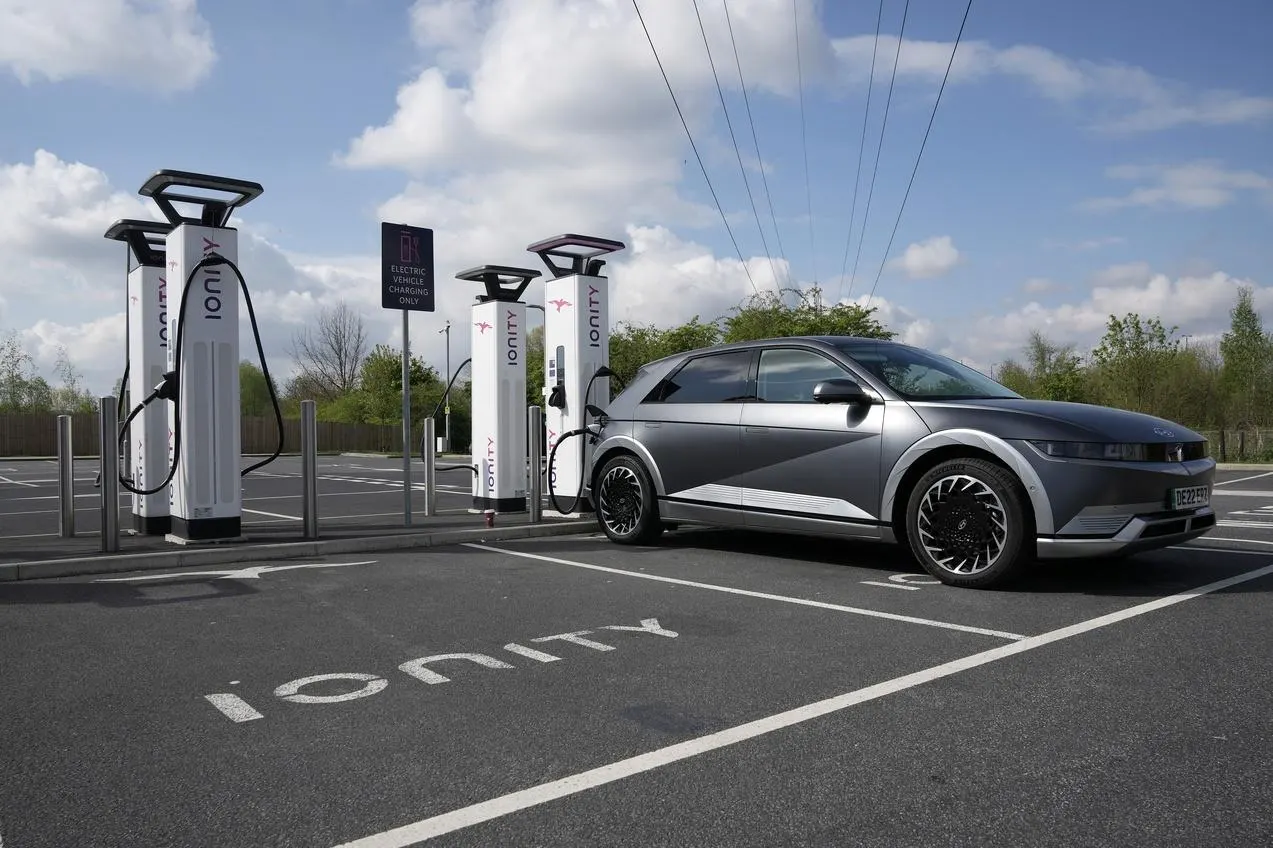

EV Charging Station
Getty Images
Cars and electricity underpin modern life. As cars migrate to electric, these century-old industries are colliding, bringing their infrastructure together in unprecedented ways. Electric vehicles accounted for nearly a quarter of all new cars sold worldwide in 2025. Who leads the growing migration will develop the advanced software-driven grid infrastructure needed to power economies in the next century.
The U.S. once defined the auto industry, now it’s losing ground to China. BYD outsold Tesla globally in pure electric vehicles for the first time in 2025, 2.26 million to 1.64 million. Those cars will now be sold closer to home as Canada this year opened its market to the Chinese EVs the U.S. blocked.
EV Infrastructure is Grid Infrastructure
The International Energy Agency forecasts global EV sales will reach 23 million in 2026. This approaches the 30% S-curve inflection point that signals inevitable technology adoption. European new EV sales climbed to 28% in 2025, with China nearing 55% and Norway soaring to roughly 96%. Meanwhile, U.S. EV sales dropped slightly to just under 10% of new vehicles in the same year.
Significant adoption of EVs naturally catalyzes investment in the intelligent grid infrastructure needed to orchestrate distributed grid assets like electric vehicles. Modernizing the grid to accommodate electrified transportation ultimately creates a more sophisticated and resilient infrastructure.
The Real Reasons America Fell Behind
While culture shapes EV adoption in the U.S., to a certain extent, three primary factors impede EV adoption in the U.S:
Charging Up
Range anxiety stems from a charging network far less ubiquitous than gas pumps. As comparison, roughly 4.86 million public chargers are deployed across China compared with America’s 249,000.
Charging has historically taken three to four times as long as fueling cars. China is closing the charging gap fastest. BYD has deployed more than 6,600 of its 1,500-kilowatt Flash Charging stations across 321 Chinese cities, capable of taking a battery from 10% to 97% in nine minutes, comparable to a gas-station stop.
Market instability has already forced retreats from charging infrastructure providers in the U.S. Tritium, the Australian DC fast-charger manufacturer with a major U.S. footprint, filed for bankruptcy in 2024. Enel X Way, which had pledged to add 10,000 DC fast chargers across North America by 2030, abruptly shut down its entire U.S. and Canada charging business in October 2025. These exits signal that building out charging infrastructure remains dependent on a business climate stable enough to attract sustained investment.
The Affordability Wall
In the U.S., the average new EV costs thousands more than the average gas-powered vehicle. That gap isn’t as stark elsewhere. BYD’s Seagull starts around $10,000 in China and roughly $21,000 (€19,990) in Europe, where it’s sold as the Dolphin Surf.
U.S., Japanese and European carmakers have struggled to close the gap, particularly since the $7,500 federal new-EV tax credit in the U.S. expired on September 30, 2025. Tariffs continue to keep cheaper Chinese EVs out of the U.S. market entirely. However, Canada reversed directions on its tariff on Chinese EVs in early 2026.
Gas cars’ cost advantage shrinks as fuel prices rise. Pricing spikes and volatile, forces consumers to rethink gas car economics when comparing EVs even where incentives are not available.
Shifting Sands
It is not the presence or absence of any single policy, but the lack of stable policy planning, that emerges as a primary barrier.
Like any industry, an uncertain policy landscape poses challenges for businesses to scale and keeps investment on the sidelines. Legacy automakers typically commit to a single vehicle platform for seven to ten years, and are not conditioned to respond to EV incentives that shift every few years.
For example, CAFE standards first set fuel economy targets for automakers in 1975. This gave them a fixed target to invest against regardless of which party held power, through multiple recessions and oil shocks. Congress eliminated CAFE’s civil penalty on July 4, 2025, ending the program’s 50-year enforcement history.
The Canadian Shift
Norway and China show two different paths to EV dominance. Norway built its lead over two decades of consistent incentives and charging infrastructure. China built its lead through industrial policy and manufacturing subsidies that created a vertically integrated, lower-cost supply chain.
Canada is now taking a new path as it decouples its strategy from the U.S. Its government replaced a 100% tariff on Chinese-made EVs with a 6.1% tariff on up to 49,000 vehicles a year, with import permits opening in March 2026. Canadian officials have said the quota is structured to draw Chinese automakers into local joint ventures and manufacturing investment over time.
China-made EVs priced near $20,000 are now crossing into Canada, a market American automakers have long treated as an extension of their own. Charging infrastructure, vehicle cost, and policy whiplash keep EVs from reaching higher adoption levels in the U.S. Each year these barriers remain unaddressed, the U.S. falls further behind in developing the insights and advancements needed to pair electrified software-based transportation with distributed energy grid infrastructure. Meanwhile, EV-forward countries across the globe are already building the infrastructure backbone of modern economies.















Leave a comment