


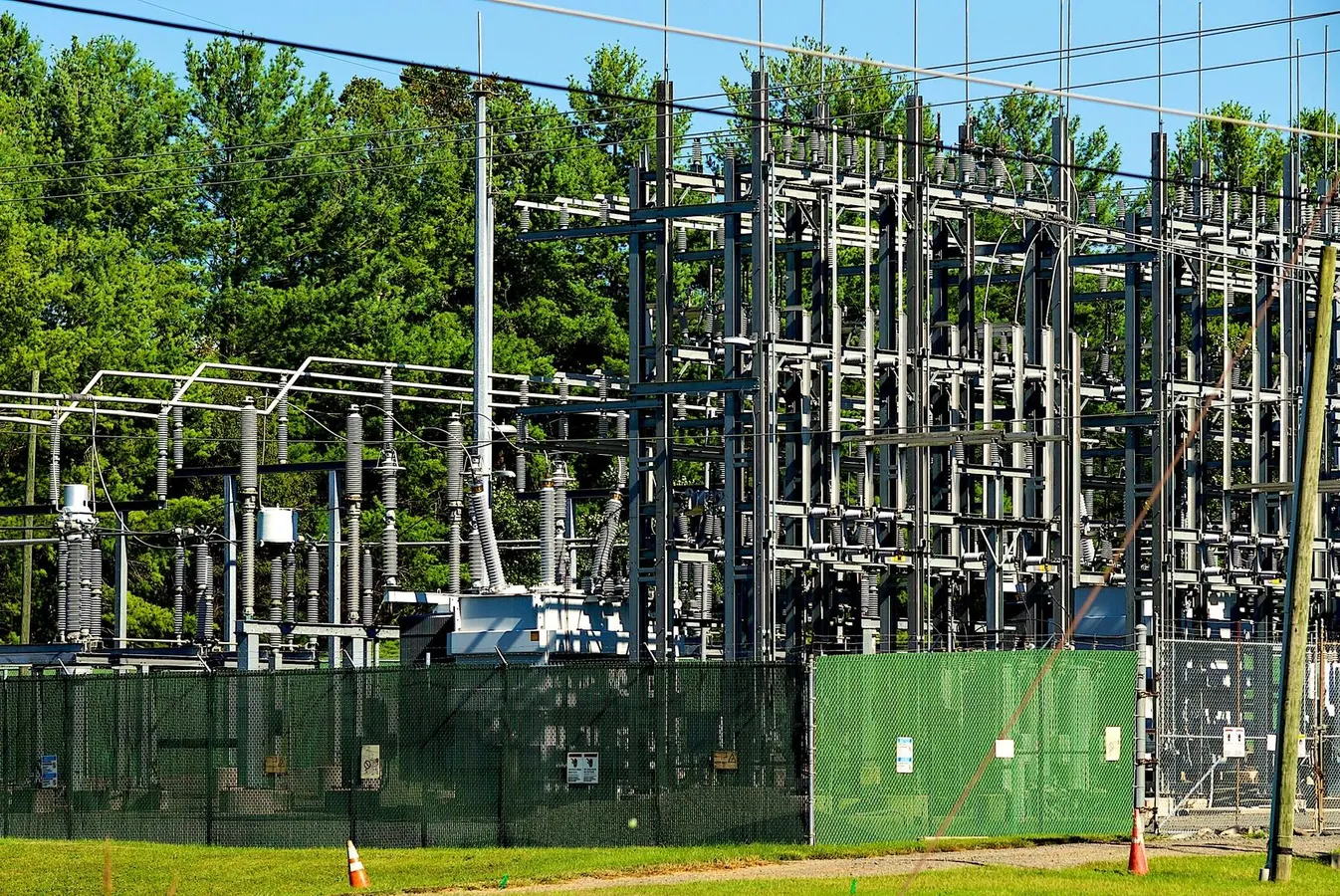

Chantilly, Virginia, USA – September 21, 2022: An electric power transfer station sits alongside a rural road in western Fairfax County on a bright afternoon.
getty
America’s electricity is undeniably in a state of rapid evolution. Demand is growing, capital is moving, and independent power producers (IPPs) are responding to supply signals which competitive power markets are designed to encourage. Much of the recent public discussion related to the grid has centered on the need to build more generating capacity quickly, a pressing and persistent need. But, as investment accelerates and interconnection and permitting queues grow ever longer, the conversation must shift to whether the rest of the system is prepared to support the added power generation as it comes online.
Power Generation, Transmission, Delivery Must Expand Apace
Building generation and delivering electricity are equal parts of the electricity delivery equation. Generation expansion can move quickly, but unless transmission and distribution can move just as quickly, they become bottlenecks to accessing more power. It is vitally important for all elements of this complementary relationship to advance in concert.
These competing priorities continue to collide within the PJM regional grid, which covers a vast swath of the Eastern seaboard from North Carolina through Pennsylvania, extending westward all the way into Illinois. Plenty of evidence exists showing that IPPs within the market have been responding to the signals to build for some time now. At the end of April, more than 800 generation projects in PJM had applied to connect to the grid, representing more than 220 gigawatts of proposed capacity. To be clear, not all of these projects will advance to completion, but the scale of requests points to something important: Developers and investors see opportunity and are acting on it.
Beyond new facilities, IPPs are increasingly seeking to expand capacity of their existing fleets of power plants, which can bring additional megawatts online on shorter timelines and maximize existing power plant footprint. These projects rarely attract the same attention as new power plant development, but they demonstrate one of the strengths of competitive power markets. When conditions change, investment follows and companies move quickly to bring supply online.
Though some in the public utility sector argue for the need to reinstitute regulated monopolies into these grids – as I detailed here in February – the argument that competitive power markets are standing still becomes untenable when new supply continues developing and investment continues flowing toward more generation capacity. The key question then becomes whether the grid will be ready to transport the power where it needs to go.
Permitting, Litigation Cause Chronic Delays
Transmission and distribution infrastructure does not appear overnight. Grid equipment demand has surged in recent years and lead times for critical components have stretched. Long delays due to permitting bureaucracies at all levels of government and interminable litigation plague the sector despite efforts at reform. Costs have increased as well and, in many cases, outpaced inflation.
Over the past two decades, transmission and distribution costs have increased in real, inflation-adjusted terms while expenditures on generation have declined, according to the Lawrence Berkeley National Lab. At the same time, the utility industry points to roughly $1.4 trillion invested in grid upgrades over the past decade and projects $1.1 trillion in grid investments through 2029.
Customers should reasonably ask what they have to show for that investment. Yet as these pressures build, executives at utilities like Exelon continue emphasizing concerns around generation supply while also pushing for a larger role in generation through guaranteed returns.
“But if we want to meaningfully lower energy bills across the country,” Exelon President and CEO Calvin Butler writes in a guest op/ed at Fox News, “we don’t need a less capable grid; we need to start with a simple, commonsense solution: produce more electricity and do it faster.”
And therein lies the central question: If IPPs in competitive power markets are ready to bring the needed supply, Butler’s commentary seems beside the point. Pushing the simplistic notion of needing more supply – urgent as it undoubtedly is – starts looking a lot more like misdirection unless accompanied by an admission that delays in the building of transmission and distribution systems have become major bottlenecks in PJM and America’s other regional grids.
Competition Delivers Value Across Regional Grids
Like it or not, the era of regulated generation dominated by public utilities is largely a thing of the past. Arguing now for a return to a more bureaucratic, less competitive system seems a quixotic pursuit. If grids remain constrained, equipment shortages persist, and concerns about readiness continue growing, it becomes painfully hard to argue that less competition is the solution. Instead, the public would be better served if utilities focused on demonstrating how future spending in their own sector will produce better outcomes.
The willingness and ability to do that becomes even more important as data center development accelerates and utilities increasingly emphasize the need to shield customers from rising costs. Protecting customers starts with managing infrastructure efficiently and delivering the investments already underway. It should not become an argument for weakening the competitive structures that continue to drive investment toward new power supply.
U.S. history clearly demonstrates that competition rewards efficiency, attracts capital, and delivers measurable value to consumers. PJM alone produces roughly $5 billion in annual savings because market participants compete to provide electricity at lower cost. But allowing utilities to reenter generation while earning guaranteed returns inside competitive markets is unlikely to become an effective approach. It risks creating the worst of both systems: less competition, weaker cost discipline, and greater exposure for customers.
The challenge facing the power sector is becoming less about whether generation will be built and more about whether utilities can deliver that power efficiently, affordably, and at the speed required. This is true not just in PJM, but in regional grids throughout the country. Investment is flooding into power generation. Now utilities should show they can deliver.















Leave a comment