


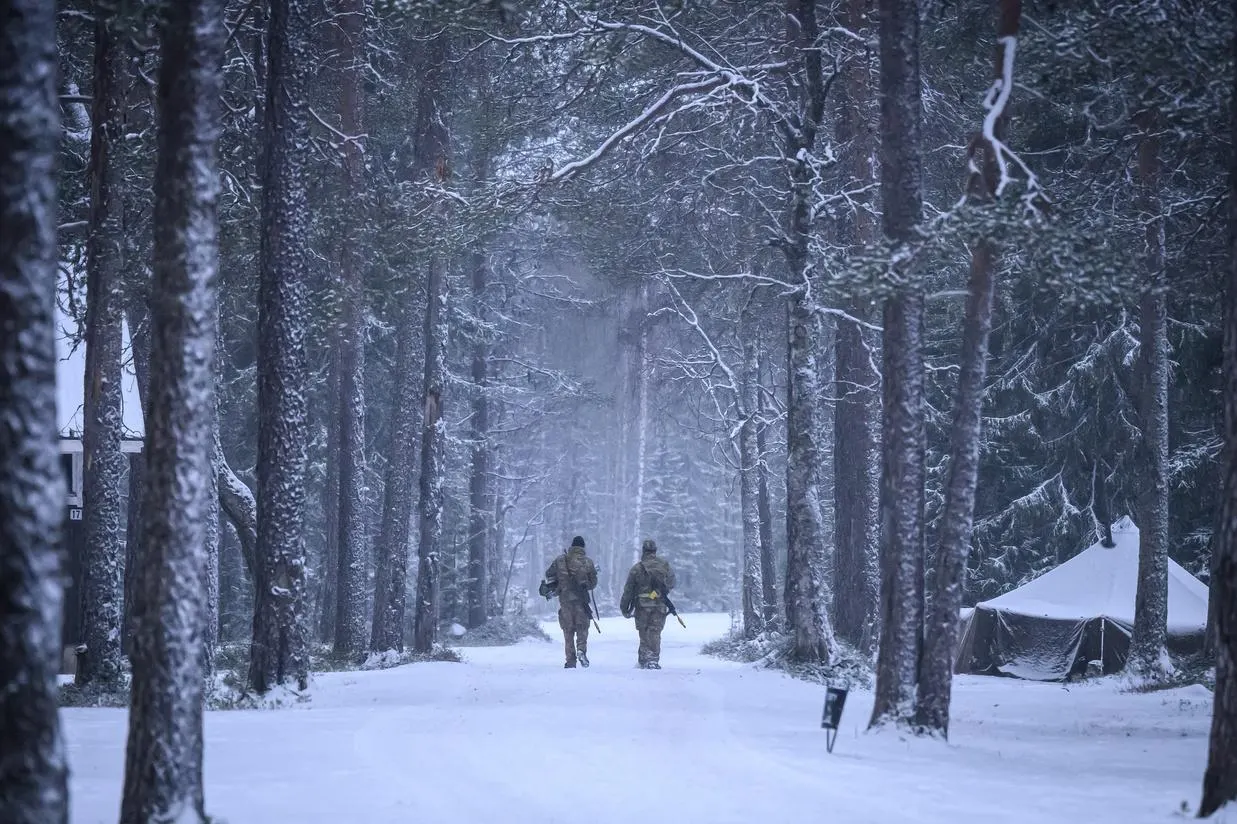

HEINUJARVI, FINLAND – NOVEMBER 19: Soldiers walk through the camp, as members of the Finnish arctic expert Jaeger Brigade train British, Swiss and french troops in cold-weather logistics on November 19, 2024 near Heinujarvi, Finland. The exercises include service members from 28 Allied and partner nations, and are taking place between November 4-24, across locations in Finland, Estonia, Germany, Poland, and Romania. (Photo by Leon Neal/Getty Images)
Getty Images
When we think about national defense, we tend to picture soldiers, military hardware and intelligence operations, not supermarkets. Yet as recent events have demonstrated, a nation’s resilience depends just as much on its ability to keep food on shelves, payments flowing and supply chains functioning during crises. In Finland, this reality is embedded in the country’s Comprehensive Security model, which treats businesses, retailers and logistics networks as part of the infrastructure that underpins national resilience.
Finland’s preparedness model extends beyond government planning and into the retail sector itself. Supply chain authorities work closely with supermarket chains, wholesalers, and logistics providers through initiatives like the National Emergency Supply Agency’s (NESA) TOIMIVA project, creating a Resilient Retail Network of stores equipped to operate around the clock with prioritized supplies and independent offline payment systems.
These public-private partnerships help maintain continuity during disruptions by coordinating contingency plans, securing alternative transportation routes, and accelerating recovery when supply chains are stressed. Consumer preparedness is reinforced through the retail marketplace as well. Specialized e-commerce providers have emerged to simplify household readiness, offering curated emergency supply packages that align with national preparedness recommendations. Some specialty retailers provide ready-to-purchase kits featuring locally sourced essentials, making it easier for consumers to meet the recommended three-day self-sufficiency standard.
From Preparedness Planning to AI-Powered Resilience
As artificial intelligence becomes increasingly responsible for forecasting demand, managing inventory and coordinating complex supply chains, the role of retail within that resilience framework is becoming even more significant. The question is no longer whether retail is critical infrastructure, but how AI can help make it more resilient when the unexpected happens.
“AI has become the coordination layer for modern supply chains, forecasting demand, managing inventory, and optimizing logistics. But these systems are trained for normal conditions. When conditions look nothing like the past, for example due to an infrastructure failure or cyberattack, purely automated systems can struggle to adapt. Finland’s preparedness model understands this instinctively. The question for retailers, and critical infrastructure more broadly, is whether they are building mature systems where AI efficiency is backed by robust human strategic judgment when unprecedented crises hit,” says Peter Sarlin, the founder of PostScriptum and co-founder of Silo AI.
In practice, this tension between automation and human oversight is central to Finland’s approach to national resilience. Finland’s preparedness model is widely understood to combine advanced digital capabilities, including AI tools, with structured human decision-making in times of disruption. Indeed, retail and commercial supply chains are explicitly embedded within this broader resilience framework.
Retail in Finland’s Preparedness System
Finland’s emergency preparedness model recognizes that modern societies depend not only on government services but also on private-sector networks. Through NESA, retailers, wholesalers, logistics providers, and producers are integrated into national contingency planning. The objective is not simply to store reserves but to preserve the functioning of everyday systems – especially food retail – so that citizens can continue accessing essential goods even during major disruptions. This makes retail a key component of Finland’s critical infrastructure and national resilience strategy.
In April, NESA released a report which explored how a military crisis could disrupt everyday economic life. The report emphasizes that supply security is not created by government stockpiles alone. It is built through cooperation between public authorities and private companies, with businesses expected to maintain preparedness and continuity plans of their own. As disruptions become more severe and prolonged, responsibility shifts from individual firms managing their own risks to coordinated action between industry and government, and ultimately to exceptional state measures to preserve essential services.
For retail, the implication is clear: supermarkets and their supply chains are not merely commercial enterprises but operational infrastructure for society during crises. The ability to keep stores supplied, payments functioning, and goods moving may be as important to national resilience as more traditional forms of critical infrastructure.
Indeed, modern supply chains have become highly efficient through consolidation, automation, and just-in-time logistics. However, this efficiency often creates single points of failure in critical facilities, systems, or suppliers whose disruption can cascade across entire networks. In food retail, distribution centers, logistics hubs, digital ordering systems, and major transport routes can all represent vulnerabilities. When these nodes fail, shortages may emerge not because goods are unavailable, but because the systems that move them have been disrupted. To address this “we should put even more emphasis on local production and supply,” says Teemu Seppälä, Technology and Innovation Director at Defence Innovation Network Finland.
The lesson from Finland is that resilience is not the opposite of efficiency, it is what makes efficiency sustainable under pressure. As AI becomes the operating system for modern supply chains, retailers will gain unprecedented visibility, forecasting capabilities and operational agility. But technology alone cannot eliminate risk. In fact, greater digitalization can create new vulnerabilities if organizations become overly dependent on automated systems or concentrated networks.
The retailers that thrive in the coming decade will not simply be those with the most advanced AI. They will be those that combine intelligent automation with strategic human judgment, diversified supply networks and robust contingency planning. In an era defined by geopolitical uncertainty, cyber threats and climate disruption, keeping stores stocked may prove as essential to national resilience as protecting borders. Retail is no longer just commerce, it is critical infrastructure.













Leave a comment