


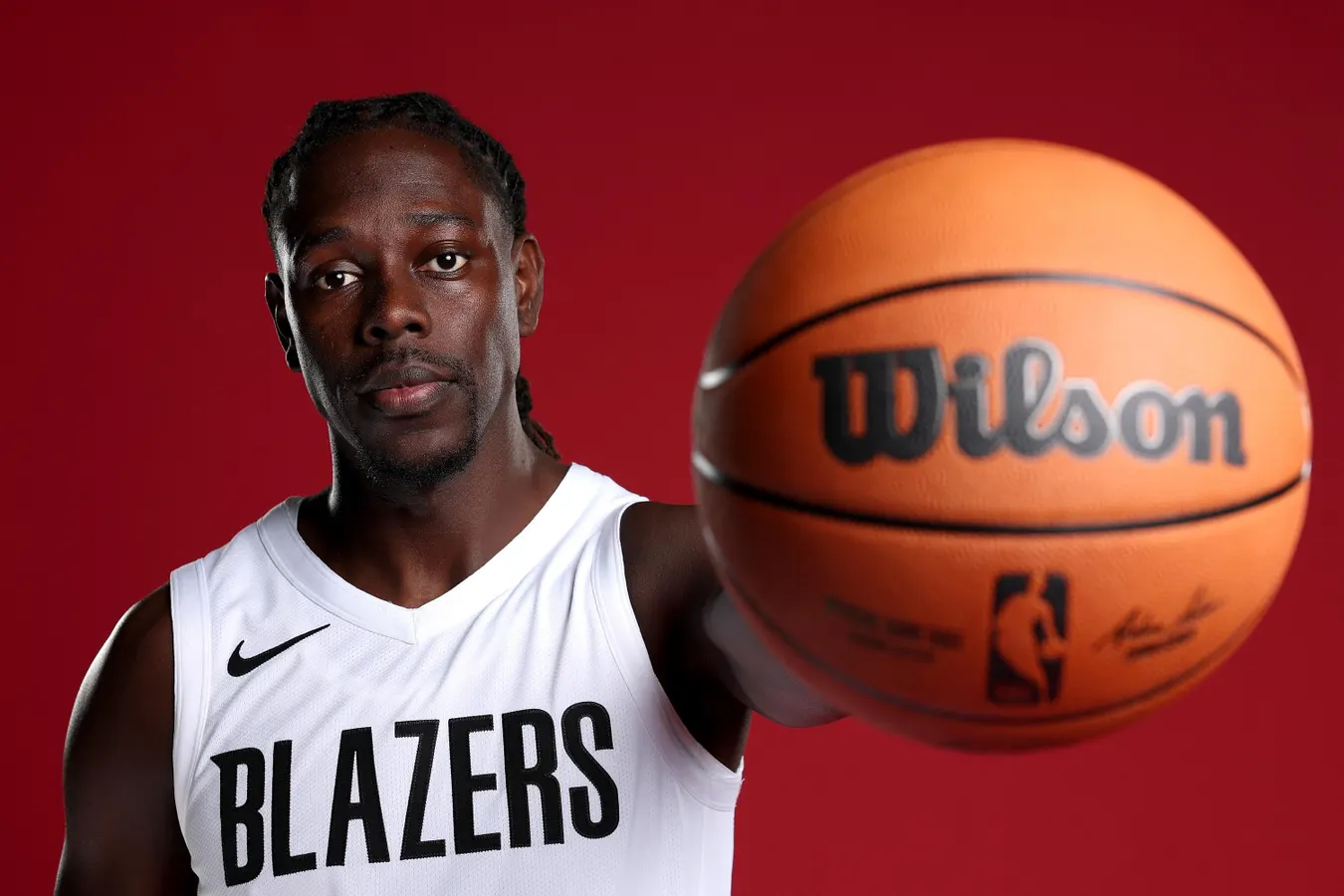

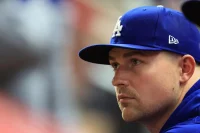
PORTLAND, OREGON – SEPTEMBER 29: Jrue Holiday #5 of the Portland Trail Blazers poses for a portrait during media day at Moda Center on September 29, 2025 in Portland, Oregon. NOTE TO USER: User expressly acknowledges and agrees that, by downloading and or using this photograph, User is consenting to the terms and conditions of the Getty Images License Agreement. (Photo by Steph Chambers/Getty Images)
Getty Images
As he evaluated who would represent him, Jrue Holiday could have prioritized a sports agency that conducted an elaborate sales pitch.
One that promised a lucrative contract regardless of whether Holiday matched his All-Star potential. One that promised hefty endorsements regardless of his marketability. Instead, Jason Glushon convinced Holiday to join his new independent sports agency in 2016 by avoiding any self-promotion or salesmanship.
“He was completely upfront and honest with me,” said Holiday, who currently plays with the Portland Trail Blazers. “He’s never ‘BSed me, not once. I think especially when you get in a field that I’m in, you can tell when people are trying to ‘BS you or when they’re being completely honest. From the beginning, he’s always done that.”
Nearly 10 years after leaving Wasserman to start his own firm at Glushon Sports Management, Glushon has signed 17 NBA players. That includes notable NBA All-Stars (Jaylen Brown, Norman Powell, Holiday), established veterans (Al Horford, Marcus Smart, Jeff Green), rising stars (Franz Wagner) and respected role players (Duncan Robinson, Landry Shamet, Moe Wagner).
Glushon conceded he lacks a “perfect answer” to explain how his independent sports agency has thrived in a competitive landscape. Glushon credited a former mentor (former longtime agent and current Detroit Pistons vice chairman Arn Tellem). He had extensive experience at Wasserman as an intern (2006-2009) and as an agent (2009-16). He praised his company’s head of sales and marketing (David Braun) and agent (Ryan Leff) for ensuring enough bandwidth to support their clients and families. But Holiday and Robinson validated Glushon’s belief that candor and substance have also become increasingly valuable amid a fluid industry.
“It’s about being honest and fighting for our players and their families,” Glushon said. “You can’t promise hundreds of millions of dollars. You can’t promise they’ll get traded to the right team. But you can promise preparation and being proactive to do your best. We have had some good partnerships and good successes.”
So has Todd Ramasar with Life Sports Agency. So have Mike Miller and Donnie McGrath with LIFT Sports Management. Through different circumstances, those agencies have also made inroads in an industry that higher profile sports agencies have often dominated, including CAA, Wasserman, Excel and Klutch Sports.
After forming their agency in 2020, McGrath (former player at Providence) and Miller (17-year former NBA player) have since secured 20 NBA players. That includes an All-Star (Paolo Banchero), this year’s No. 13 pick (Nate Ament) and the No. 20 selection (Jayden Quaintance). After working at BDA Sports Management as their Vice President of Player Representation, Ramasar formed his own agency in 2015 and currently has 15 NBA clients. That includes an All-Star (Pascal Siakam), a member of last season’s All-NBA Rookie team (Cedric Coward), key players in the 2025 NBA Finals (Oklahoma City’s Ajay Mitchell, Indiana’s Andrew Nembhard) and a respected role player (New Orleans’ Kevon Looney).
No wonder Coward watched Ramasar in admiration last month as he hosted an NBA pre-draft workout for eight of his clients at the Los Angeles Lakers’ practice facility before various front office executives and scouts. Only a year ago, Coward and his family spoke to Ramasar for three hours to consider his services. Then, Coward became increasingly interested with how Ramasar detailed his optimism about his career trajectory.
Coward was not highly recruited amid stops with Williamette (2021-2022), Eastern Washington (2022-24) and Washington State (2024-25). But as Coward remembered, Ramasar conveyed “the same belief in me that I’ve had of myself.” Ramasar often tells prospective and current clients that “honesty and transparency is a premium in this business” and that he focuses on “competency and execution.”
Shortly afterwards, the Grizzlies acquired Coward in a pre-draft trade with Portland as last year’s No. 11 pick. Coward then made the NBA’s All-Rookie First team for his positional versatility, team-oriented play and efficiency. That journey validated why Coward became intrigued with joining an independent sports agency.
“It doesn’t have to be glamorous if it works,” Coward said. “As an agency, I think we’re growing each and every other day. [Ramasar’s] putting as much into this as he puts into us. Honestly, his success story kind of reminds me of my own. We’re coming from a spot where we were doubted, but we made things happen. For me, that was the most important thing.”
Banchero apparently viewed things similarly. In only their second year, LIFT Sports Management signed Banchero shortly before the Orlando Magic selected him at No. 1 in the 2022 NBA Draft. McGrath pointed to Miller as a major reason. Miller brought instant credibility as a former NBA champion (2012, 2013), 6th Man of the Year (2006) and coach (University of Memphis assistant, Houston High school head coach). Miller also trained with Banchero personally and oversaw pre-draft workouts as he outlined his vision.
“It’s the personal attention toward him,” McGrath said of how Miller recruited Banchero. “I think [Banchero] saw he wasn’t going to be able to get that at other agencies with the stature that he had. I think that is something that is unique that we can offer.”
NEW YORK, NEW YORK – MAY 19: Pascal Siakam #43 of the Indiana Pacers celebrates after making a shot in the fourth quarter against the New York Knicks in Game Seven of the Eastern Conference Second Round Playoffs at Madison Square Garden on May 19, 2024 in New York City. NOTE TO USER: User expressly acknowledges and agrees that, by downloading and or using this photograph, User is consenting to the terms and conditions of the Getty Images License Agreement. (Photo by Elsa/Getty Images)
Getty Images
How independent sports agencies have succeeded in a competitive market
Granted, independent sports agencies experience ongoing challenges with competing against the heavyweights. They have larger staffs and more financial resources. Independent sports agencies also face the same issues that larger agencies manage, including fluid contract negotiations, unexpected trades and player departures.
Brown, one of Glushon’s key clients, has experienced uncertainty on whether the Boston Celtics will trade him this offseason. Six years after Ramasar’s marquee client became a key part of the Toronto Raptors’ lone NBA title run (2019), Siakam was traded to the Indiana Pacers amid their hopes to contend for an NBA championship and the Raptors overseeing a rebuild. Memphis Grizzlies guard Ja Morant left LIFT Sports Management in 2025 after signing with them the previous year.
“With Ja, those guys kind of wanted to do their own thing,” McGrath said. “I don’t think there was anything that we did negatively or did something wrong. We just parted ways mutually. We’re focused on building the business and trying to maximize everything we can for the clients that we have and create as much value for them as we can. I think we had some exciting things that we were working on with Ja. I wish him the best, and we’ll continue on with our business.”
After all, all three agencies have experienced more success than failure.
LIFT Sports Management have hired reputable agents with previous experience elsewhere, including Noah Croom, Kevin Bradbury, Yann Balikouzou and Milan Nikolic. That has enabled Miller and McGrath to rely on their familiarity with contract negotiations and the salary cap, while tapping into their expertise as former players. Last summer, LIFT Sports Management helped ensure Banchero to a five-year, $239 million max rookie extension through the 2030-31 season. The contract can reach as high as $287 million should Banchero make an All-NBA team or win the league’s regular-season MVP or Defensive Player of the Year award.
“When Mike Miller is advocating for a player, a GM takes it a little bit more seriously because of Mike’s playing career, Mike’s stature and Mike’s ability to know the game,” McGrath said. “The way he talks the game and the way he knows the game and teaches the game, it’s at an incredibly different level than I’ve seen from other agents and the way they talk to presidents, GMs, owners and teams.”
Following his own playing experience as a UCLA role player (1997-2000), Ramasar also worked with various agents. That included Tellem, Bill Duffy, Thad Boucher, current Lakers general manager Rob Pelinka and former Golden State Warriors general manager Bob Myers, the President of Sports for the ownership group that manages the Philadelphia 76ers (Harris Blitzer Sports & Entertainment). That prepared Ramasar to negotiate a deal in 2004 for former Warriors guard Baron Davis that included an early termination clause. That led to a $70 million contract in 2008 with the LA Clippers and an eight-figure NBA shoe endorsement deal with Li-Ning.
Nearly two decades later, Ramasar secured other lucrative contracts. Shortly after guiding the Raptors to the 2019 NBA championship as the league’s Most Improved Player, Siakam signed a four-year $129.9 million extension. In the 2024 offseason, Ramasar negotiated with the Pacers to grant max extensions to Siakam (four years, $189.5 million) and Nembhard (three years, $59 million).
“Pascal was someone that I’m proud of, not only because of his career, but he’s the lowest player ever drafted to sign a max contract extension,” Ramasar said. “At the time, people said I couldn’t do that or we couldn’t do that. Only big agencies could. But we did it.”
So did Glushon. In 2019, Brown received a four-year, $115 million extension with Boston. Four years later, Brown signed supermax extension with the Celtics at five years and $303.7 million. That marked the NBA’s highest deal in league history at the time. Only two NBA players have since secured bigger annual salaries, including Celtics forward Jayson Tatum (five years, $314 million) and Oklahoma City Thunder guard Shai Gilgeous-Alexander (four years, $285 million).
There’s more. Glushon negotiated multiple deals for Horford with Boston in 2016 (four years, $113 million), with Philadelphia in 2019 (four years, $109 million), with Boston in 2022 (two years, $20 million and extension to previous contract) and to return to the Warriors next season (two years, $14 million). Glushon also secured lucrative extensions for Holiday with New Orleans in 2017 (five years, $150 million), with Milwaukee in 2021 (four years, $135 million) and with Boston in 2024 (four years, $135 million). The Celtics traded Holiday to Portland last summer as part of their efforts to fall below the second apron, which results in league-imposed restrictions on roster building.
“I haven’t been in the rooms with him. But I’ve heard Glu can get a little strong-armed if he needs to, but I also know that it’s done in a respectful way,” Holiday said. “People say that he drives a hard bargain, but I love him.”
Glushon stressed those deals materialized because of “the market.” The NBA secured lucrative media rights deals in 2016 (nine-year, $24.03 billion) and in 2025 (11 years, $76 billion). Brown has become a five-time NBA All-Star and eventually won both an NBA title and Finals MVP (2024). Holiday made two All-Star appearances and offered consistent two-way value on NBA championship teams with Milwaukee (2021) and Boston (2024). Horford has carved out a successful 19-year career as a five-time All-Star, NBA champion and respected locker room leader. Yet, Glushon’s clients also credited his detail-oriented approach and negotiating skills.
“The key is to be honest, fight for principle and fight for every dollar and work our tails off. In addition, you have to be very comfortable in your skin in such a unique business environment,” Glushon said. “You have to make sure that you are fighting for every penny. Some of these executives have been doing this a lot longer than I have and have been alive longer than I’ve been in the business. So you have to be prepared, and you fight on principle each and every time.”
That philosophy helped Robinson secure a five-year $90 million extension with the Miami Heat in 2021. At the time, that marked the largest contract for an undrafted player. Last year, Glushon also helped Robinson receive a three-year, $48 million sign-and-trade deal to the Detroit Pistons.
“I never question the work that he’s doing or question the terms that he’s able to negotiate,” Robinson said of Glushon. “We developed a rapport over time where I just have a great amount of trust in him. When he says, ‘I’ve pushed as far as I can push and I’ve done everything that I can do,’ I know wholeheartedly that that’s true. You see a lot of guys’ tensions seem to form with people not being on the same page or when they feel like their agent is not doing enough on their behalf. I never questioned that with Glu. If anything, if we haven’t been able to do something, to me it’s more of a reflection on myself than it is on him. Or it’s on the circumstances and conditions of the market, and less about whether or not he was able to do his job adequately. That piece of mind and confidence goes a long way.”
ORLANDO, FLORIDA – MAY 01: Duncan Robinson #55 of the Detroit Pistons celebrates a three point basket against the Orlando Magic during the fourth quarter in Game Six of the First Round of the NBA Eastern Conference Playoffs at Kia Center on May 01, 2026 in Orlando, Florida. NOTE TO USER: User expressly acknowledges and agrees that, by downloading and or using this photograph, User is consenting to the terms and conditions of the Getty Images License Agreement. (Photo by Rich Storry/Getty Images)
Getty Images
How independent sports agencies maximize bandwidth
Those deals represented full-circle moments for Robinson considering Glushon was the only NBA agent that expressed interest in him. Then, Glushon projected optimism in Robinson’s potential. Glushon also helped arrange pre-draft workouts so that Robinson could become more exposed to NBA personnel. Robinson said he felt encouraged with that feedback, but he also trusted Glushon because of his candor and pragmatic approach.
“Glu does a really good job of breaking down the objectives and the goals that lay in front of us, while not getting too caught up in the macro,” Robinson said. “Obviously, I had this dream of becoming an NBA player and playing for a long time. But I think he did a really good job with having me focus on the present and what was immediately right in front of me.”
Hence, Glushon Sports Management, Life Sports Agency and LIFT Sports Management have shown their value go beyond securing rich contracts for their clients.
Glushon secretly arranged travel logistics for some of Robinson’s family members so they could greet him in one of the Heat’s conference rooms just before signing his new contract. Holiday credited Glushon and his agency for helping him and his wife, Lauren, with moving logistics, travel itineraries and property searches following each of his trades. Miller has talked to clients about his playing career, hosted training sessions and overseen player development programs. Ramasar has assisted clients with vetting potential financial advisors, making travel arrangements for personal trips and introducing them to various medical and training technology platforms.
“We’re not boutique anymore,” Ramasar said. “We’re a medium-sized agency that I built. The goal is to continue growing, but always keeping that boutique feel where our clients always feel their individual needs are being served on and off the court.”
Therefore, all three agencies wrestle with finding the right balance to this challenge: where do they find the sweet spot between expanding and protecting their bandwidth?
“That is an excellent question,” Croom said. “The key is having different players at different stages of their development in their career. As players go through the process and develop at different rates, that allows us to provide them the services that they need. Part of this is also to surround Mike with the right people that can support him so that he’s able to do the things that he’s able to focus on doing.”
Even in a crowded sports agency landscape, key clients have noticed the difference.
“With smaller groups, you get more attention,” Holiday said. “You don’t just get it from the main entity. You get it from the whole group. I think that is something that I’ve always tried to build – a family type of relationship. I’ve done it literally in everything that I’ve done. If it’s in the business or it’s on the basketball team, I’ve always tried to build a family type of environment. I feel like that’s what Glu does.”












Leave a comment