


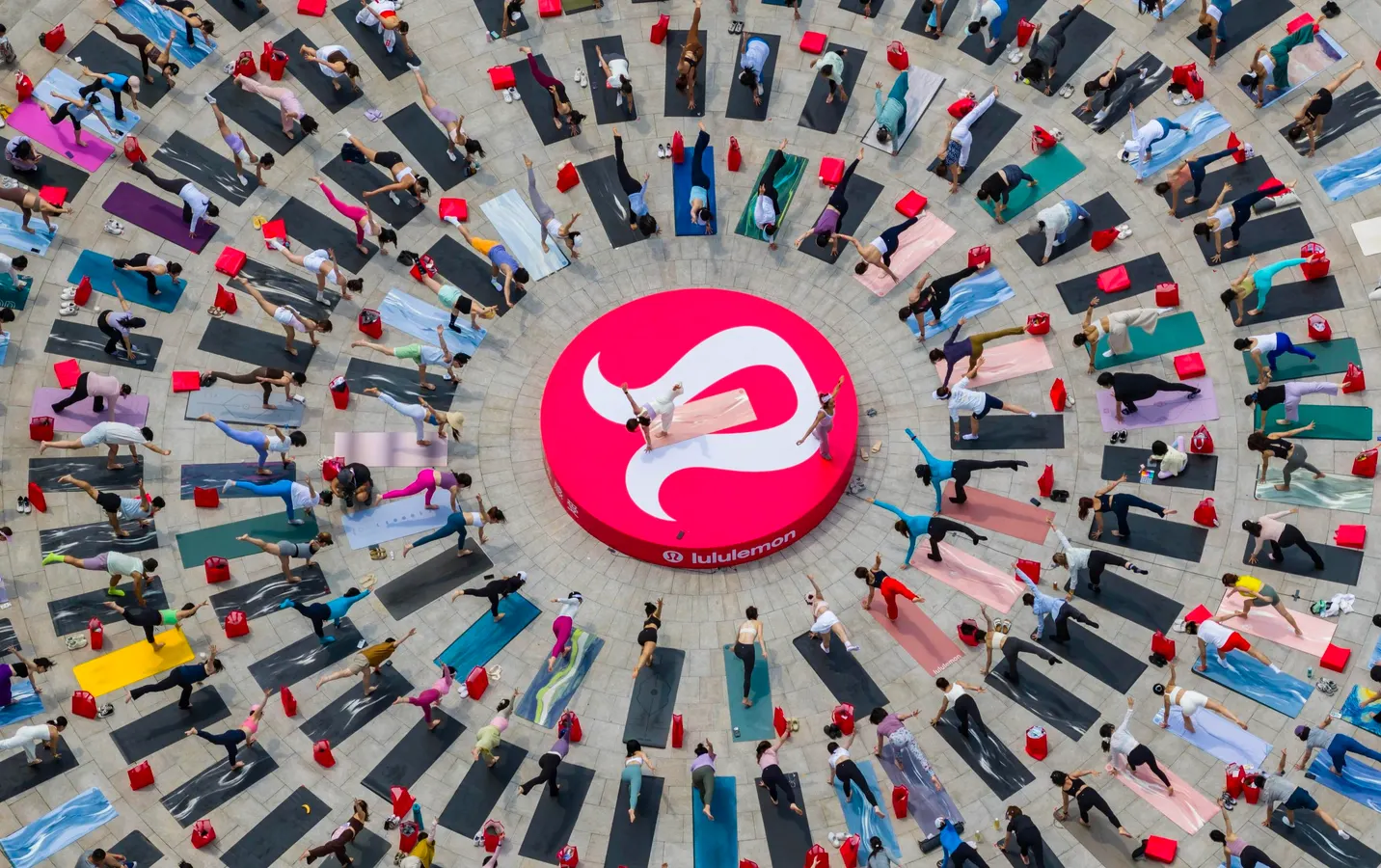

SHENYANG, CHINA – JUNE 13: Hundreds of yoga enthusiasts practice yoga at the Sun Square of Shenyang Grand Theatre on June 13, 2026 in Shenyang, Liaoning Province of China. (Photo by Cai Jingyu/VCG via Getty Images)
VCG via Getty Images
At a May 30 promotional event on the Great Wall of China, the company featured a giant Japanese taiko drum instead of a culturally appropriate Chinese dagu drum for a musical performance. The misstep immediately sparked backlash for cultural insensitivity and drew over 50 million views on Weibo—other Western brands, including H&M, Dolce & Gabbana, Dior, Burberry, and Gucci, have been caught in similar cultural crosshairs.
It took Lululemon over two weeks to acknowledge the mistake and issue an apology on Weibo, pledging its commitment to honoring Chinese culture—a critical priority for Western brands doing business in China—and accepting responsibility for an inadequate planning and review process.
As global communications firm Edelman said, “Trust is the currency of consumer power,” and another misstep gives loyal customers an excuse to leave the brand and potential customers a reason to look elsewhere—something Lululemon can ill afford now as its business growth slows, leadership is in transition and its stock price is down 50% this year.
Plagued By Controversies
Controversies have haunted Lululemon almost from the beginning in 1998 under founder Chip Wilson. He explained that the company name with multiple L’s was originally chosen because it was a letter that Japanese people couldn’t pronounce. “It’s funny to watch them try to say it,” he infamously said.
He later walked it back later by saying the name is “innately North American and authentic” because the letter L does not exist in Japanese phonetics. The Chinese drum controversy recalled those remarks, reinforcing the perception that Lululemon still struggles with cultural awareness.
Wilson continued to make highly controversial remarks throughout his tenure with the company, which officially ended in 2015. Though as the company’s single largest shareholder, he has persisted in speaking out publicly against leadership’s decisions, most recently in his proxy battle to get his chosen picks on the board.
Back in the day, Wilson defended not offering clothing for plus-sized women because such larger sizes were too expensive to make and he blamed excess pilling in some designs because women were wearing the clothing wrong or had a body shape that wasn’t suitable to its designs.
Beyond such insensitive remarks, the company had a major quality issue in 2013 after widespread complaints emerged that its yoga pants were too sheer. That led to millions of yoga pants being recalled and a reputational crisis for the brand.
Lululemon was hit with further complaints about sheerness in its Align leggings in 2021 and again in 2025. Early this year is got the same complaints for its Get Low leggings, causing the company to temporarily halt online sales. Plus, in 2024, the Breezethrough leggings were pulled for quality issues.
It also was caught making false claims about the health benefits of products made with seaweed-infused fabrics. In 2007, the Canada’s Competition Bureau ruled the company’s claims of anti-inflammatory, detoxifying qualities in its Vitasea product line were unsubstantiated, false and misleading and forced the company to remove all such health benefit claims from its advertising and marketing.
And most recently, in April, the Texas Attorney General Ken Paxton has launched an investigation into Lululemon’s use of PFAS, so-called “forever chemicals” that don’t break down in the environment and may have negative health effects. The company claims it phased out use of the substances in early 2024 and is cooperating with the state. However, it’s one more black eye against the company.
Taken together, these controversies suggest a pattern that Lululemon has never fully put behind it. They invite debate about whether the most recent missteps will quickly fade from memory or if they deepen a persistent trust problem for the brand.
Clouds Of Uncertainty
The general consensus is that the latest China misstep will leave no permanent damage. BNP Paribas analyst Laurent Vasilescu said, “The push back tends to be a short-term headwind.” And RepTrak’s Stephen Hahn noted any reputational damage will remain confined to the local market and have no long-term impact globally. “This story is less likely to drum up any major reputational noise about Lululemon outside of China.”
However, the China drum incident, paired with the Texas AG’s PFAS investigation, reopens the question of whether Lululemon is a brand consumers can trust. It refreshes memories of past controversies and casts the company once again in a negative light.
Notably, during the first-quarter earnings call, the company acknowledged it experienced “spikes of negative commentary” in the media and across social media—including in China where brand momentum slowed after a strong Chinese New Year. And that was before the Great Wall of China fiasco, casting a cloud over second-quarter results, potentially even beyond.
Customer trust is the key metric. Edelman’s global research among 15,000 consumers in 15 countries found 88% rank trust equally important to “ best quality” and “good value for the money” when making a purchase decision. Lululemon is challenged on all counts—quality questions persist, value is threatened amid rising prices and trust shaken by cultural missteps and regulatory scrutiny.
GlobalData retail analyst and managing director Neil Saunders told CBS News earlier this year that Lululemon’s products have become “junkified,” adding, “What it suggests is that there’s kind of a lack of quality control, there’s a lack of care, there’s a lack of attention to detail.”
Reasons To Flee
Consumers have a long memory when controversies around a brand’s cultural sensitivity and product quality issues resurface again and again—a memory that shapes how they interpret its latest controversies and could drive them to look elsewhere. And unlike in Lululemon’s early days, the competition is coming on strong.
Privately-held Vuori has reached a market cap of $5.5 billion valuation after a recent investment round. It’s on a path to 100 global stores, including five just opened in China, and an IPO is rumored to be in the works.
Alo Yoga has about 130 stores globally, with plans to open a 7,000-square-foot, two-story Hong Kong waterfront store shortly. Forbes estimates that Alo Yoga’s parent company, Color Image Apparel, has generated nearly $2 billion most recently.
And heavy-hitter Nike entered the premium women’s activewear market in a collaboration with Kim Kardashian’s SKIMS brand last year, with the NikeSKIMS product line expanding globally this year.
The irony is that Lululemon, a brand that once defined the athleisurewear category, opened the door for these and other challengers while being distracted by controversies of its own making.
And hanging over all of this is Chip Wilson’s highly-publicized proxy battle where he was characteristically outspoken about the company’s leadership mistakes and claims that Lululemon has “lost its cool.”
Eroding Trust
Before the China drum backlash, Lululemon was guiding on a net revenue decline between 2%-3% in the second quarter, after squeaking out 4% revenue growth in the first quarter. In the latest earnings call, the company acknowledged headwinds as it entered the second quarter around negative publicity—e.g. Wilson’s critiques and the Texas PSFA investigation—and recent product launches that didn’t “generate anticipated guest response,” such as the alleged see-thru Get Low leggings.
These remarks came before the China controversy, which is likely to hit the company’s sales harder than its earlier guidance suggests. Noting that momentum is slowing in China—comparable sales slipped from 30% in fourth quarter 2025 to 20% in first quarter 2026—BNP Paribas warned, “We are worried that China revenues will flatten out,” as it also expressed concerns about Lululemon’s continued decline in North America—the Americas comparable sales dropped 5% in first quarter. And the firm noted this was before the full impact of the two recent social media controversies are factored into results.
The last thing Lululemon needs now is further erosion of consumer trust and while the particulars of the latest controversies will fade, more general negative feelings about the brand are likely to persist, adding fuel to the competition’s fire.
If trust continues to slip, the question won’t be if Lululemon can regain momentum with new product drops and marketing initiatives, but whether consumers will continue to give the brand the benefit of the doubt.
See Also:















Leave a comment