


Current Climate brings you the latest news about the business of sustainability every Monday. Sign up to get it in your inbox.
3D printed turbine components
Arbor Energy
Welcome back to Current Climate. Spiking demand for electricity from data centers and stressed urban grids is boosting installations of large solar and battery storage systems, but there’s still a huge need for reliable base power generation to supplement renewable power. Natural gas plants fill that role, but demand for new turbines far outstrips supply, leading to wait times of five years or more from manufacturers such as Siemens and GE Vernova.
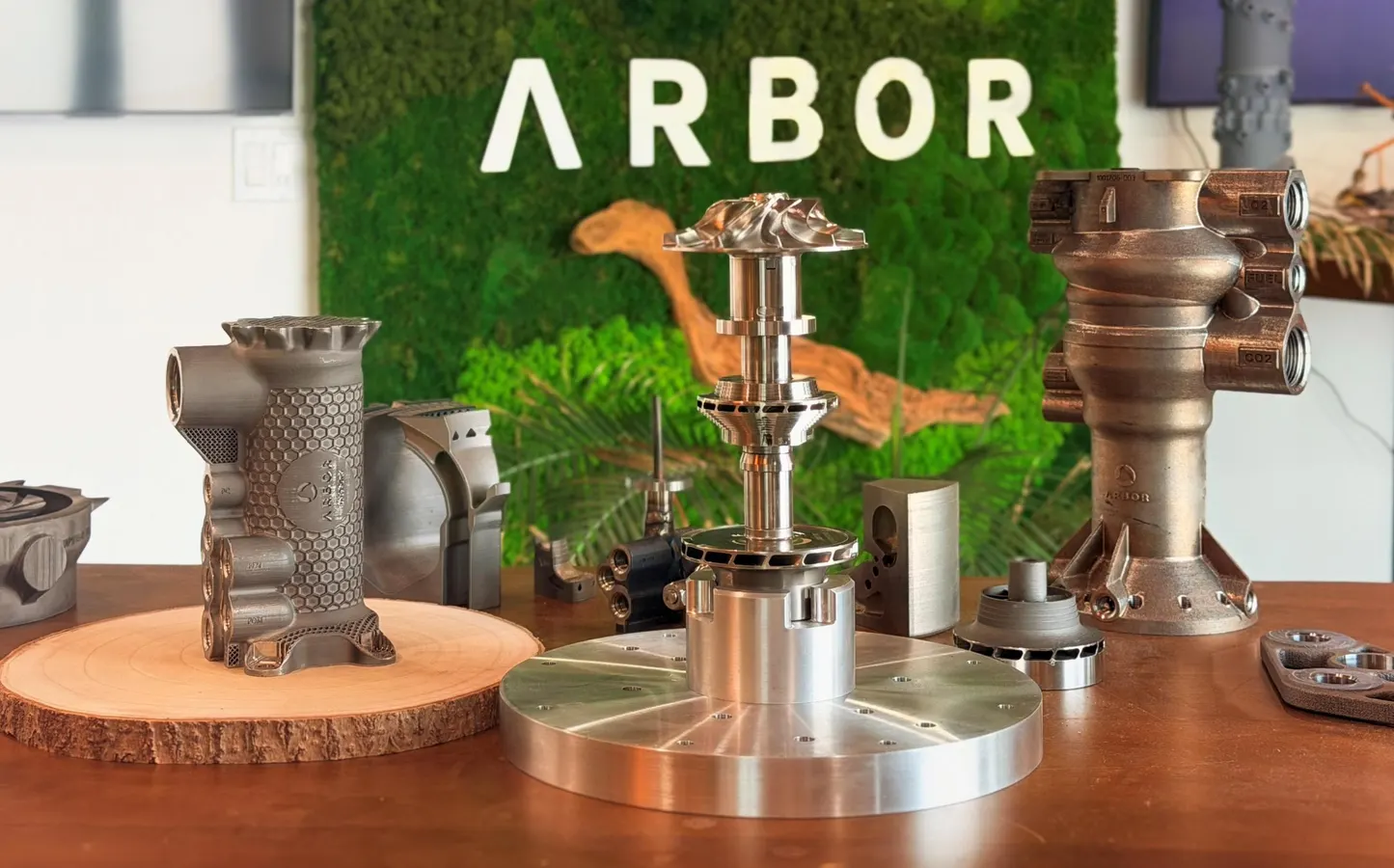
Brad Hartwig, a former SpaceX rocket engineer, thinks he can solve the problem – and cut carbon emissions at the same time. Arbor, his Los Angeles-area startup, developed a turbine that’s about a fifth the size of conventional units and that can be made relatively fast using 3D printers. Its rocket engine-inspired design has the added benefit of making it easy to capture carbon dioxide for sequestration. It even produces water as a byproduct.
“Instead of burning fuel with air like a traditional gas turbine, we’re burning it with oxygen as you do in a rocket engine,” Hartwig told Forbes. “When you burn your fuel with pure oxygen, you end up with just CO2 and water. Normally, when you burn natural gas and air in a regular gas turbine, you also get CO2 and water, but you also get a whole lot of hot air. And all of that goes out the smokestack into the atmosphere.”
“What we’re doing, which is called oxy combustion, makes it so that you’re only getting CO2 and water as your combustion product – no hot air, no nitrogen. What that allows you to do is expand that gas through a high-pressure turbine, condense the water out, and then you have a pure stream of high-pressure, high-purity, dry CO2 that can be directly sequestered in geologic formation. So it’s zero emission. It’s also water positive, which is increasingly exciting for some of our customers. We can actually produce on the order of one million gallons of fresh water per year for every megawatt that we deploy.”
Arbor is testing a one-megawatt prototype but plans to set up a factory in California next year, with initial capacity to make 40 units of 25-megawatt HALCYON turbines a year. Its first deal is to deliver up to 5 gigawatts to GridMarket starting in 2029. The company raised $55 million last year to get up and running, backed by funds including Lowercarbon Capital, Voyager Ventures, Gigascale Capital, and Marathon Petroleum Corporation. A further funding round is likely this year to pay for the factory.
Hartwig wants the first commercial units to be operating in 2028. And while that’s 18 months away, that’s still half the time it would take to deliver a conventional turbine. In terms of cost, his goal is to sell them at less than $2,000/kilowatt, halfway between the cost of a conventional simple gas turbine and a highly efficient combined cycle unit. But with the added benefit of emissions control and water generation.
“Optimizing for a product that is zero emission and outside of the current supply chain is huge,” Hartwig said. And with its smaller footprint and faster delivery time, he’s betting “it’s really going to be kind of a game changer for the power industry.”
The Big Read
The EV Race Is About Infrastructure. America Is Losing Both
Cars and electricity underpin modern life. As cars migrate to electric, these century-old industries are colliding, bringing their infrastructure together in unprecedented ways. Electric vehicles accounted for nearly a quarter of all new cars sold worldwide in 2025. Who leads the growing migration will develop the advanced software-driven grid infrastructure needed to power economies in the next century.
The U.S. once defined the auto industry, now it’s losing ground to China. BYD outsold Tesla globally in pure electric vehicles for the first time in 2025, 2.26 million to 1.64 million. Those cars will now be sold closer to home as Canada this year opened its market to the Chinese EVs the U.S. blocked.
The International Energy Agency forecasts global EV sales will reach 23 million in 2026. This approaches the 30% S-curve inflection point that signals inevitable technology adoption. European new EV sales climbed to 28% in 2025, with China nearing 55% and Norway soaring to roughly 96%. Meanwhile, U.S. EV sales dropped slightly to just under 10% of new vehicles in the same year.
Hot Topic
Sunrun CEO Mary Powell on collaborating with Tesla and Renew Home to bolster the grid with residential solar and battery power
By tapping your residential solar customers this way is Sunrun now a de facto power company?
We’ve been making a major, continued transformation of the company over the last few years to one that really is a storage-first company, owning our place as the nation’s largest residential independent power producer. This has been a passion of the company, certainly a passion of mine as someone who’s been in energy for 25 years.
The grid of the 1800s can’t power the innovation Americans demand. And when you layer on top of it the innovation needed for AI, it certainly isn’t in any position to power it. So we have been doing a lot of work. We have expanded. We have been supplying electrons to the grid all over the country in 18 different programs. And we have also been in conversations about how we can leverage our assets to help bring a much more affordable, innovative solution to the capacity challenge around the country.
We already partner with Tesla. We’re their major supplier of storage across the country. And we also have been in conversations with Renew, and we all realized that if we partner together, we’re capable of building out multiple gigawatts of additional capacity across the country in a way that is so flexible. The power’s here today: 16 gigawatts. It isn’t like we’re partnering to build that 16. We’re partnering to leverage the 16 gigawatts that we collectively have around the country to solve what I would say is the biggest challenge: providing speed to interconnection for data centers. Because we have the largest combined home energy footprint with utility relationships in all the major markets.
Are you trading power back and forth with the grid, diverting some from customers when their usage is low?
No, we’re not trading back and forth. The 16.8 gigawatts of power comes from 7.8 gigawatts of battery resources. Those are resources that operate just like any other power plant, just like a peaker plant. Those literally export energy right to the grid. And then we’re combining that with Renew Home, which spun out of Google Nest. They own and control 9 gigawatts of thermostat resources. As an example, let’s say it’s Ohio. We have the capacity there to both send electrons to the grid, and then utilizing Renew’s resources, you can also lower residential demand at the same time by just changing a thermostat control by one degree. That’s why it becomes such a powerful resource – because it’s also incredibly flexible.
What Else We’re Reading
U.S. government climate data site shuttered by Trump relaunched by former NOAA staffers (Climate.us)
Data centers are a growing target of global climate-related legal cases (The Guardian)
Beyond denial: How oil executives shaped a landmark climate study (Pro Publica)
California needs water and clean power. It might have a fix for both (New York Times)
















Leave a comment