


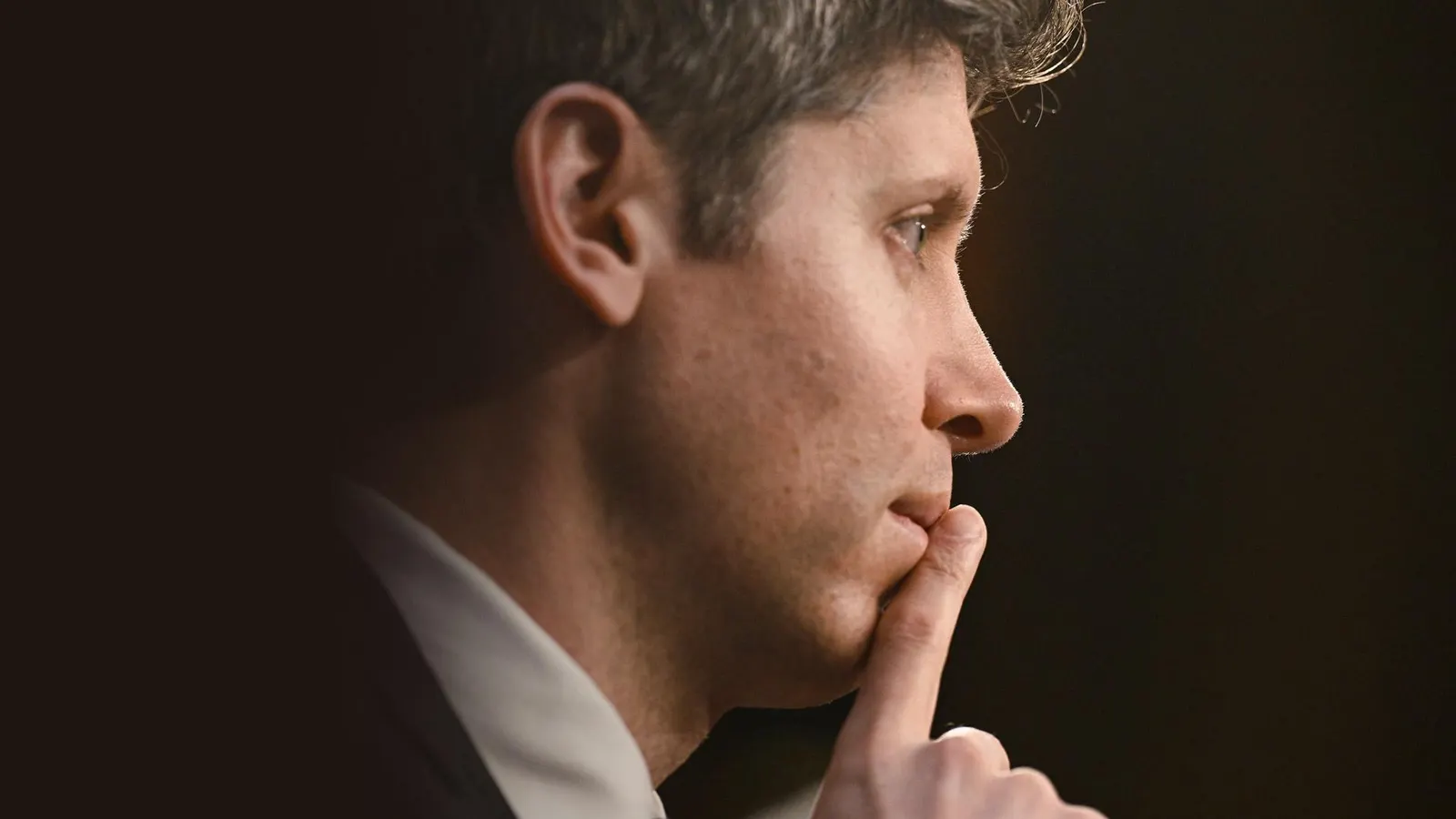
When OpenAI wants to sell the country’s biggest health systems on its healthcare ambitions, it often brings in one person a hospital CEO won’t ignore: Sam Altman.
Altman, 41, is OpenAI’s billionaire cofounder, CEO and chief converter of skepticism into purchase orders. He has sold investors, boards of directors and governments on the idea that OpenAI is the engine of the next computing era. Now he is personally making that case to hospitals.
Altman’s involvement in these sales calls underscores just how central healthcare is to OpenAI’s ambitions. In January, the AI behemoth announced eight major health systems, including Cedars-Sinai Medical Center and HCA Healthcare, are now customers of its enterprise-grade healthcare tools.
OpenAI has also tapped hundreds of doctors to make its health answers better for the more than 230 million people globally who turn to ChatGPT for advice every week. It’s rolling out a new version of ChatGPT for clinicians, as well as “ChatGPT Health,” a tab within the main app that allows consumers to securely connect their medical records and their wellness apps, such as Apple Health and MyFitnessPal (it’s waitlist-only currently). And its models power other health companies’ tools to create clinical notes and help consumers understand their lab results. OpenAI has rolled out three new products focused on healthcare in the past six months alone.
“It is one of our most important verticals at OpenAI,” says Nate Gross, who leads OpenAI’s healthcare strategy. Gross, who joined OpenAI in 2025, has an MD from the Emory University School of Medicine and an MBA from Harvard and previously cofounded $4 billion (market cap) healthcare network Doximity. While the company is also making a play for other big markets like education and finance, Gross says, “everyone experiences health issues and this is an opportunity to help everyone.”
“Health is one of our most important verticals at OpenAI.”
Healthcare, after all, represents some 18% of the entire U.S. economy. And AI has huge potential to help consumers make better decisions about their health, aid doctors in providing better care and assist health systems in running their operations more efficiently—if it’s done right.
OpenAI head of health Nate Gross
OpenAI
OpenAI’s sweeping push into healthcare comes at a make or break moment for the company. While OpenAI sparked the AI revolution with ChatGPT three years ago, it appears to have conceded some of its edge to fast-growing rivals like Anthropic and Google. The company brought in $13 billion in revenue in 2025, but its net loss reportedly ballooned nearly eight-fold to $39 billion last year from $5 billion in 2024. In April, OpenAI reportedly missed important revenue and user targets. The $852 billion-valued juggernaut filed confidentially to go public in June, but under pressure from investors is now said to be considering delaying its IPO until next year.
While the company won’t break out financial metrics for its healthcare operations in advance of its IPO, healthcare is clearly key to its future success.
But OpenAI will need to win out against Anthropic, which has been focused on enterprise from the start and has its own suite of healthcare products, as well as Google, and all the health tech companies gunning for the same market. As models’ capabilities become increasingly commoditized, it’ll also have to compete on pricing, as hospitals run on razor-thin margins. “I am pretty bullish on their ability to succeed with consumers,” says John Beadle, managing partner of health-focused Aegis Ventures. “I am less convinced on the enterprise side.”
In February 2024, Lauren Bannon started feeling unwell. She struggled to bend her fingers in the morning and at night. For months, she ignored the pain. Then it found its way to her stomach. After a series of tests, a doctor told her she had a form of rheumatoid arthritis that wouldn’t show up on blood tests.
But the 42-year-old marketing agency founder based in North Carolina wasn’t convinced—and like so many others, turned to ChatGPT for answers. Bannon plugged in a series of queries about her symptoms, and the AI suggested she might have Hashimoto’s disease, a condition in which the immune system attacks the thyroid. An ultrasound of her thyroid showed that to be true, and doctors found two small lumps. Bannon had an aggressive thyroid cancer. In January 2025, surgeons removed her thyroid gland as well as two lymph nodes where the cancer had spread.
“I honestly do believe, and I don’t just say this flippantly, ChatGPT literally saved my life,” Bannon says.
Most of the millions of people turning to ChatGPT for health- and wellness-related queries aren’t in Bannon’s position. They ask simple questions, like “Why does my knee hurt while climbing the stairs?” or “What exercises will help maintain my bone density?” They use it to decode medical jargon, analyze lab reports and understand the effects of medications. But others query it about strange symptoms that sometimes turn out to be serious illnesses.
“Today, health is one of the most active use cases of ChatGPT,” says Karan Singhal, OpenAI’s head of health AI. “There’s the potential for good and the potential for harm—but the potential for good is so large.”
In the U.S., clinician shortages and administrative overload have left physicians burnt out and patients struggling to get the appointments they need. In rural areas, more than one-third of adults use the ER for care that could have been provided at a primary care practice, while 86% of rural counties don’t have a single practicing cardiologist.
“Access to medical care is a really big issue. Many hundreds of millions of people are having an experience where Chat is giving them critical information. Maybe it’s six months before they can see a doctor. Maybe they are terrified and don’t know what’s next,” says Ashley Alexander, OpenAI’s head of health products. “It’s not a replacement for care, and we are very clear about that. But what it does is give you that information in an otherwise debilitating and scary time.”
“Trying to undo or untangle the information from these searches takes away from the time to delve into the actual problem and talk about a treatment plan.”
But using ChatGPT to guide and unofficially diagnose our ailments–like Dr. Google before it–has been a double-edged sword. It can clearly help. But it can also offer up erroneous information, send patients to the ER when it isn’t necessary or lead them to ignore symptoms that need attention.
A study of ChatGPT Health, OpenAI’s new consumer health tool, published in the journal Nature Medicine in February, found that it did not recommend a hospital visit when medically necessary in more than half of cases. It also missed patients who were suicidal if they identified a means of self harm, though it performed better in those who did not. For non-urgent cases, 65% were sent for care they didn’t need, which could clog up an already strained healthcare system. (OpenAI published a detailed rebuttal on X, and Gross says that “there were some pretty flawed elements to the methodology and it was using an older version of the model.”)
OpenAI’s head of health products Ashley Alexander
OpenAI
OpenAI has reportedly received subpoenas from several states, including for its handling of health data and safety. A Canadian woman sued the company over her 24-year-old daughter’s death by suicide, alleging that ChatGPT encouraged it. (OpenAI has said that it takes the concerns of the state attorneys general “seriously” and will respond “constructively.”)
Doctors see the pros and cons firsthand. Dr. Jinsy Andrews, a neurologist at NYU Langone whose practice focuses on ALS, says patients often come to her office with printouts from ChatGPT. Sometimes, she says, it helps people seek medical help and be diagnosed earlier for the progressive and incurable neurological disease. But ChatGPT can also create unnecessary complications. One person came to her office afraid of having ALS because ChatGPT suggested it was a reason for their muscle twitching. It wasn’t, but “fed into their anxiety,” Andrews says. Another patient asked to try experimental therapies that ChatGPT suggested, but the research it referenced was made up. “Trying to undo or untangle the information from these searches takes away from the time to delve into the actual problem and talk about a treatment plan,” she says.
Another physician, at Albany Med Health System, who declined to be identified, recounts multiple cases of patients using ChatGPT to dispute doctors’ diagnoses and come up with treatment plans that have no basis in science. One patient, for instance, entered his symptoms into ChatGPT, which indicated he might have an autoimmune condition. “He did not want to pursue any other diagnostic workup to establish a diagnosis,” the physician says. “He just was adamant about, ‘This is what I have. This is what ChatGPT said I need to get.’”
“I honestly do believe, and I don’t just say this flippantly, ChatGPT literally saved my life.”
OpenAI is well aware of these pitfalls, and has assembled a group of more than 260 physicians to improve ChatGPT’s health advice. These doctors rate ChatGPT’s responses to queries, talk through specific cases and, importantly, train the models to know when they don’t know enough to give advice at all.
“When I started, I did not think that it was very good,” says Rebecca Soskin Hicks, a Stanford-trained pediatrician who OpenAI recruited to test, or red-team, its models about two-and-a-half years ago and is now its physician network lead. “Frankly, it wasn’t that hard to get it to mess up.”
Since then, the team has reviewed more than 700,000 example responses to dramatically improve the model’s accuracy for both consumers and clinicians. OpenAI says that millions of clinicians now use ChatGPT every week. HealthBench, OpenAI’s own benchmark which ranks model performance on 48,000 different criteria such as escalating emergencies and expressing uncertainty when required, showed newer OpenAI models performed significantly better on healthcare tasks than previous versions but still struggled to ask for missing information.
But its models are more reliable when it comes to healthcare operations. Florida-based Advent Health, which owns more than 50 hospitals, says it saw 80% time savings in using OpenAI’s models for administrative tasks. Memorial Sloan Kettering in New York rolled out a test pilot to 1,000 people, but it’s too soon to tally OpenAI’s impact. “The early signals are great,” says Ophelia Chiu, MSK’s VP of strategic innovation. “Healthcare organizations are so early on in their learning curve despite all the marketing hype over the past 36 months,” she says.
OpenAI’s Gross says that a lot of the company’s mission in healthcare will be realized through the startups and companies that build new products off its models.
Take Labcorp, the $23 billion (market cap) diagnostics giant. While people are already using AI to interpret lab results—41%, per a recent Labcorp survey—the tools vary in their ability to offer accurate information. So in May, it teamed up with OpenAI on a new AI-powered mobile app to help consumers understand their lab results and track trends over time.
“I am pretty bullish on their ability to succeed with consumers. I am less convinced on the enterprise side.”
“We ask physicians who have tried to break it, and the accuracy is extremely high,” says Bola Oyegunwa, Labcorp’s chief information and technology officer.
Thousands of organizations and startups like Abridge, Ambience and EliseAI also use OpenAI’s models.
Take Abridge, best known for tech that listens to patient-doctor conversations and writes them up as clinical notes. Davis Liang, who leads the company’s machine learning team, says that it relies on frontier models from OpenAI and Anthropic and uses its own in-house ones to build the best product for clinicians. OpenAI’s models are especially helpful for notetaking and general user tasks but do less well when assessing a patient’s symptoms and generating diagnostic codes, which are also used for billing. “This is a hard task because it’s high specificity,” he says. “OpenAI will say this patient has diabetes mellitus. Actually the patient has diabetes mellitus with myopic retinopathy.”
Still, AI is moving so fast that it’s hard to know what the field will look like in six months, let alone five years.
“There’s no magic bullet to 20% of GDP,” OpenAI’s Gross says. “We just have to make sure our models can be helpful to people.”













Leave a comment