


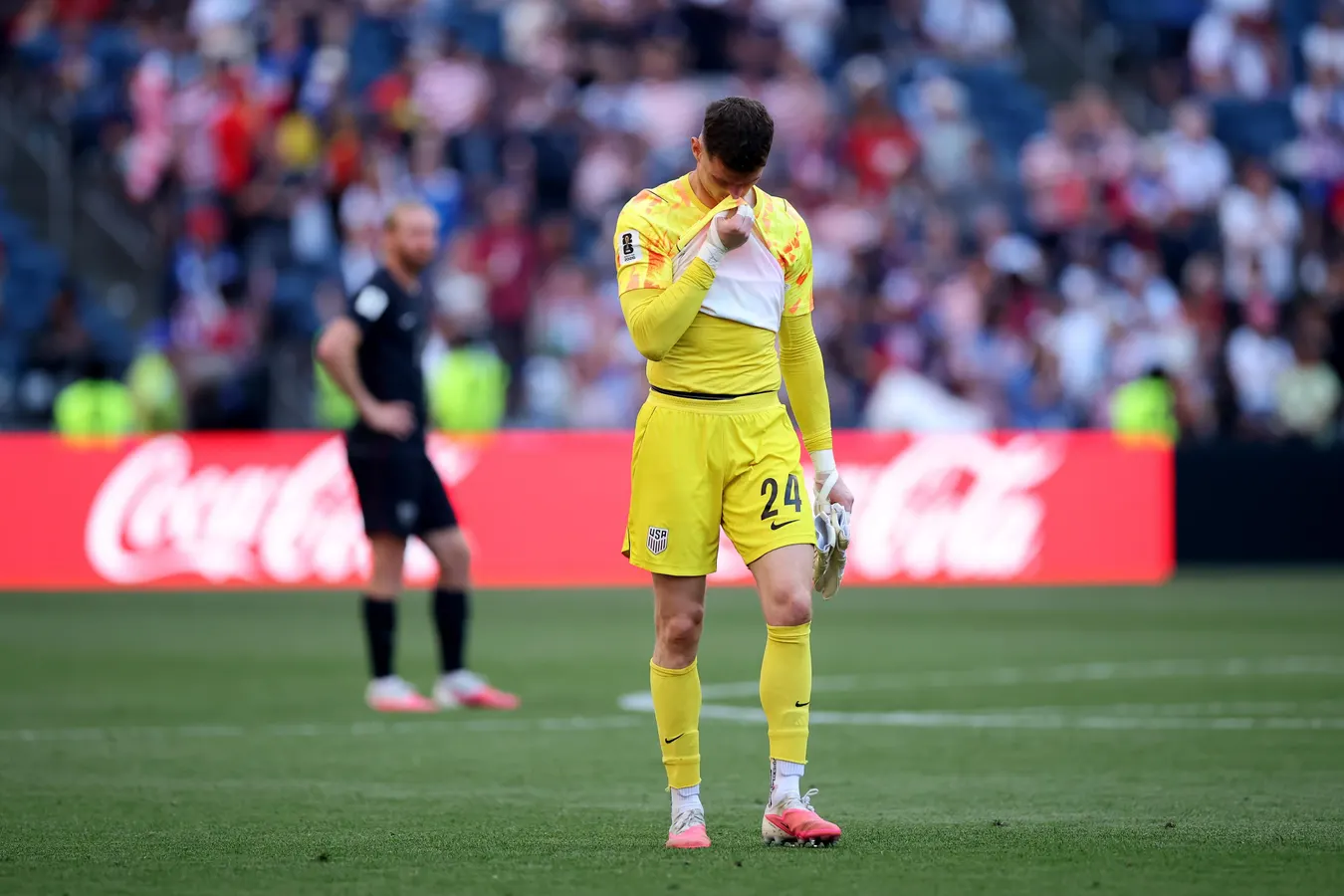

SEATTLE, WASHINGTON – JULY 06: Matt Freese #24 of the United States shows dejection after the team’s 1-4 defeat in the FIFA World Cup 2026 Round of 16 match between USA and Belgium at Seattle Stadium on July 06, 2026 in Seattle, Washington. (Photo by Alex Grimm/Getty Images)
Getty Images
Monday night’s FIFA Men’s World Cup match had the potential to be the biggest in modern United States Men’s Soccer history.
Playing on home soil with an experienced group that looked relatively impressive in the tournament, the U.S. faced Belgium with a chance to advance to the quarterfinal round for the first time since 2002.
And yet, much like the last time the U.S. played Belgium with a quarterfinal birth on the line (back in 2014), they lost.
Yet in 2026, the defeat is accompanied by a far larger existential crisis about the state of the United States men’s soccer program as a whole.
Monday’s Blowout Brings Up Old Concerns
On its own, a loss to Belgium wasn’t going to render this entire World Cup a failure for the U.S.
The team won its first two group stage matches for the first time since 1930, and won its group for just the third time. Beating Bosnia and Herzegovina in the round of 32 gave the team its first knockout round win since 2002.
Going into Monday’s match, the excitement around the team was easy to see from soccer and non-soccer fans alike. There would’ve been no shame in losing to a top European squad by a close margin.
But instead, the U.S. lost 4-1, putting in one of the worst performances of any team in this knockout round so far.
After the Stars and Stripes lost 5-2 to Belgium in a friendly match back in March, there were outward concerns about the state of the U.S. heading into this co-hosted World Cup.
While no one was going into this cycle thinking the that the United States were one of the top contenders to win the tournament, the general thinking was that with a more talented roster than ever (at least by way of the number of players on rosters in Europe), they could at least be competitive on the field. And a 5-2 loss was far from competitive.
This 4-1 defeat was similarly lopsided, despite the larger stakes. And revealed a glaring problem for the U.S. that it’s still not ready for this moment. The stats make that fact inarguable.
On Monday, the United States managed just two shots on goal (versus seven for Belgium), and zero big chances (compared to four for Belgium). By expected goals on target, the team was down 3.51 to 0.22 post-match. Their best chance on net was the only one that connected: Malik Tillman’s free kick in the 31st minute (and even that benefited from being a set piece just outside the box).
Offensively, they simply weren’t a team that was ready to adjust when they didn’t score first – the lone time that occurred in this World Cup – and weren’t able to audible when Belgium sat back comfortably in the second half with an established lead.
SEATTLE, WASHINGTON – JULY 6: Maxim De Cuyper, #5 of Belgium and Alex Freeman, #16 of the United States battle for the ball during the FIFA World Cup 2026 Round Of 16 match between USA and Belgium at Seattle Stadium on July 6, 2026 in Seattle, United States. (Photo by Jane Gershovich/ISI Photos/ISI Photos via Getty Images)
ISI Photos via Getty Images
Supposed To Be Different
Again, the U.S. wasn’t supposed to win the World Cup this year (they had 33-to-1 odds pre-tournament). But playing at home, they were supposed to be past this sort of embarrassing result.
Under Gregg Berhalter, the team mostly beat up on squads they were supposed to, but could also gut out one-goal wins over peers or better teams (Mexico, in particular). At the same time, they were also susceptible to failures – most notably, failing to qualify for the 2018 World Cup.
Moving on from Berhalter in 2024, there was supposed to be improvement under Mauricio Pochettino.
Despite the 2022 team being the youngest in the World Cup field, they still managed to advance to the knockout round, before falling 3-1 to the Netherlands.
For as much as it’s painful to lose, though, a young team getting that experience under their belts early seemed to bode well for the United States heading into the 2026 cycle where it would have the benefit of not having to qualify for the World Cup, but also playing at home.
In the time since, though, they’ve assembled 30 wins, 20 losses and nine draws. The U.S. has lost to every major European team they’ve played (some multiple times). They lost the CONCACAF Nations League tournament despite playing all matches domestically. And have found themselves increasingly dropping matches to regional rivals Mexico and Canada, whom they’re a combined 0-4 against since Pochettino took the reins.
For a U.S. group that has more players in Europe than ever, and has been increasing resources around its program (see the new $250 million national training center in Atlanta), there’s a natural assumption that they’re improving. Yet, the on-field results don’t actually show significant progress compared to less talented – on paper – rosters from the previous generation of players.
What Now?
That’s the biggest question for the U.S. coming out of what will now (despite early momentum) have to be seen as a World Cup where they fell short of expectations.
Pochettino may very well be on the way out, which means rebuilding in yet another coach’s image. But no matter who’s in charge, this United States men’s roster will likely look pretty similar when the 2030 World Cup cycle gets going.
For instance, this year’s roster features just two players over 30 years old (Tim Ream and Matt Turner). Many of the standouts from the 2026 squad, including names like Tillman, Folarin Balogun and Ricardo Pepi, will still be under 30. Christian Pulisic, Tyler Adams and Chris Richards will only be 31.
Those names have meant a lot to the U.S. program in recent years, yes. But to what end? And four years later, do supporters expect to see vast improvement from a roster that’s largely underperformed as a group?
It’s why the United States’ men’s soccer project may be back to the drawing board all over again. With no clear path of how to reconstitute things for a better result next time.













Leave a comment