


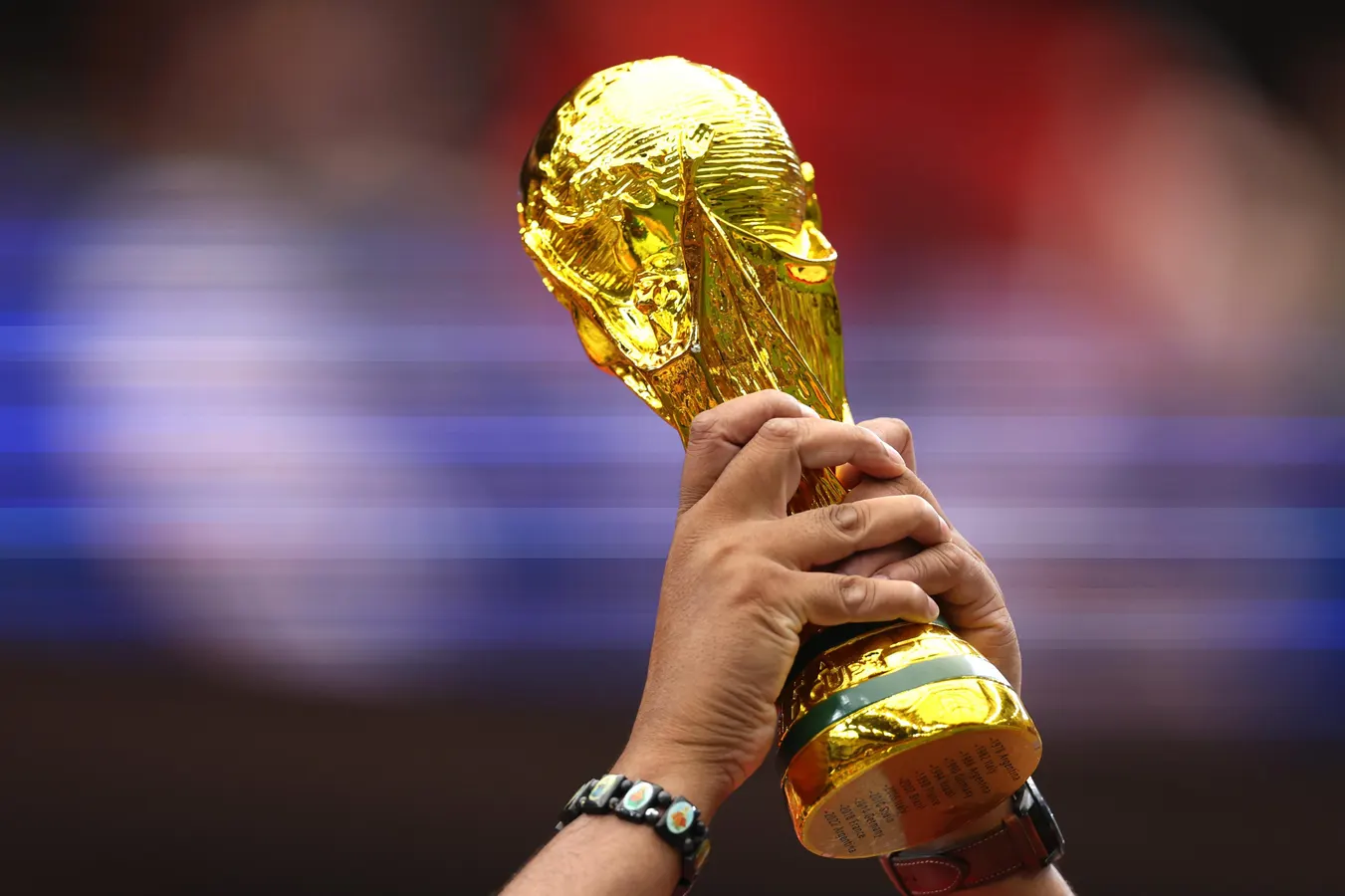

HOUSTON, TEXAS – JULY 04: A fan holds a replica of the FIFA World Cup Trophy before the FIFA World Cup 2026 Round of 16 match between Canada and Morocco at Houston Stadium on July 04, 2026 in Houston, Texas. (Photo by Molly Darlington/Getty Images)
Getty Images
The 2026 FIFA Men’s World Cup is far from over. And yet, attention is already turning toward 2030, and how this year’s tournament can lead to even more lucrative opportunities the next time around.
On Tuesday, Front Office Sports reported that the bidding for 2030 World Cup media rights could start at $1 billion in the U.S. – more than double the $485 million Fox paid for this year’s event, which can only be considered a steal.
Along with advantageous time zones in the United States, Canada and Mexico, the 2026 World Cup has also benefited from an expanded tournament field, a fleet of exciting games and big stars, and the much-maligned (by fans) hydration breaks.
While those factors won’t all be repeated for 2030, the results of this year’s event are clear: The World Cup is becoming significantly bigger business on the media front.
2026 Success
By default, the 2026 event was bound to be an improvement compared to 2022, when the World Cup was not only based in Qatar but also took place outside of the traditional summer tournament time frame.
While airing across November and December of 2022, iSpot tells Forbes those matches accounted for 2.77% of TV ad reach during live national linear programming.
With the benefit of the summer and 40 additional matches (by tournament’s end), this year’s World Cup accounts for 13% of live national linear programming TV ad reach since the event started. Thanks to more games and the hydration breaks, TV ad impressions have already nearly tripled versus 2022. Even ad reach for World Cup Today, the studio show, have doubled.
On Fox alone, the U.S. team drew 30 million viewers for Monday night’s loss to Belgium; a number that would have put it among the 20 most-watched telecasts in the country last year.
It’s uncertain if that sort of media momentum continues now as the United States has been eliminated (as have fellow host countries Mexico and Canada). But there’s significant reason to believe audiences are hooked, especially with limited programming up against it on TV right now aside from MLB action, and an active social media appetite for soccer.
Tubular Labs data provided to Forbes shows World Cup-related videos have generated 146.8 billion views across platforms like YouTube, TikTok, Instagram and Facebook. U.S. creators account for the highest share of views generated on all of those sites since the start of the tournament.
NEW YORK, NEW YORK – JUNE 11: FIFA World Cup 2026 FOX Sports branding in Times Square featuring Lamine Yamal, Lionel Messi, Christian Pulisic and Cristiano Ronaldo on June 11, 2026 in New York City, New York. (Photo by Catherine Ivill – AMA/Getty Images)
Getty Images
Rights Scarcity Driving More Interest
Even as live sports have progressively taken over the TV landscape, there’s a scarcity of premium properties.
NFL rights are locked up through 2033. The NBA’s new deal is through 2036. NHL rights are coming up soon, but have limited suitors. MLB’s rights are coming up, but also carries uncertainty around its coming labor strife (and depends more on regional programming than the other leagues).
College conferences have also been consolidating for the past decade and a half, and most of those leagues’ rights are also secured for the time being, as are the rights for the biggest women’s sports properties in the U.S.
Men’s soccer, therefore, becomes the biggest fish left out there. And if hydration breaks open the (excuse the pun) floodgates for more ad inventory, then the sport inherently becomes a more valuable entity than non-World Cup action has been to-date.
That’s notable when looking at more – relatively speaking – affordable rights like the English Premier (up for a new deal after the 2027-28 season) and Major League Soccer (reworked Apple deal now ends after the 2028-29 campaign). And even more so for something more lucrative and broadly relevant like the Men’s World Cup.
Fox and Telemundo’s respective abilities to put up huge audience numbers during the 2026 World Cup naturally draws the interest of other bidders around the 2030 and 2034 events. The larger field’s March Madness-like rework also generates similar day-long programming blocks where networks and/or streaming services can sell viewers on the idea that “anything can happen.”
And suitors are already lining up.
Interested Parties
While ESPN has made it clear that it was not pleased with how previous negotiations with FIFA went when World Cup rights were last up for negotiation (ESPN previously owned them from 1994 to 2014), the Worldwide Leader would be among the bidders for 2030 rights.
On Tuesday, CNBC’s Alex Sherman reported that Netflix, Disney and YouTube were all interested in bidding on the 2030 and 2034 World Cups, along with existing rightsholders Fox (English language) and Telemundo (Spanish language).
Sherman also notes that Apple and Amazon could get involved, too – a development that would effectively involve every major media player in the U.S. save Paramount (whose soccer programming already includes UEFA Championship League and Serie A, among others).
Should all of these companies get involved, it fuels the idea that a starting point on bids blows right past the $1 billion mark, into the $1.5-2 billion range. The 2030 and 2034 rights are also likely to be sold together, which drives up the price as well.
Also factoring into future negotiations with any of these media entities: What impact does it have on their streaming platforms?
While there were streaming components to this year’s event (including YouTube airing the first 10 minutes of matches live), the 2026 World Cup was still very much a traditional TV property. That’s unlikely to be the case going forward, as the tournament grows into a multiplatform event to match multiplatform viewing habits.
Linear TV’s continued role in the World Cup almost certainly means a traditional media company is winning part if not all of the event’s 2030 and 2034 rights. But a deep-pocketed streamer may eventually just make that impossible.















Leave a comment