


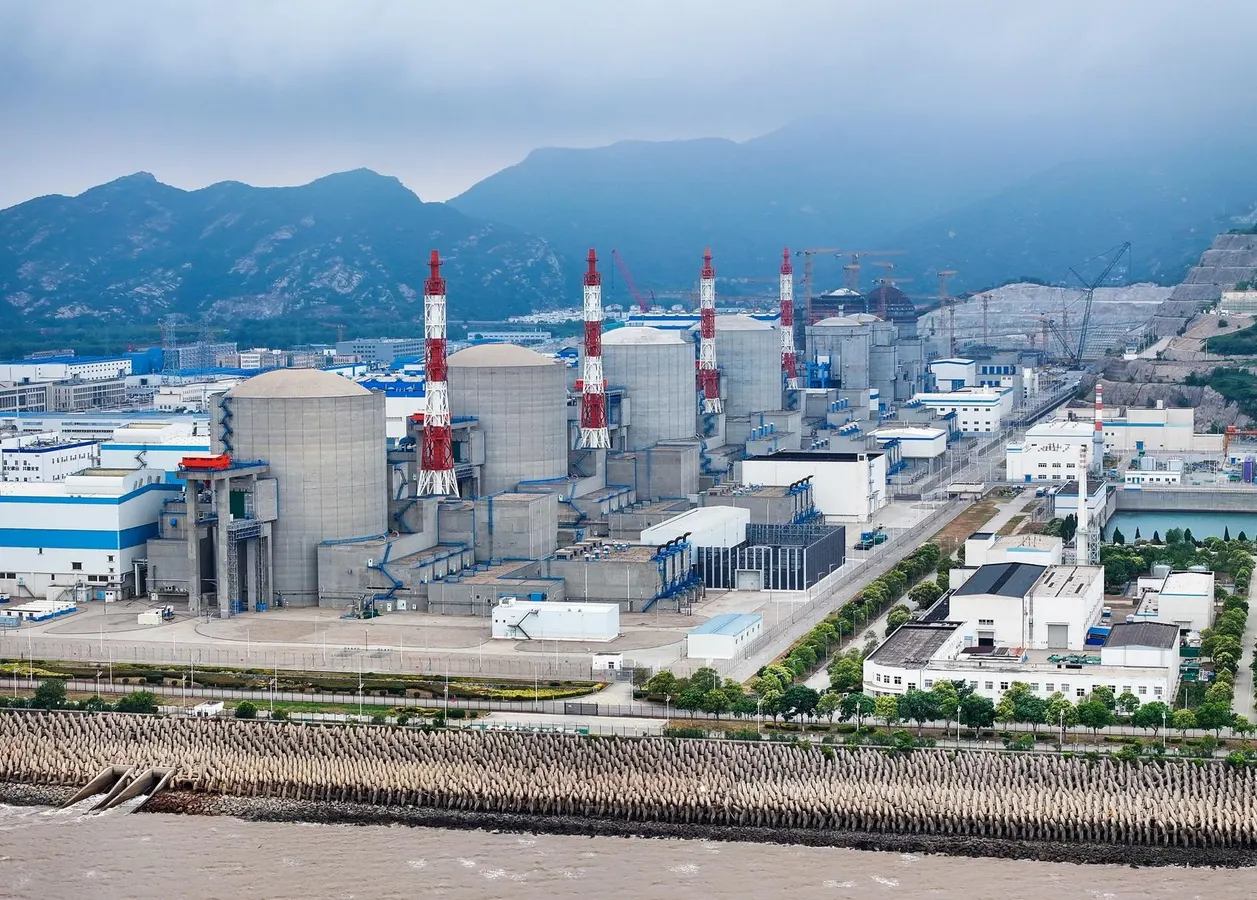

LIANYUNGANG, CHINA – JUNE 19: Aerial view of pipelines and facilities at China’s first industrial-use nuclear energy steam supply project, Heqi No.1, on June 19, 2024 in Lianyungang, Jiangsu Province of China. Heqi No.1, which is located at the Tianwan Nuclear Power Plant, was officially put into operation on June 19. (Photo by VCG/VCG via Getty Images)
VCG via Getty Images
Global nuclear power generation reached an all-time high in 2025, and China supplied all of the net growth. According to the latest Statistical Review of World Energy, nuclear plants generated 2,845 terawatt-hours worldwide last year, up 30 terawatt-hours, or 1.3%, from 2024. China increased its output by more than 34 terawatt-hours, which means that without China, global nuclear generation would have declined.
Those figures capture the state of the industry better than the broad claims of a worldwide nuclear renaissance. Output is rising, but the expansion remains heavily concentrated. The United States continues to operate the world’s largest nuclear fleet, while China is rapidly closing the gap. Japan is gradually restoring generation, but much of Europe remains below the levels reached a decade ago.
A Record Nearly Two Decades in the Making
The new record deserves some context. Global nuclear generation reached 2,803 terawatt-hours in 2006, so the 2025 total was only about 1.5% higher despite the passage of 19 years. Nuclear power has finally moved beyond its previous high, but this has not been a period of rapid global expansion.
Global Nuclear Power Generation 1965-2025.
Robert Rapier
More recently, output rose from 2,576 terawatt-hours in 2015 to 2,845 terawatt-hours last year. That represents growth of 10.5% over the decade, or about 1% annually. China accounted for more than the entire increase, with its nuclear generation climbing from 171 terawatt-hours in 2015 to 485 terawatt-hours in 2025. Worldwide generation rose by about 270 terawatt-hours over the same period, while China alone added nearly 314 terawatt-hours.
Remove China from the totals, and the rest of the world generated about 44 terawatt-hours less nuclear electricity in 2025 than it did a decade earlier. That does not negate the global record, but it does show how dependent the headline number has become on the growth in a single country.
The United States Still Leads
The United States generated 826 terawatt-hours of nuclear electricity in 2025, representing 29% of the global total. That was more than any other country and nearly 70% more than China produced. China ranked second with 485 terawatt-hours, accounting for 17.1% of worldwide generation, while France followed with 390 terawatt-hours, or 13.7%.
Russia generated 219 terawatt-hours, South Korea produced 185 terawatt-hours, and Japan generated 94 terawatt-hours. Canada followed at nearly 85 terawatt-hours. Together, these countries account for the vast majority of global nuclear production, reflecting the capital requirements and long development timelines that limit nuclear power to a relatively small group of nations.
The U.S. fleet remains highly productive, but output has changed little. American nuclear generation was 839 terawatt-hours in 2015, slightly higher than last year’s total. But China nearly tripled its nuclear output over the decade at an average annual growth rate of almost 11%.
The United States remains comfortably ahead, but the gap is narrowing. If recent growth rates for both countries continue, China will surpass the U.S. as the world’s top nuclear power producer in about five years.
France and Japan Added to the Growth
China was responsible for most of the increase in 2025, but several other countries also reported gains. French nuclear generation rose by 9.6 terawatt-hours to 390 terawatt-hours. France has recovered from the unusually weak output recorded earlier in the decade, although generation remains about 47 terawatt-hours below its 2015 level.
Japan added another 9.2 terawatt-hours, increasing generation by 11.1% to 94 terawatt-hours. Japanese output has risen substantially from the lows that followed the Fukushima accident and the shutdown of the country’s reactor fleet, but it remains well below pre-Fukushima levels. Japan generated roughly 292 terawatt-hours of nuclear electricity in 2010, more than three times its 2025 total.
The United States added about 3.1 terawatt-hours last year, while Russia gained 2.9 terawatt-hours. Smaller increases came from South Africa, the Czech Republic, Belarus, Ukraine, Slovakia, and Pakistan. Those gains were partially offset by declines elsewhere. Taiwan’s nuclear output fell by almost 9 terawatt-hours, Belgium lost 7.5 terawatt-hours, and the United Kingdom, Switzerland, South Korea, and Sweden also recorded notable declines.
Nuclear Growth Moves Toward Asia
The regional figures show how sharply the center of nuclear growth has shifted. Asia-Pacific nuclear generation rose from about 420 terawatt-hours in 2015 to nearly 845 terawatt-hours in 2025. The region more than doubled its output and now produces almost 30% of the world’s nuclear electricity.
North America remains slightly larger, generating 921 terawatt-hours last year, but that was down from 952 terawatt-hours in 2015. Europe recorded a much steeper decline, with nuclear generation falling from 968 terawatt-hours in 2015 to 759 terawatt-hours in 2025. That represents a drop of nearly 22%.
The comparison between developed and developing economies is equally stark. Nuclear generation in OECD countries fell by about 96 terawatt-hours over the decade, while non-OECD generation increased by nearly 366 terawatt-hours. OECD countries still account for roughly two-thirds of worldwide nuclear production because of their large existing fleets, but they are no longer providing the growth.
Record Generation, but No Gain in Energy Share
The record also looks different when nuclear is compared with the entire global energy system. Nuclear energy supplied 31.0 exajoules in 2025, up from 30.7 exajoules the previous year. Total global energy supply increased more quickly, rising from 592.2 exajoules to 600.3 exajoules.
As a result, nuclear’s share of global energy supply edged down from 5.19% to 5.17%. The industry produced more energy than ever, but it did not gain ground against oil, natural gas, coal, hydropower, and renewables.
National figures vary widely. Nuclear provided about 47% of France’s total energy supply in 2025. Its share was approximately 33% in Finland, 31% in Sweden, 25% in Ukraine, and 23% in the Czech Republic. In the United States, nuclear accounted for about 9.6% of total energy supply.
In China, despite its rapid expansion and position as the world’s second-largest nuclear generator, the share was only about 3.3%. China’s nuclear industry is already large enough to determine the direction of the global totals, yet it remains a relatively modest part of the country’s enormous energy system. That leaves considerable room for further growth if the country continues building reactors at its recent pace.
The Big Picture
The 2025 record confirms that nuclear power is growing again, but it is not yet a broad global surge. The United States still generates more nuclear electricity than any other country, although its output has been essentially flat for a decade. France and Japan made meaningful gains last year, but European production remains far below its 2015 level. Nuclear’s share of global energy supply is also virtually unchanged.
China is the clear exception. It added more nuclear generation during the past decade than the world’s total net increase, and its gain in 2025 exceeded the increase recorded globally. For now, the nuclear record is less evidence of a worldwide construction boom than of China’s rapid expansion while much of the developed world continues to rely on reactors that were built years or decades ago.














Leave a comment