


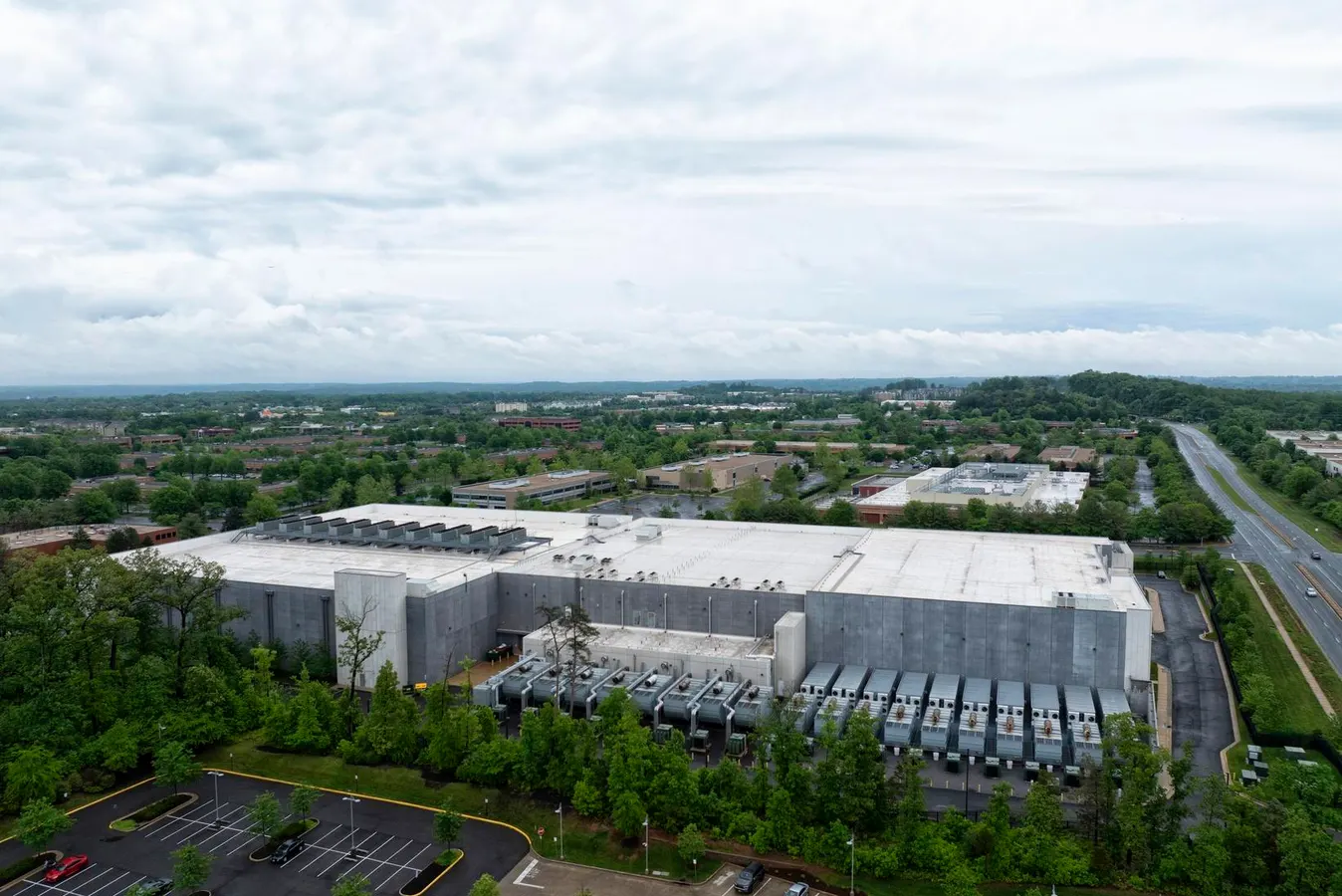

Aerial view of data centers in Sterling, Virginia. More research still needs to be done in actual data centers to better understand their risks to people who live near them.
getty
When Fairfax County, Virginia, had to decide how close a data center could sit to somebody’s house, it worked the problem by analogy. Its planners compared data centers to uses already in the zoning code and landed on a distance of 200 feet, more than a livestock barn gets and less than a crematory. A zoning code is not a health study, though. Which leaves the obvious question: how safe is it to live near a data center? The ordinary complaints are well documented, but the health effects aren’t as clear yet.
How Safe Are Data Centers?
Thus far, no study has tied a data center to a specific illness. Their environmental and community impact depends on which type of data center you get.
Take a single hyperscaler, one of the handful of firms building these at giant scale. It might drop an air-cooled campus with a generator yard beside houses in one county, then put a water-cooled building on an industrial parcel in the next.
Picture a warehouse of computers running flat out around the clock. The computers themselves burn nothing. They make enormous heat, and it has to go somewhere. That makes it different from a factory, where the emissions are part of the process. A data center gets its emissions from the supporting cast: the generators that start when the grid fails, the cooling gear, the years of construction, the power lines feeding it.
So “safe” isn’t a simple question. It’s whether you get sick, whether the river can spare the water, whether your bill goes up and whether you still enjoy your yard.
The Potential Risks Of Living Near A Data Center
Most of what neighbors report is annoyance and expense: a hum, a lit fence line, gravel trucks, a bigger utility bill. Only a couple could truly affect your health, and diesel exhaust is the main one. How much exhaust reaches you depends on where the generators sit and how often they run.
Data centers are arriving closer to houses than they used to. Almost a third of Virginia’s sites now sit within 200 feet of residential land, and the share is growing. Which is where the trouble starts: a permit number gets met and the neighbors are still unhappy. Noise is the clearest case. In 2023, Virginia’s Joint Legislative Audit and Review Commission set out to study the state’s data centers. It found they’re “rarely loud enough to violate noise ordinances.” It also found that some residents say the constant noise “affects their well-being.”
The Hum That Noise Ordinances Don’t Measure
The main culprit is the fans. Cooling equipment runs around the clock, and it makes a low, steady drone: a house air conditioner magnified to industrial scale. The same review counted at least 15 Virginia data centers, about one operational site in ten, where neighbors regard the noise as a problem.
The noise isn’t loud, which surprises people. Measurements at the Virginia sites that drew complaints run an estimated 40 to 59 decibels, typically below the 55 or 60 that Loudoun, Prince William and Fairfax counties allow in residential areas. What residents object to isn’t the volume. It’s that the sound never stops. That’s where the health worry starts. The peer-reviewed assessment lists sleep disturbance and annoyance as short-term effects of steady noise, and cardiovascular problems as a long-term one. But it draws those from research on traffic and industrial noise, not from data centers, and says so plainly.
Diesel Generators And Local Air Quality
A big campus keeps a yard of diesel generators for the day the grid fails, a median of 35 per Virginia site. Running them puts out the same exhaust a truck does, which the EPA calls probably carcinogenic to humans. The nitrogen dioxide in it can also tighten the airways of people with asthma. So the question is how often the engines run.
Quincy, Washington, is a data center town. When the state measured its diesel health risk, it counted every major source: the highway, the rail line, the farms, the building sites. Trucks, trains and farm equipment produced more than three quarters of the town’s diesel soot. The data centers’ generators put out about an eighth of what their permits would have allowed. But if they had run flat out, the study found, a few nearby homes would have been breathing air like a busy road. Virginia points the same way. Generators there produce under 4% of the nitrogen oxides that help make smog, and most operators logged only one or two brief outages in two years.
Water Use, And Why The Peak Day Is The Problem
Some data centers cool themselves by evaporating water. Warm water goes up a cooling tower, part of it leaves as vapor, and that part never comes back. So it’s your watershed’s problem more than your street’s.
In the Washington, DC area, a river commission found the region’s data centers draw from the public water system, the same pipes that serve houses. They account for about 1% of the water the region pulls from its rivers. But a house sends most of its water back down the drain, while a data center that evaporates its water returns only about a quarter, on the commission’s estimate. Count the water that never comes back and their share rises to about 9%, and up to 12% in summer. On the hottest days a site can draw up to ten times its own average.
Higher Electricity Bills
This one isn’t about proximity. Meeting the new demand means building generation and transmission that wouldn’t otherwise get built, and utilities recover those fixed costs from all their customers. Supply gets tighter, so prices rise too.
Virginia’s watchdog found current rates “appropriately allocate costs to the customers responsible.” It also modeled the growth. For a typical household served by Dominion, the state’s largest utility, generation and transmission costs would rise an estimated $14 to $37 a month by 2040 in today’s money. That’s a model, not a prediction of your bill and rates are climbing for reasons that have nothing to do with data centers. Data centers pay in, too. In Virginia’s five mature markets, they supplied anywhere from under 1% to 31% of local revenue. The same building reads as a threat in one county and a budget in the next.
Security Lighting That Runs All Night
Light is the easiest of these problems to fix. Virginia’s reviewers found many sites run bright security lighting behind their fences and where the fixtures aren’t shielded that light ends up in somebody’s bedroom. Shielding, aiming and dimming solve it.
The health case underneath is contested. The American Medical Association recommended in 2016 that community lighting be shielded and kept at 3000K or below. That’s roughly the warm yellow of an old bulb rather than the blue-white of a stadium light. The Illuminating Engineering Society, which writes U.S. lighting standards, called that limit unfounded. Neither, however, was writing about data centers.
Years Of Construction
Each building takes 12 to 18 months, and because a big campus goes up in phases, a large site can take seven years to finish. The neighbors meet gravel trucks, dust, mud and runoff first.
In July, West Virginia’s environmental regulator issued an enforcement order against a data center site in Mason County. Heavy rain on July 11 overwhelmed the erosion controls, sediment-laden water reached neighboring homes, and work had begun before the required controls were installed. The developer said it would repair the damage at no cost to residents. A second case is still unsettled. In September, several Georgia families sued Meta and a local development authority, alleging that clearing, blasting and excavation for a data center disturbed the aquifer and filled their wells with silt. Meta points to a study it commissioned showing groundwater flows away from those properties. No regulator has tested the wells.
How Can A Data Center Impact Your Health?
A peer-reviewed assessment in Feb. 2026 found no study measuring health outcomes at a data center. So it looked at what steady noise, diesel exhaust and night light do to people elsewhere, then applied those findings to data centers. The result is a set of plausible routes, not proven ones:
- Sleep disruption from noise. Widely reported by residents, and plausible given the general noise research. Never measured near a data center.
- Annoyance and stress. The one with the most evidence behind it, recorded in residents’ own words in Virginia’s review.
- Sleep disruption from light. Likely where unshielded fixtures reach a bedroom. Unstudied at data centers.
- Respiratory irritation from diesel exhaust. Real at sufficient exposure, though where regulators have checked, generators ran far below their permitted limits.
- Hearing damage. NIOSH sets its exposure limit at 85 decibels over an eight-hour day, and the Virginia complaint sites measured 40 to 59.
- Cardiovascular effects. Associated with traffic noise across large populations. Not measured at data centers.
So is anyone going to settle this? Virginia’s environmental regulator started an air monitoring project in February. It put seven air sensors around Loudoun County, the center of the state’s data center industry, to measure carbon monoxide, nitrogen dioxide and fine soot. The readings go up weekly.
The stated goal is modest: work out whether fuller monitoring is needed. Nothing equivalent exists yet for noise. A review in August found no published study had measured a working data center’s sound down into the pitches you can’t hear and checked it against the neighbors’ health. Two neighbors on the same road can honestly disagree about whether or not they hear a thing.
How Data Centers Can Reduce Their Impact On Nearby Communities
Reducing the impact of data centers on nearby communities mostly comes down to design choice. Enclose the loud equipment. Shield the lights and aim them down. Keep generator testing to business hours. Measure setbacks from that equipment, not from the building wall. Additionally, pay attention to two things operators say that sound better than they are. “Clean power” lowers carbon, not noise. “Closed loop” means the water gets reused, not that the site uses less.
What separates a promise from a protection is a number. Chandler, Arizona, makes operators measure neighborhood sound before building and yearly for five years. Lancaster, Pennsylvania, capped each campus at 20,000 gallons of city water a day. It also holds a $10 million letter of credit, drawable in stages if the clean-energy commitment isn’t met. Ask what the nearest house hears during a generator test and during a real outage, whether anyone measured the low pitches at night, and what the campus wants in a drought. Most sites never draw a noise complaint. Whether yours is one of them depends largely on what your county wrote down.
















Leave a comment