


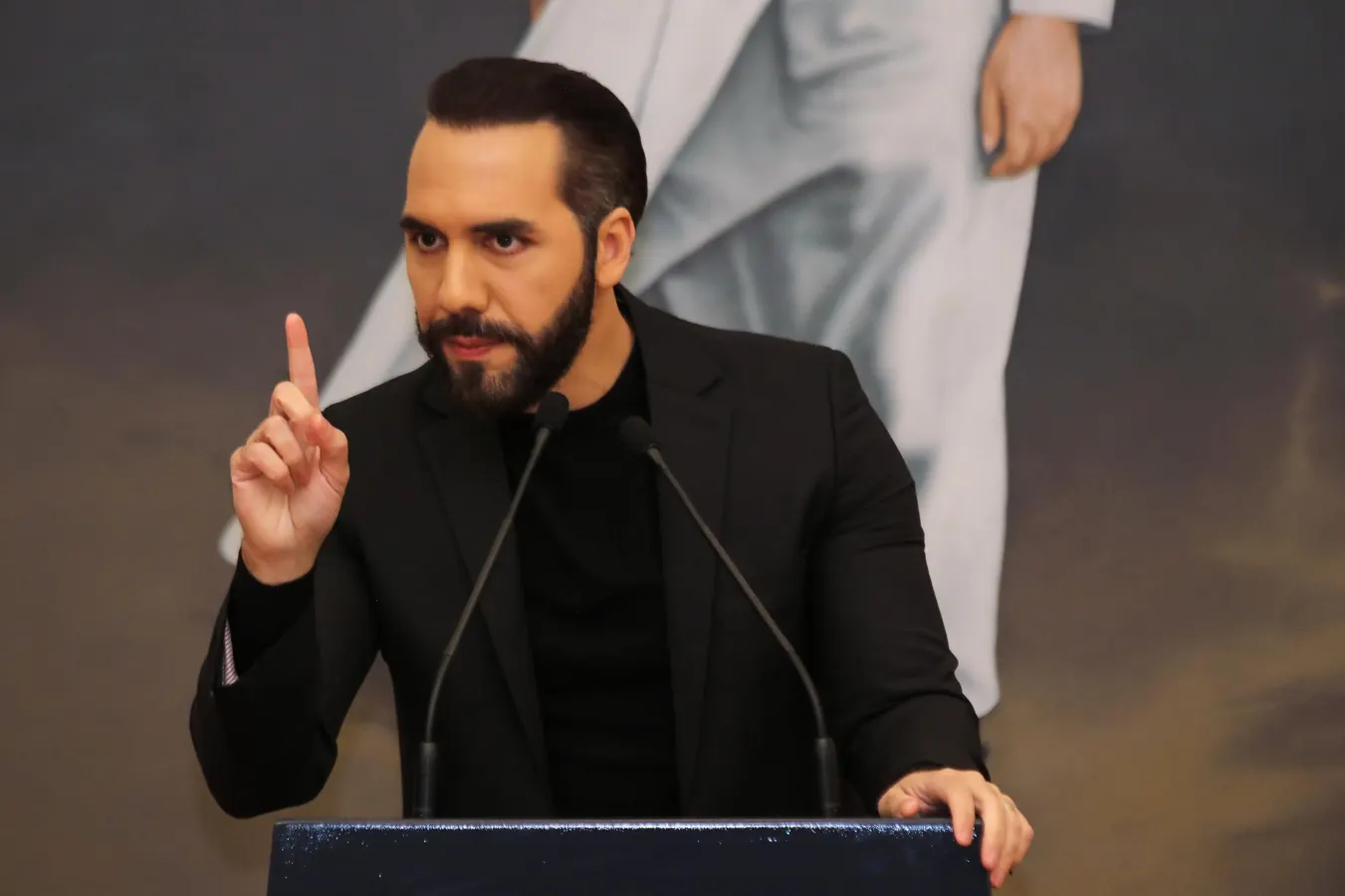

SAN SALVADOR, EL SALVADOR – JANUARY 14: President of El Salvador Nayib Bukele delivers a speech during the first press conference of the year at Casa Presidencial on January 14, 2025 in San Salvador, El Salvador. (Photo by Alex Peña/Getty Images)
Getty Images
Nayib Bukele, president of El Salvador, is the kind of guy that gets things done. In 1999, then age 18, he established his own advertising company. In 2015, he was Mayor of San Salvador, the capital. In 2017, he was ousted from his political party, the FMLN, and started his own, Nuevas Ideas. In 2019, he became president. He immediately ramped up policing, and in the process, lowered El Salvador’s homicide rate from 38 per 100,000 people in 2019, down to 1.9 in 2024.
Pretty impressive. Now what?
I propose that El Salvador should try to become as wealthy as Singapore – and the wealthiest country south of the Texas border. But how?
Although Bukele’s recent success with policing is a wonderful development, it hasn’t done much for the economy. One way of measuring whether a country is “emerging” or not, is to measure per-capita GDP (in dollars), as a percentage of US per capita GDP.
El Salvador per capital GDP in USD, as a percentage of US per capita GDP.
Federal Reserve
When we do this, we find that El Salvador’s per-capita GDP today is about 6.5% of the US standard – about the same as 1968. At least in relative standing, El Salvador has gone nowhere in sixty years; and there isn’t any evidence that any new trend has started.
In 1960, Singapore wasn’t that much better off than El Salvador. The city-state, which was already a key transportation hub, did have a number of advantages inherited from British establishment and rule. But, in 1966, per-capita GDP was only 13.7% of the US figure. Today, it is 110%.
Singapore per-capita GDP in dollars, as a percentage of US per-capita GDP.
Federal Reserve
When I look at El Salvador’s economic policies, they look … not bad … but ordinary. You won’t achieve extraordinary results with ordinary policies. It hasn’t happened, in the history of El Salvador in the past sixty years, it’s not happening now, and it will probably never happen. Bukele took extraordinary actions, with regard to policing, and achieved extraordinary things. He didn’t just sit around and say: “Well, it’s not too bad so I won’t worry about it.”
Any country that aspires to become wealthy should embrace the Magic Formula: Low Taxes, and Stable Money. I wrote a book about it, The Magic Formula (2019), which is now available in free .pdf format.
El Salvador already has the Stable Money part. It dollarized in 2001. This is not an ideal solution – the US dollar itself is not as stable in value as we would like – but it is about as good as a Latin American country can practically attain. Bukele has, rather daringly, embraced Bitcoin as a dollar alternative in El Salvador, although not much has come of it. This is because Bitcoin is far too unstable in value to serve as an effective monetary device. Bukele should follow the lead of the BRICS worldwide, and introduce a dollar alternative based on gold. This “gold based dollar alternative” could take the form of some kind of crypto stablecoin – such as Tether Gold, which has had a bump higher in popularity recently.
How about Low Taxes?
El Salvador’s personal income tax has a top rate of 30% on income of $22,857. This is not too bad, compared to the average income in El Salvador, but it also tends to cap incomes at $23,000.
The combined employer+employee payroll tax is 16%, on the first $85,000 of annual income – practically no upper limit at all. There’s also an additional 10.5% healthcare payroll tax, on the first $12,000 of income. Together, that’s a 26.5% combined payroll tax rate. In a country with an average annual household income of $9,156, this applies to most people.
Then there’s a VAT, of 13%. All together, this produced tax revenue/GDP of about 24%. For comparison, the US has about 25% tax revenue/GDP, for Federal, State and Local combined.
Corporate income tax rates are around 30%.
We find that El Salvador’s tax rates are notably higher than in the US, while the revenue/GDP is a little lower. This is evidence of significant tax avoidance. Not surprisingly, the main impetus today is toward a “crackdown” on tax avoidance.
Whenever you have to “crack down” (always the same phrases) on tax avoidance, it is evidence that your tax rates are too high, and that you would actually get more revenue from lower taxes.
How about Singapore? The top income tax rate is 24%, but that doesn’t apply until you hit a million SGD ($782,000) in income. At SGD 120,000 ($94,000), the marginal rate is 15%. There is a 9% Goods and Services Tax (sales tax), and a 17% Corporate Income Tax. There is no Payroll tax, but rather a complicated system of private accounts (with mandatory employer contributions) for healthcare and retirement savings. Singapore’s tax revenue/GDP ratio is 13.4%, about half that of El Salvador.
Singapore’s system is pretty good, but I think El Salvador can do better. I would eliminate the Income Tax altogether, at both the Individual and Corporate level. There is still a VAT, which is analogous to a 13% Flat Tax on individual and corporate income. It produces about 40% of total tax revenue today, at a moderate 13% rate. The combined 26.5% Payroll tax, on the first dollar earned, generates only 2.6% of GDP, evidence that this is widely avoided. I would cut this down to 15% and see what happens. Revenue/GDP might go up – just as happened when Bulgaria cut ten percentage points off its payroll tax rate. The US Federal payroll tax, at a rate of 15.65%, generates around 6.0% of GDP of revenue.
Probably, what we would see is that GDP starts to grow much more quickly, when there are no more Income Taxes. Thus, tax revenue would also rise, even if revenue/GDP declined. This is exactly what we saw in Ireland in the 1980s and 1990s, after big tax rate reductions. Ireland, at the beginning one of the poorest countries in Europe, became one of the wealthiest.
Of course you can add a lot of other things – regulation, education, public investment, and so forth. You should definitely do those things. If you want to know how to do it, look at Singapore today, and read the books that Lee Kuan Yew, architect of Singapore’s greatness, wrote to explain exactly how he did it.
But, I think that if you got the Magic Formula right, all these things would fall into place pretty easily. And if you don’t get the Magic Formula right, then you can attempt to do all those things, and find that it is terribly difficult, and won’t matter even if you do. This is the pattern of history, and there are not many exceptions.
If El Salvador wants to just be another mediocre Latin American country that doesn’t make much progress in the next sixty years, like it hasn’t in the last sixty, then just keep doing what you are doing. I bet it will work.
But if El Salvador wants extraordinary results, then it has to take extraordinary action. Eliminating the Income Tax, and reducing Payroll Taxes to levels that people are actually willing to pay, would almost guarantee that El Salvador’s relative per-capita GDP begins to rise.















Leave a comment