


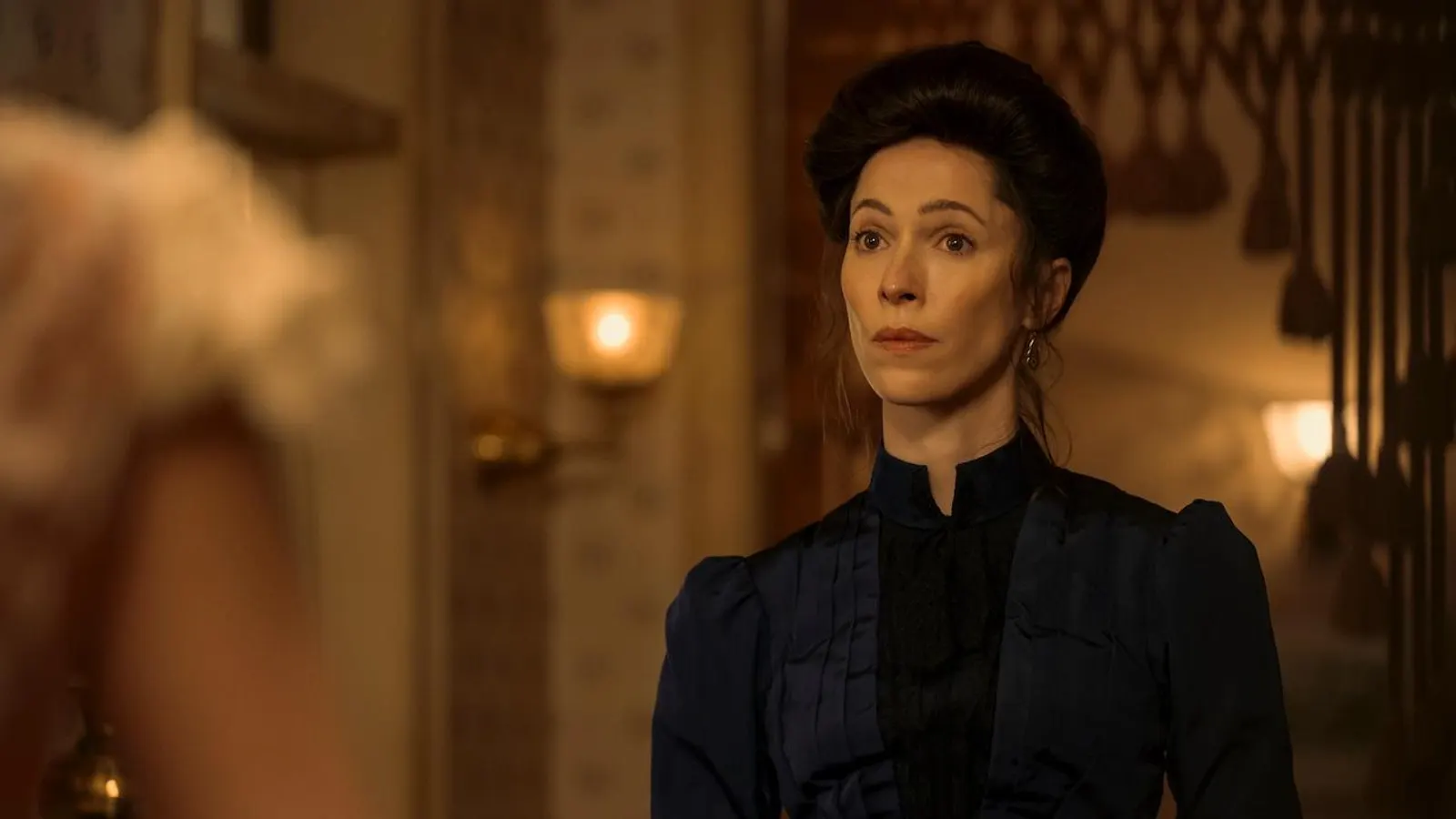

Rebecca Hall as Abby Borden in ‘Monster: The Lizzie Borden Story’ on Netflix.
PHOTO BY SUZANNE TENNER/NETFLIX
Rebecca Hall had a deliciously wicked time playing Abby Borden, Lizzie Borden’s cruel stepmother in Netflix’s Monster: The Lizzie Borden Story. Abby’s misery manifests in vicious ways, from hurling scalding-hot soup into a maid’s face, even as she licks her own bowl clean, to regularly unleashing demeaning insults at Lizzie.
Directed by Max Winkler and Sarah Adina Smith, Monster: The Lizzie Borden Story debuted at No. 1 on Netflix’s English TV list with 12.1 million views. The eight-episode season is the fourth installment of Ryan Murphy and Ian Brennan’s anthology series, following seasons about Jeffrey Dahmer, the Menendez brothers, and Ed Gein.
Created and written by Brennan, the latest season stars Ella Beatty as Lizzie Borden, with Hall as Abby, Charlie Hunnam as Lizzie’s father, Andrew, and Sarah Paulson, Vicky Krieps, and Billie Lourd also among the cast.
Charlie Hunnam and Rebecca Hall in ‘Monster: The Lizzie Borden Story’ on Netflix.
PHOTO COURTESY OF NETFLIX
The season revisits the notorious murders of Andrew and Abby Borden in Fall River, Massachusetts. Lizzie was 32 when she was arrested and charged with killing them with an ax inside their home on August 4, 1892.
The evidence against her was largely circumstantial, and after a trial in 1893, a jury acquitted her after just 90 minutes of deliberation. No one else was ever convicted, leaving the case officially unsolved. Lizzie remained in Fall River and later lived with her sister, Emma, until her death in 1927 at age 66.
Unlike her ruthless character, Hall was all smiles and quite funny in an interview ahead of the September 17 premiere. She laughed when recalling a scene in which Lizzie and live-in maid Bridget “Maggie” Sullivan attempt to kill Andrew and Abby with poisoned soup.
The couple survive but suffer horrendous food poisoning in a scene filled with violent projectile vomiting. Hall said keeping a straight face was nearly impossible. When asked how she managed it, Hall said she didn’t. “There’s a lot of footage of me not keeping a straight face, and I think whatever we have, where I am not laughing, is what made it in.”
For Hall, Abby was a dream role, thanks in part to the character’s wickedly funny dialogue. She recalled getting the call from Murphy. “He called me up and asked me to do it. He was like, ‘This part is so good; she has the best lines. It’s the part that I would want to play.’ She’s such a delicious blend. She’s the archetypal wicked stepmother for a start, but with several twists on that.”
Rebecca Hall and Ella Beatty in ‘Monster: The Lizzie Borden Story’ on Netflix.
PHOTO BY SUZANNE TENNER/NETFLIX
Hall found a way to understand Abby without excusing her behavior, seeing the character as part of the Monster franchise’s larger exploration of how people become monstrous. “She’s like all of the monsters in the Monster franchise; they’re not born, they’re created. There is an emotional backstory, and there is this kind of pain there.”
At the same time, Hall embraced Abby’s darkly comedic side. “She’s really funny. I think she’s an intensely comedic character who was also frightening at the same time, and that sort of tonal balancing act was a challenge that I really relished and really enjoyed.”
That combination is on full display in the scene when Abby throws scalding-hot soup in a maid’s face. Hall’s response to her character’s cruelty? “Well, she should have known better. I mean, Abby’s got to do something to entertain herself.”
Behind Abby’s cruelty, Hall sees a woman whose life has become painfully small. “She hasn’t got much going for her. She always struck me as the kind of character that, you know, in a different context, she would have been a star, right? She demands a lot of attention. She’s very erudite and funny and witty and quick. If she had that attention and that sort of power, she probably would have been fine. But she’s in this situation where she’s got to, you know, medicate with paint thinner and entertain herself with horrible acts of cruelty.”
Hall emphasized that understanding Abby is not the same as excusing her behavior. “I think it’s possible to be empathetic with pretty much anyone, whilst also judging their choices. You know what I’m saying? I’m not forgiving her. I think she’s a narcissistic sociopath, but I understand that’s her personality.”
Rebecca Hall as Abby Borden in ‘Monster: The Lizzie Borden Story’ on Netflix.
PHOTOP BY SUZANNE TENNER/NETFLIX
She also pointed to the losses and disappointments that shaped Abby. “She had awful grief in childhood. Then she got given over to a marriage that she thought was going to be great, and then he gives her no attention because he’s in love with his dead wife. And then she has to look after two children who aren’t her own. Then she can’t have children. Then she’s stuck in Massachusetts in Fall River, where there’s nothing happening, and she’s actually got kind of an artistic soul, but she has got no outlet for that.”
That lack of power, Hall believes, is ultimately what fuels Abby’s cruelty toward those beneath her. “She has no power, so she just has to take it out on those who have even less power than her, which is Lizzy and the maids and everyone else in the house, so that she can feel better about herself.”
And then there’s the alcohol, or, more accurately, the paint thinner. Hall points out that Abby is barely holding herself together. “She’s also drunk, let’s be clear. She is constantly drunk, but likes to think of herself as this incredibly buttoned-up society woman. She’s a hot mess in the purest sense. I didn’t shy away from the extremities of it because I think in a funny way, if you try and make a character like that likable, you’re just softening the edges. And actually what we like about the character is her extreme messiness. She’s a complete liability, and she’s awful, and that’s what becomes actually intoxicating about her. You can’t quite believe it. I just embraced that.”














Leave a comment