


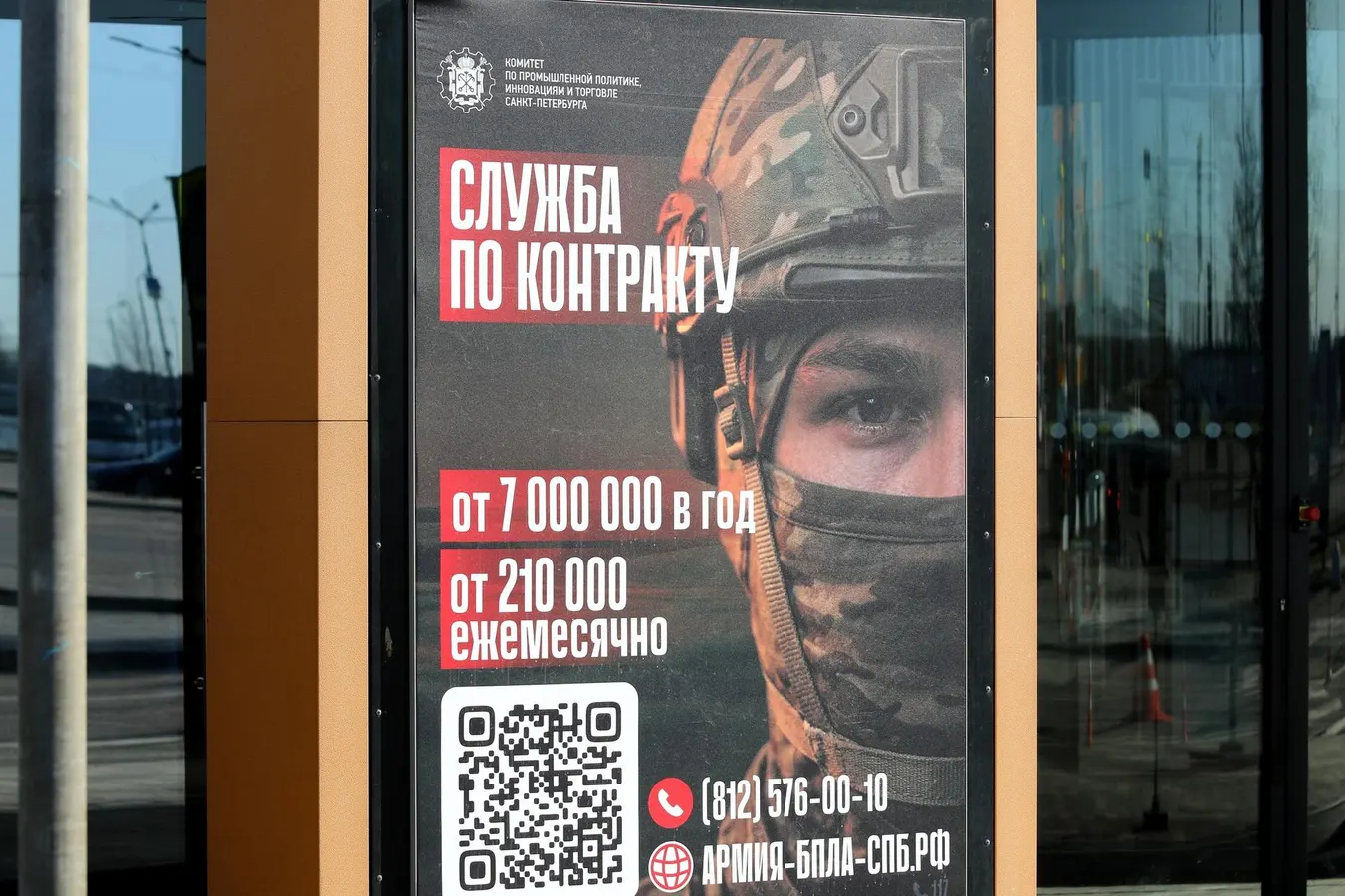

SAINT PETERSBURG, RUSSIA – 2026/04/02: An inscription on an advertising poster in St. Petersburg, Russia: “Contract service.” It is indicated that a potential salary of up to 7 million rubles (87,045 USD) per year and from 210,000 rubles (2,611 USD) per month. (Photo by Maksim Konstantinov/SOPA Images/LightRocket via Getty Images)
SOPA Images/LightRocket via Getty Images
After more than four years of fighting, Russia has taken a toll in its full-scale invasion of Ukraine. On July 1, the Center for Strategic and International Studies published a report stating that the Russian Federation has suffered 1.4 million battlefield casualties. The CSIS report also found that Russia’s casualty rate in 2026 alone has been significant, with the Russians averaging roughly 30,000 casualties a month. CSIS estimates that the ratio of Russian to Ukrainian military casualties has reached roughly 8:1. Despite these losses, the Institute for the Study of War found that the Russian Federation has “failed to make any operationally significant gains” during its spring and summer offensives this year.
The Russian Federation has experienced additional losses. Business Insider has reported that Ukraine has damaged or destroyed “around half of the Russian fleet’s warships” on the Black Sea, and that Russia had lost “at least two-thirds of its tanks since it launched its invasion of Ukraine.” Meanwhile, the Atlantic Council has found that the Russian Federation has lost tens of billions of dollars in oil and gas revenue. Additionally, Russia has lost billions of dollars due to sanctions imposed by the international community. Finally, Ukraine has used drones to strike Russian oil and gas refineries, which has led to a rise in fuel prices in Russia.
As a result of these losses, Russian Central Bank Governor Elvira Nabiullina has warned that Russia could face labor shortages. Russian President Vladimir Putin has also acknowledged that the Russian Federation is facing an economic slowdown.
“Russia’s war on Ukraine, in the last six months or so, has resulted in persistent everyday inconveniences for the Russian people,” Andrew D’Anieri, an Associate Director at the Atlantic Council’s Eurasia Center, told me in an interview. “Fuel prices have increased as a result of Ukrainian strikes on oil and gas refineries. Those same strikes have prompted petrol rationing and shortages for automobiles. Meanwhile, drone incursions on military installations have regularly delayed dozens of flights across Russia. Similarly, summer camps and vacation hotspots in occupied Crimea have been closed. Finally, inflation in Russia is once again rising.”
Nevertheless, Meduza reported on June 24 that “Russian authorities are discussing a new wave of mobilization after the State Duma elections” this autumn. Then, the Institute for the Study of War wrote on July 28 that “Kremlin officials are reportedly considering a wide range of options to support a potential mobilization.”
Putin last announced a partial mobilization of 300,000 reservists in September 2022 as Russia looked to gain ground in Ukraine. Nearly one million Russians fled the country in the year following the invasion. Since then, the Russian Federation has attempted to incentivize volunteers by offering sign-on bonuses, raising salaries, and providing tax breaks. Despite this, The Wall Street Journal reported on August 2 that voluntary recruitment in Russia has stalled.
“Russians generally are tired of the war and want it to end,” Dr. Brian Taylor, the Director of the Moynihan Institute of Global Affairs at Syracuse University, told me in an interview. “They are well aware that the full-scale war against Ukraine started in 2022 has already lasted longer than the ‘Great Patriotic War’ against Nazi Germany. This war weariness does not mean, however, that Russians want peace at any price, or that they will protest against the war.”
A poll conducted by the Levada Center, published in March, found that 67% of surveyed Russians believe that peace negotiations with Ukraine are now necessary. Additionally, only 24% of the surveyed participants believed that Russian military action in Ukraine should continue.
Nonetheless, the fighting persists. Some experts predict that, if a mobilization were to occur, these additional Russian troops would be used for Putin’s campaign in the Donbas. The Moscow Times has reported that Putin “intends to secure full control over the Donbas region of eastern Ukraine.” According to a Reuters calculation based on Russian assessments, the Russian Federation controls more than 90% of the territory in the Donbas, which consists of the Donetsk and Luhansk Oblasts (regions) of Ukraine.
“If Putin does decide to mobilize, he will do so because he sees battlefield advantage in doing so. He has said time and again that Moscow wants to take all of Donetsk and Luhansk Oblasts. Russian gains in those areas have been grindingly slow and hugely costly for a few years now. So far, they have used ‘meat grinder’ tactics—throwing as many bodies as necessary into the fight—to try to achieve these goals. It is possible the Kremlin believes mobilization will help finally deliver those territories, though battlefield evidence suggests that might be unlikely,” D’Anieri told me.
Similarly, Taylor said that Putin remains determined for the war in Ukraine to continue. He noted that Putin’s goal is to seize the Donbas, “despite the massive losses the Russians have incurred over the last four and a half years.” He added, however, that a “new influx of Russian troops would be unlikely to change the war significantly.”
Still, it is uncertain if or when another mobilization in Russia will occur. What is known, however, is that casualties have mounted for the Russian Federation this year, and that the Russian economy is beginning to strain. What impact this will have on the Russian government’s decision to mobilize, if any, will remain to be seen.
Observers of the Russia-Ukraine War, supporters of Ukraine, and Russia analysts will continue to monitor the situation closely, especially as Russia prepares for the State Duma elections this September. This is an event that Meduza, the Institute for the Study of War, and others have flagged as the likely trigger point for mobilization in Russia if any comes.













Leave a comment