


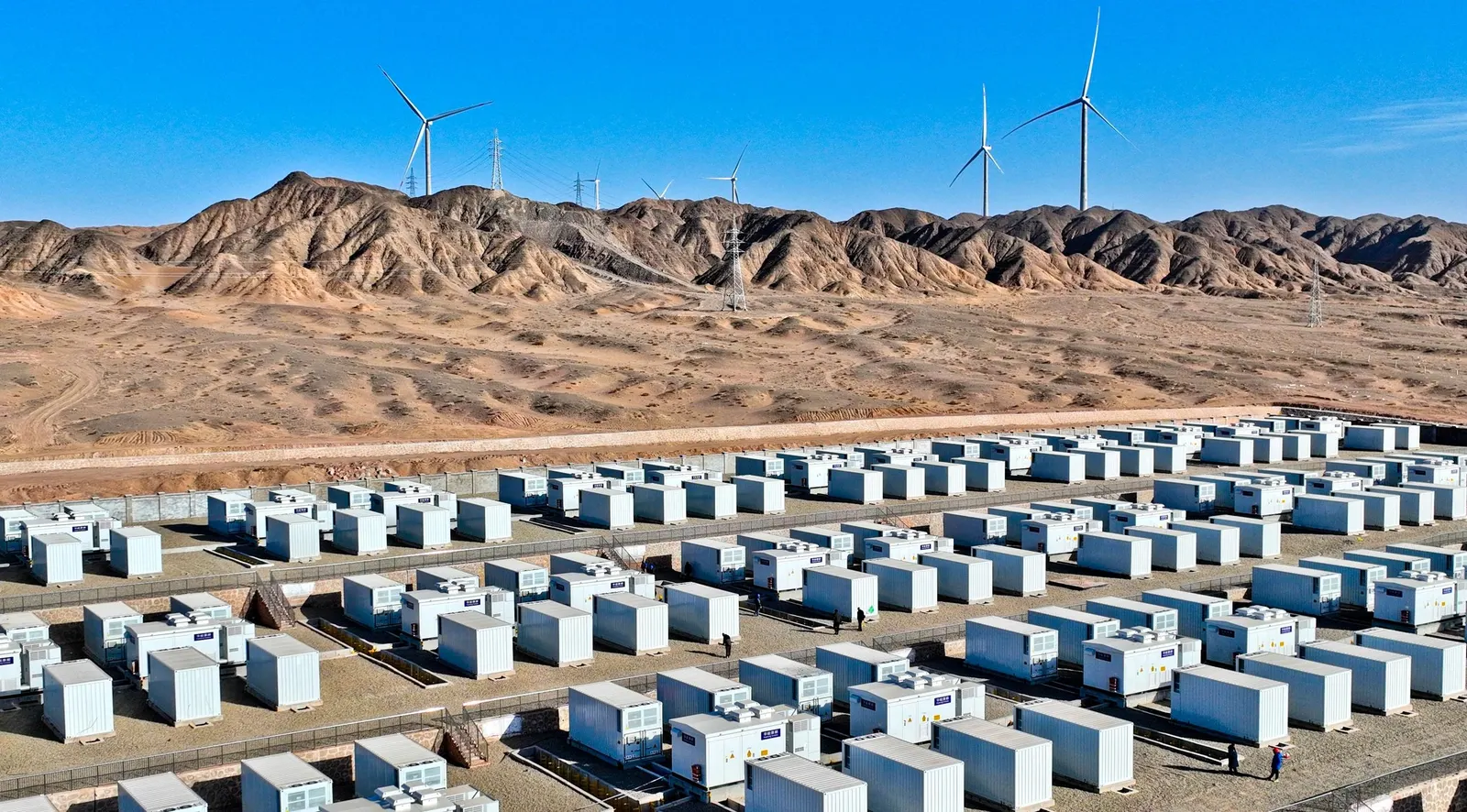

The constructors adjust the storage battery container at the construction site of the 300MW/1200MWh independent energy storage project in GaoTai County, Zhangye City, Gansu Province, China, on January 15, 2026. (Photo by Costfoto/NurPhoto via Getty Images)
NurPhoto via Getty Images
For the past several weeks, I have been working my way through the major findings in the Energy Institute’s 2026 Statistical Review of World Energy. This article concludes that series.
For readers who want to catch up, the previous installments are:
I saved battery storage for last because it is newer and still much smaller than the major sources of energy covered in the previous articles. But measured by growth, batteries may be the most remarkable story in the entire Statistical Review.
Global battery energy storage system capacity reached 301.7 gigawatts in 2025, up from 182.0 GW in 2024. That is a one-year increase of nearly 120 GW, or 65.8%.
Go back a decade, and the numbers become almost difficult to believe. Global installed battery capacity stood at just 1.9 GW in 2015. In ten years, it increased by a factor of about 158.
That works out to an average annual growth rate of roughly 66%.
Why Batteries Are Becoming So Important
That growth is closely connected to another major trend I discussed in the previous article: the extraordinary expansion of solar power.
Solar generation has become cheap enough to deploy at enormous scale, and in 2025 it surpassed wind in global electricity generation for the first time. But solar has an obvious limitation. Its output peaks during daylight hours, and electricity demand doesn’t disappear when the sun goes down.
Battery storage changes that equation.
A battery can absorb electricity when generation is abundant, then return it to the grid later when electricity is more valuable. That can help shift solar production into evening demand periods, reduce curtailment, provide frequency regulation, smooth short-term fluctuations, and reduce the need to start other generating resources during periods of high demand.
There is an important distinction in the Statistical Review data. Capacity here is reported in megawatts, which measures how much power the battery fleet can deliver at a given moment. It does not tell us how much total energy the batteries can store. That would be measured in megawatt-hours.
A 100-MW battery capable of operating for one hour is quite different from a 100-MW battery that can operate for four hours. So, these numbers should not be interpreted as a complete measure of stored energy. But they provide an excellent picture of how rapidly battery power capacity is being added to electric systems.
China Accounts for Nearly Half the World’s Capacity
As with solar, wind, and increasingly nuclear power, China dominates the battery-storage numbers.
China finished 2025 with about 144.1 GW of installed battery capacity. That represented nearly 48% of the global total.
A year earlier, China’s capacity stood at 79.5 GW. Thus, China added almost 64.6 GW in a single year, more than half of all the new battery capacity installed worldwide.
The longer-term growth is even more dramatic. China had only about 115 MW of battery capacity in 2015. Its 2025 total was more than 1,200 times larger.
Most of China’s capacity is front-of-the-meter storage, meaning large systems connected directly to the electric grid rather than batteries installed behind a customer’s meter. China’s front-of-the-meter capacity reached nearly 134 GW in 2025.
That makes sense in the context of China’s enormous renewable buildout. The country is simultaneously adding solar panels, wind turbines, nuclear reactors, transmission, and batteries at a scale unmatched anywhere else.
The U.S. Is a Distant Second, but Growing Rapidly
The United States ranked second with 56.6 GW of installed battery capacity in 2025, representing almost 19% of the global total.
U.S. capacity increased from 34.7 GW in 2024, a gain of more than 21.9 GW, or about 63% in a single year.
The U.S. market is also more balanced between utility-scale and behind-the-meter installations than China’s. Front-of-the-meter capacity reached approximately 43.3 GW, while behind-the-meter capacity totaled about 13.3 GW.
A decade ago, total U.S. battery capacity was only about 354 MW. The 2025 figure is roughly 160 times larger.
China and the United States together now account for about two-thirds of the world’s installed battery capacity. They also supplied more than 70% of the increase in global capacity last year.
Europe and Australia Are Scaling Quickly
Europe collectively finished 2025 with about 57.7 GW of battery capacity, slightly more than the United States. Germany was Europe’s leader at 17.5 GW, followed by Italy at 9.2 GW and the United Kingdom at 9.0 GW.
Germany’s market is notable because most of its capacity is behind the meter. Of its 17.5 GW total, roughly 14.4 GW was installed on the customer side of the meter.
Australia also stands out. Battery capacity nearly doubled during 2025, rising from 6.6 GW to 12.6 GW. That gave Australia more than 4% of worldwide capacity despite having a relatively small population.
There are dramatic percentage increases elsewhere, although they come from much smaller bases. Saudi Arabia jumped from just 35 MW in 2024 to more than 2 GW in 2025, largely through new front-of-the-meter capacity. Chile more than doubled to approximately 2 GW.
Utility-Scale Storage Is Growing Fastest
The global totals also show an interesting shift in where batteries are being installed.
I calculate roughly 224 GW of front-of-the-meter battery capacity worldwide in 2025, versus about 78 GW behind the meter. That means approximately three-quarters of global battery capacity is now on the grid side of the meter.
Front-of-the-meter capacity increased by roughly 72% in 2025, compared with about 51% growth for behind-the-meter systems.
This is an important evolution. Batteries aren’t merely becoming more common in homes and businesses. They are increasingly becoming pieces of utility infrastructure.
Ten years ago, batteries were still frequently discussed as something that might eventually allow large quantities of intermittent renewable power to be integrated into the grid. Increasingly, that is no longer a theoretical discussion. The infrastructure is actually being built.
The Big Picture
Battery storage remains small when compared with the enormous generating fleets built around coal, natural gas, nuclear, hydro, wind, and solar. Batteries also aren’t an energy source. They don’t generate a single kilowatt-hour. Every unit of electricity they return to the grid must first have been generated somewhere else.
But that misses their importance.
Batteries can change when electricity is available. As solar becomes an increasingly important part of global generation, that capability becomes much more valuable.
The 2026 Statistical Review shows a global energy system that remains heavily dependent on fossil fuels even as renewable generation expands at extraordinary rates. That tension has been a recurring theme throughout this series.
Battery storage sits directly in the middle of that tension. It cannot eliminate the intermittency of renewable energy, nor can today’s batteries replace every form of dispatchable generation. But storage can make rapidly growing solar and wind resources more useful to the grid.
Going from 1.9 GW to more than 300 GW in a decade suggests the market has reached a very different stage. Battery storage is no longer an experiment at the margins of the electric grid. It is becoming part of the grid itself.
















Leave a comment