


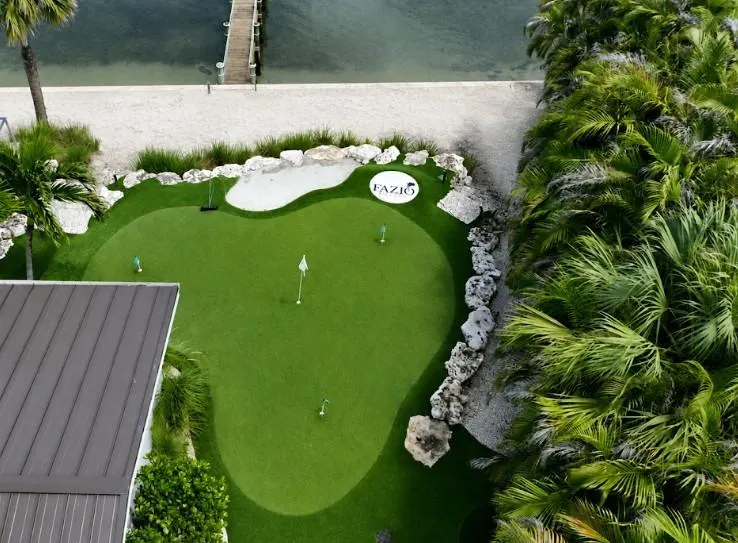

Tom Fazio’s design company will be creating courses — including simulated holes and physical greens —for CityGolf USA, which is debuting its first location in Nashville in late 2026.
Fazio Design Technologies
Renowned golf architect Tom Fazio, who counts nine original course designs among Golf Digest’s ranking of the Top 100 U.S. courses, is taking his craft to a new medium.
Fazio has partnered with CityGolf USA, an operator that is launching the first 18-hole indoor golf course this winter in Nashville, a concept that combines simulator technology with real-world green complexes that are made of artificial turf but play like the real thing.
Fazio Design Technologies will create a series of innovative courses specifically for CityGolf locations, including the 174,000-square-foot flagship venue in Tennessee that’s the size of three football fields. With these innovative indoor courses being open 19 hours a day (or possibly more), operators forecast between 150,000 to 200,000 rounds per year, per site, with almost 90% of those being public.
“FDT and CityGolf USA are committed to providing a one-of-a-kind environment and entertainment venue that is unmatched,” said Fazio, whose top real-world designs include courses such as Shadow Creek in Las Vegas, Congaree in South Carolina, Gozzer Ranch in Idaho, Victoria National in Indiana, the Estancia Club in Arizona and Diamond Creek in North Carolina. “The ability to design and create unique golf courses for CityGolf USA has been seamless and we look forward to people all over the United States having the opportunity to play them.”
Tom Fazio has designed golf courses across the country, but some of his newest designs will be entirely different. (Photo by Mark Boster/Los Angeles Times via Getty Images)
Los Angeles Times via Getty Images
Play Puzzles & Games on Forbes
CityGolf USA is building on a model that started in Asia and refining it for the American market, including more of an entertainment and socially focused experience. All locations will include a restaurant and bar, private event spaces, and separate driving-range bays for corporate and social gatherings.
But some of the biggest differences are on the course itself, which features 18 individual hitting bays and 18 individual and unique greens. Players will move from bay to bay throughout a round, teeing off and playing shots on the GOLFZON simulator screens until they reach the green area. At that point, the screen lifts and participants walk through to finish the hole at the realistic green complex.
Unlike the version that first launched in China, which has poured concrete under relatively flat greens, the Fazio-designed greens at CityGolf USA locations will have crushed rock and padding beneath the undulating synthetic grass surfaces to replicate the feel of real putting and chipping. Bunkers around the green will have real sand and can have steep-faced walls up to three feet high.
With real-world short game play, there are safety concerns too, such as having berms around the various green complexes and some kind of plexiglass of similar dividers in certain areas – not unlike the protection found at a hockey rink – in case someone blades a 70-foot chip shot that flies over their green.
“What I was most impressed by is it’s real golf,” said CityGolf USA CEO Tony Graffia Jr., who is also the Managing Partner of Nessie Capital and tried the concept internationally before bringing what he calls a ‘uniquely American’ version to the U.S. “It didn’t feel like a video game. I felt the pressure of making the putts and 3-putted my first hole with a group watching me play. And then I was wowed by the technology.”
Fazio Partnership
Shadow Creek Golf Course in Las Vegas, Nevada, is one of Tom Fazio’s most famous designs. (Photo by Harry How/Getty Images)
Getty Images
The partnership with the Fazio brand adds cache and legitimacy to the concept, with a concerted effort to integrate real-world course strategy with both digital and live shot making.
Gavin Fazio, who is Tom’s son and the founder of Fazio Design Technologies (FDT), said he’s excited to help bring a completely new and innovative golf concept to a U.S. market that continues to embrace alternative forms of “off-course” participation.
The past four years have seen more Americans playing away from the course – at golf entertainment complexes, indoor simulator facilities or driving ranges – than the number of golfers who play on a real course, according to the National Golf Foundation. That off-course participation number climbed to almost 38 million in 2025, even as traditional golf has enjoyed surges in play and players.
“We are looking forward to introducing a concept that will appeal to everyone — from passionate golf enthusiasts and social players to beginners who are just discovering the game,” said Gavin Fazio. “Creating new and unique digital golf environments that would traditionally require a much bigger footprint expands what is possible in the world of golf.”
Indoor Golf Model
The indoor golf concept can allow a foursome to tee off just before midnight, even if there’s snow on the ground or a storm outside.
A smaller version of an indoor green used to promote the CityGolf concept at the PGA Merchandise Show in January 2026.
Erik Matuszewski
And while the model in China is largely private, the CityGolf USA focus is on keeping it largely open to the public, with a small membership that gets access to premium tee times. As for the cost, pricing will fluctuate depending on time and day of week, with discounts for juniors, seniors, military, and other groups.
“I keep telling people, I’ve got to deliver a $300 experience for a $100 price point,” said Graffia, who’s made a career out of finding and investing in products outside the U.S. that he believes will have real traction with the American consumer.
“If I do that, people will just continue to keep coming and coming. Now, will it always be $100? No, sometimes it’s going to be $30 because we’re off hours. Sometimes it’ll be $60. At 9 o’clock on a Friday night, you know that’s going to be a more expensive time to play than a Tuesday at 10 a.m.”
First Location and Others to Come
While there had been plans to have the first CityGolf USA location in Chicago, the permitting process slowed things down considerably. Chicago is still in the future plans, along with markets such as Indianapolis, Columbus and Minneapolis.
After players tee off and play their approach shots in a simulator bay at CityGolf, the screen rises up to let them walk through to the physical green complex.
Erik Matuszewski
Graffia said he’s had city leaders in states such as Texas and California reach out and offer to pay for entire CityGolf venue builds, which can run between $10 million and $15 million, with essentials such as technology, air conditioning, and hospitality helping drive prices up well beyond green complex designs. One positive is that indoor courses don’t need to worry about drainage or irrigation.
Graffia said there’s even been interest from a golf mecca like Myrtle Beach, where a CityGolf USA venue could provide an all-day indoor option to help satisfy the enormous existing demand in the area.
And when it comes to actual course design, there’s far more flexibility in this new medium – one that other true golf architects, including Beau Welling, Agustin Piza and Gil Hanse – have ventured into with fully simulated holes for the TGL indoor league. The landscape upon which holes are laid out can be much more severe at CityGolf USA than a normal course, at least up to the greens. Designers on the Fazio team don’t have to be concerned about whether golf carts can traverse the terrain, or if the mountain or desert setting is too inhospitable.
A rendering of the CityGolf venue in China. The ‘Americanized’ version in the U.S. will be considerably different in look and feel, including a more social feel and entertainment concept along with more realistic play on the greens.
Golfzon
And soon golfers will get to experience the newest entry in the world of off-course golf for themselves.
“They’ve designed a bunch of different holes in different places that just weren’t playable. Those are the kinds of things they can bring in,” said Graffia. “I saw the 18th hole of one of the greens they’ve designed and it’s literally on an island. You’re on an island hitting to the fairway and then hitting to another island. So, we can make some really cool experiences that you can’t do on a regular golf course.”














Leave a comment