


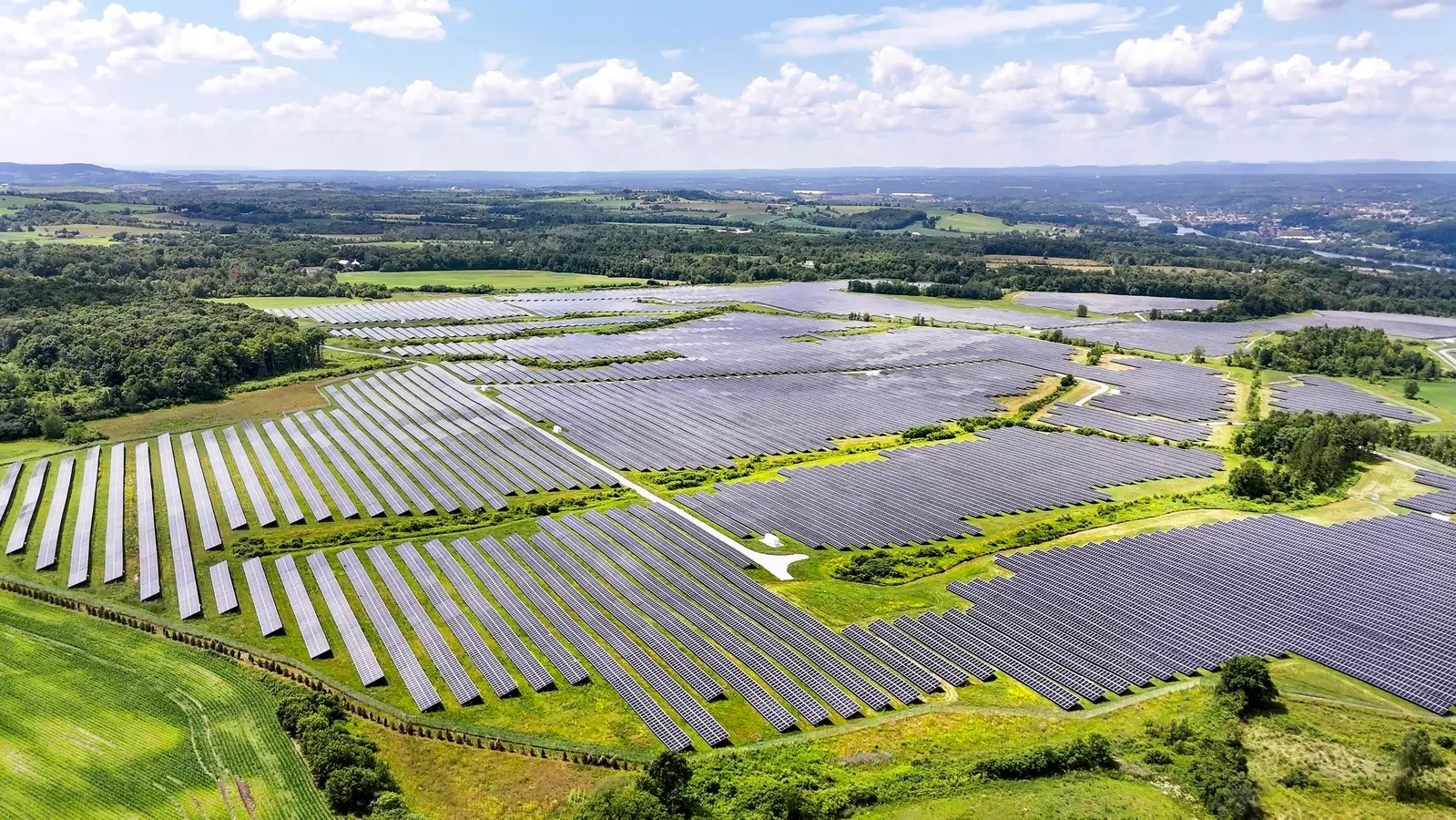

Aerial view of rows of solar panels covering a large portion of farmland in Amsterdam, New York, on July 9, 2026. (Photo by John Paraskevas/Newsday RM via Getty Images)
Newsday via Getty Images
For more than a century, coal has helped keep America’s lights on. It powered our country’s industrial expansion, anchored the electric grid, and became a fixture of nearly every major debate about American energy. But this spring, something changed.
In May 2026, solar generated more electricity in the U.S. than coal for the first time on record. Solar supplied 12.8 percent of the nation’s electricity that month, compared with 12.2 percent from coal. Solar, in the process, became our third-largest source of electricity, trailing only natural gas and nuclear power.
It’s an important milestone. But perhaps more important is why it happened. Because this was not the result of a new federal mandate or a single piece of legislation. Rather, it was the visible result of a much larger change in the economics of electricity. Solar costs have fallen dramatically, deployment has accelerated, and utilities and developers are increasingly turning to solar to meet growing electricity needs.
The great solar-coal flip is worth paying attention to, marking a transition that is increasingly being driven by markets, technological innovation, and consumer demand.
First used primarily in satellites, solar technology became commercially viable on Earth as costs fell in the 1970s. Since then, deployment has surged while module prices have plummeted. This powerful “learning effect” creates a virtuous cycle: greater production lowers costs, and lower costs drive further adoption. Remarkably, for more than four decades, each doubling of global solar capacity has produced a consistent 20% decline in price.
Max Roser, Our World in Data
The Economics Have Changed
Sunlight is free. In financial advisory firm Lazard’s 2025 analysis on the cost of energy, solar and onshore wind remained the most cost-effective forms of new electricity generation in the U.S. This makes sense. Solar and wind generators have little to no fuel bill once they are up and operating. Their economics, therefore, differ fundamentally from those of fossil-fuel generators, which must continually purchase coal or natural gas to produce electricity.
Further, the technology behind solar has become more affordable. The cost of solar panels has dropped by an astounding 99% since the 1970s, while panel efficiency continues to improve – meaning fewer panels are needed to generate the same amount of energy.
U.S. President Jimmy Carter speaking in front of Solar Panels placed on West Wing Roof of White House, announcing his solar energy policy on June 20, 1979. Today’s solar panels are 99% cheaper than the solar energy of the 1970s, and exponentially more effective in electricity generation.
Universal History Archive/Universal Images Group via Getty Images
To be clear, this doesn’t mean that solar is always the cheapest source of electricity at every hour of every day. Solar is intermittent, varying within the time of day and weather, and its value depends on where a project is located, how much transmission is available, how much electricity consumers need at that moment, and whether storage or other resources are available on cloudy days or after dark. These limitations are important. But they do not erase the underlying economic advantage.
For a country that needs to add enormous amounts of electricity-generation capacity quickly, we need technologies that can be built at scale, at competitive cost, and on a timeline that matches rapidly growing demand. Increasingly, solar is one of the answers that meets these requirements. And nowhere is this more visible than Texas.
Texas Leads In Solar Energy
If you want to see the economics of the new power system playing out in real time, you don’t have to look to California. Just look to Texas.
Texas has become the country’s solar growth engine. In 2024, it surpassed California as the state with the most utility-scale solar capacity, becoming the national leader. The gap is poised to grow. The U.S. Energy Information Administration (EIA) expects developers to add 43.4 gigawatts of utility-scale solar capacity across the U.S. in 2026. Texas, alone, is expected to account for roughly 40 percent of this.
Aerial drone view above Mueller District, a solar panel community in Austin, Texas.
getty
Texas has several advantages that make solar particularly attractive. It has enormous amounts of open land, strong solar resources, and a large and growing electricity market. Most of the state’s grid is operated by the Electric Reliability Council of Texas, or ERCOT, whose system operates largely independently of the rest of the country’s major regional grids.
But perhaps the biggest factor is demand. Texas is experiencing some of the fastest electricity-demand growth in the country, driven in part by data centers, cryptocurrency mining, manufacturing and other large electricity users that are putting new pressure on the grid. At the same time, developers are looking for generation that can be brought online quickly and affordably. Solar is particularly well suited to meet that need.
The result is a striking feedback loop. Texas needs more electricity, developers need generation that can be deployed at scale, and solar is increasingly one of the technologies best positioned to fill that gap. It’s a genuinely exportable blueprint for other states, red or blue.
Between 2009 to 2024, the price of electricity from solar has declined by 88%, from $496/MWh (one megawatt of electricity used or produced per hour) to $60/MWh, dropping below both coal and gas in price.
Pablo Rosado and Max Roser, Our World in Data
Beyond The Wattage
Closer to home, in Tennessee, solar power isn’t just winning on price. It’s also changing the way we think about land. Large solar installations require substantial amounts of land, and their expansion can create legitimate conflicts with agriculture, ranching, and other land uses. But solar doesn’t necessarily have to displace agriculture. In some places, the two can coexist. The practice is known as agrivoltaics, using the same land for both solar energy production and agriculture.
Nashville-based Silicon Ranch has spent years developing solar-grazing systems in which livestock graze beneath and around solar panels. Sheep can manage vegetation around the panels, reducing the need for mechanical mowing, while the panels provide shade and alter the microclimate experienced by the animals and vegetation.
The author, Senator Bill Frist, visiting a Silicon Ranch installation on a farm in Lee County, Georgia on September 5, 2025. Silicon Ranch’s in-house shepherds manage the farm’s large resident flock of sheep intentionally to restore approximately 2,100 acres of land to a functioning grassland ecosystem, improving soil health, water quality, and biodiversity. In recognition of their pioneering work there, Silicon Ranch received the Lee County Chamber of Commerce 2024 Partner in Agriculture Award.
Bill Frist, MD
The concept is simple. Use the same piece of land for more than one purpose. It’s a win for farmers too. They get a steady, guaranteed income stream on top of their existing operations, and in many cases get to expand flocks they didn’t have the pasture for. Texas is seeing a version of this too, as solar developers there increasingly lease land to ranchers instead of displacing them.
Early research is also exploring whether regenerative grazing and solar generation can provide environmental and economic benefits beyond electricity production alone. Silicon Ranch and its research partners, for instance, are studying how these systems can affect vegetation, soil composition, and other ecological characteristics within solar installations. And there does seem to be at least one more small bonus. Australian sheep raised under these types of solar installations, shaded and shielded from dust and burrs, are producing measurably better wool than flocks in open pasture.
A Different Kind of Energy Transition
Solar power is spreading. And it’s proving to be a reliable and cost-efficient energy source that is good for the planet, good for people, and good for animals, too. Undoubtedly, this year’s solar-coal flip is more than a symbolic changing of the guard. It is a snapshot of our power system being modernized in real time. And it’s exciting.
Large solar panel array near Brodheadsville, Pennsylvania, situated adjacent to agricultural fields and a small commercial area with parking at sunset. Rolling hills, farmland, buildings, and silos visible in the distance, showcasing blend of modern renewable energy technology with traditional rural landscape.
getty
The transition will not happen overnight, nor will it happen everywhere at the same speed. And we will continue to need a diverse electricity system including natural gas, nuclear power, hydropower, wind, and other resources to keep the grid reliable around the clock. But the direction is clear. Solar power is no longer a niche technology waiting for the future. It’s here. And it’s already one of the central technologies shaping the future of the American power grid.















Leave a comment