


Topline
Beijing-based artificial intelligence startup Moonshot is preparing a confidential Hong Kong initial public offering that could value the company at up to $50 billion, a record for a Chinese native AI company, provided it can resolve an escalating equity dispute with former shareholders.
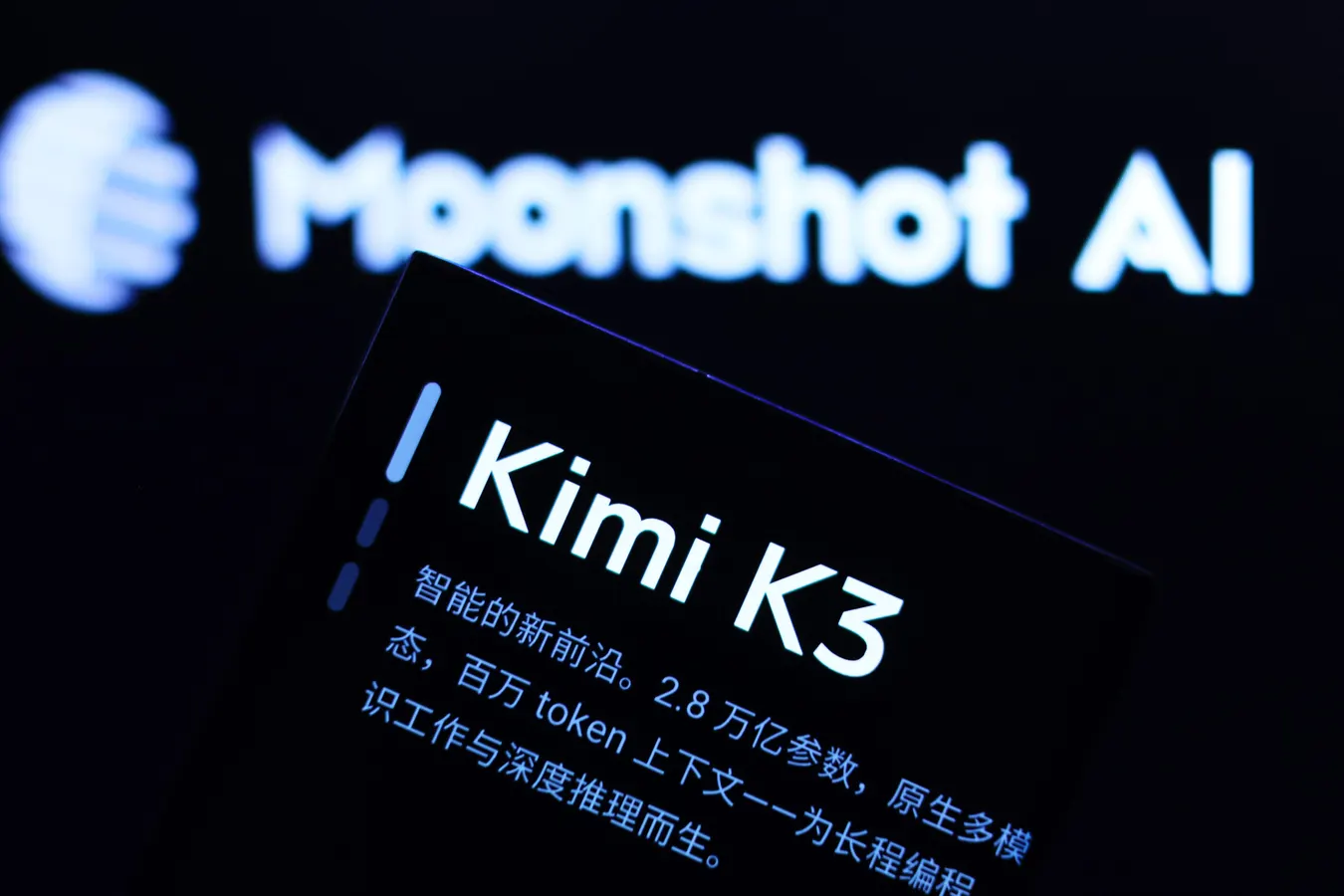
The logo of Kimi K3 is displayed on a smartphone screen on July 17, 2026.
VCG via Getty Images
Key Facts
Moonshot AI, the company behind the popular Kimi K3 chatbot model, has confidentially filed for a Hong Kong IPO targeting a $50 billion valuation and is aiming to raise between $3 billion to $5 billion.
The company, however, is reportedly locked in out-of-court settlement talks to resolve a $700 million legal claim from early investors who’ve accused CEO Yang Zhilin and chief technology officer Zhang Yutao of misconduct and launching the high-profile startup without proper board authorization.
Software developer Recurrent.ai, co-founded by Yang and Zhang Yutao in 2016, and some of its investors claim the pair breached their fiduciary duties by secretly transferring key server infrastructure and intellectual property directly from Recurrent to Moonshot to launch the new company without reimbursement or board approval.
Yang and Zhang Yutao are also accused of concealing their Moonshot equity stakes and keeping Recurrent’s early venture capital backers in the dark about their new ownership roles while winding down their active involvement in Recurrent, Reuters reported.
The claimants are seeking compensation equal to 10.5% of Moonshot’s original shares, which could be worth more than $700 million based on a June funding round.
Yang has denied the allegations and an attorney for Moonshot told Chinese media the case “lacked both legal and factual basis.”
HOW COULD THE ALLEGATIONS IMPACT THE IPO?
Regulatory experts have said Moonshot’s unresolved legal dispute could mean regulatory hurdles, investor skepticism and massive financial exposure ahead of its would-be IPO. Quartz News reported that while arbitration may not outright cancel the public listing, strict Hong Kong Stock Exchange disclosure rules mean it could give pause to potential investors and add friction to the listing. The ongoing arbitration also brings escalating financial stakes for Moonshot: because Recurrent.ai’s claim is pegged to a 10.5% compensation, the potential liability swells dramatically at its $50 billion IPO target.
WHAT TO WATCH FOR
The Moonshot IPO. Reports indicate it could come as soon as Q1 2027 and, if completed, it would be the world’s largest pure-play generative AI IPO and the largest tech listing in Hong Kong since 2021.
Key background
Yang founded Moonshot in 2023 and it’s now considered one of China’s six premier “AI Tigers”—the elite cluster of frontier labs leading Asia’s generative AI push. Its early large language model, Kimi, was among the first to allow users to process entire books, codebases and massive documents before Western competitors made long-context standard. It pulled in billions of dollars in consecutive funding rounds from Chinese tech giants including Alibaba, which acquired a 36% equity stake and provided the startup with crucial cloud computing infrastructure. Earlier this year, Moonshot released its Kimi K3 model, purportedly the world’s largest open AI model and it a direct challenger to LLMs offered by Anthropic and OpenAI. Kimi K3 is an open-weight model, meaning it allows developers to download, run and modify the AI, unlike proprietary models ChatGPT and Claude, whose underlying systems are private. The release of Kimi K3 sparked intense debates in Washington and Silicon Valley over open-source AI regulations and U.S. technological lead times.
TANGENT
China’s AI Tigers—Z.ai, Moonshot AI, MiniMax, Baichuan, StepFun and 01.AI.—are aggressively utilizing Hong Kong IPOs to secure expansion capital. Z AI and MiniMax both went public in January and raised about $550 million and $600 million, respectively, at valuations of roughly $6.5 billion each. StepFun is also preparing for a Hong Kong IPO in early 2027. The trend is starkly different from in the United States, where market leaders like OpenAI and Anthropic remain private and firms face intense IPO skepticism over cash burn rates and high entry multiples.












Leave a comment