


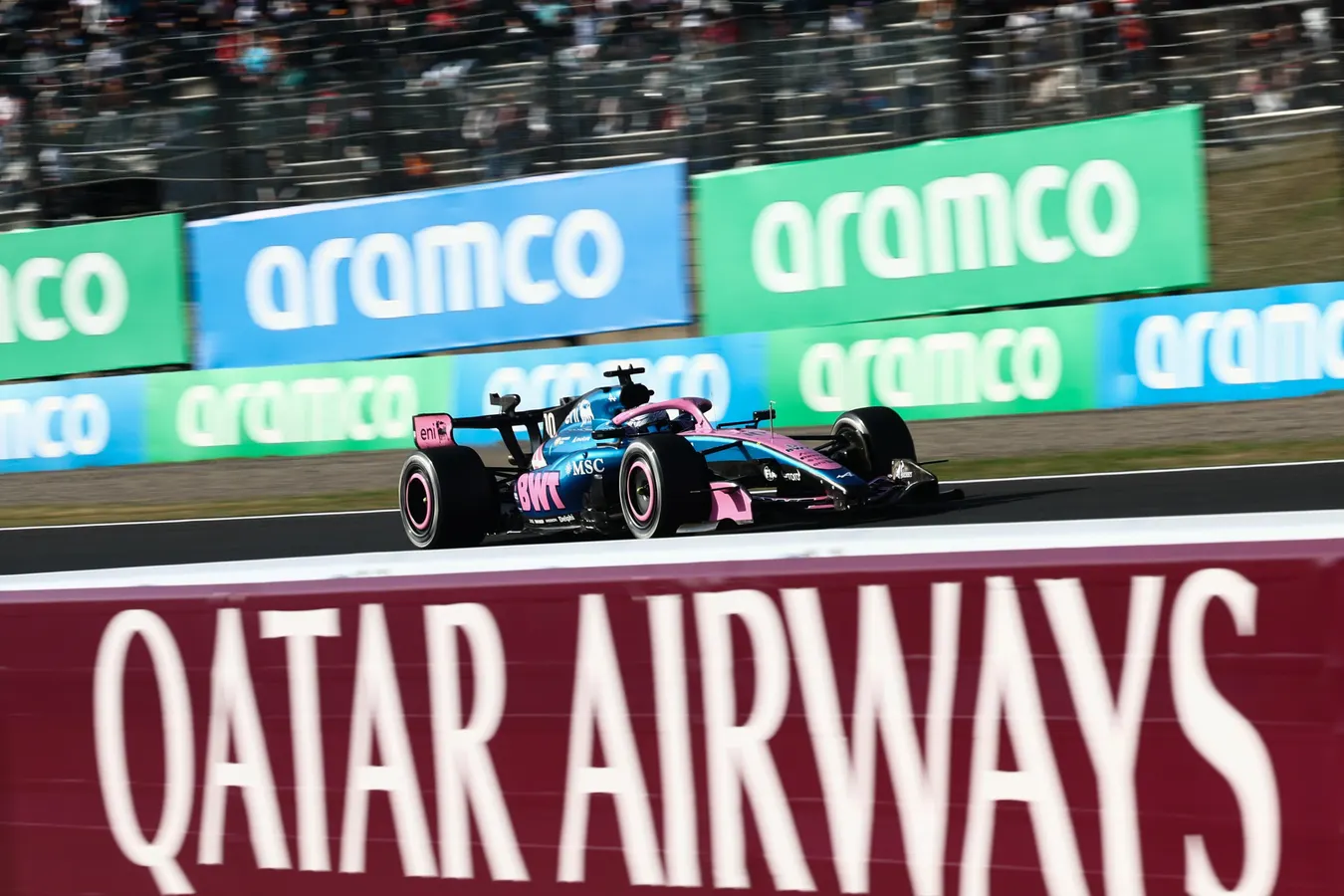

Pierre Gasly of Alpine during the second practice ahead of the Formula 1 Japanese Grand Prix at Suzuka Circuit in Suzuka, Japan on March 27, 2026. (Photo by Jakub Porzycki/NurPhoto via Getty Images)
NurPhoto via Getty Images
With the concluding races of this season’s F1 World Championship a matter of weeks away, it remains to be seen whether the series will conclude as planned.
Following recent Houthi missile attacks on Saudi Arabia, notably the country’s main international airport in Riyadh, allied to ongoing turbulence across the region, doubts surely remain about the impact upon global motorsports’ premier competition.
Qatar’s race is scheduled for the end of November, whilst the final Grand Prix in Abu Dhabi is penned for the start of December.
Any further escalation in regional armed conflict could put both in jeopardy, after F1 races earlier this year – in Bahrain and Saudi Arabia – were cancelled, at an estimated cost of $120 million+ for both hosts.
Grand Prix chaos amid geopolitical turbulence
Bahrain’s race was relocated to Malaysia under a unique agreement between the two countries, with the former paying the latter hosting and rights fees (estimated at $68 million) to keep the Grand Prix on the 2026 calendar.
Strategically, this was important to the small Arabian Gulf nation, which became the first country in the region to ever host an F1 race back in 2004.
Amid intense global competition to host F1 races, officials in Manama were likely concerned that failing to stage a race this year might result in the city’s disappearance from the sport’s annual calendar altogether.
Bahrain is especially vulnerable to regional turbulence; it is one of Asia’s smallest countries – 1.8 million people and 300 square miles in size – though it produces significant volumes of oil and gas.
The problem is, most of it is exported by ship via the Strait of Hormuz (a seaway between Oman and Iran), which this year has been impacted by the war involving Iran, Israel and the United States.
STRAIT OF HORMUZ – 11 JANUARY: A satellite view of the Strait of Hormuz, a strategic waterway between Iran and Oman that links the Persian Gulf to the Arabian Sea. This vital energy chokepoint handles nearly 20% of global oil and 25% of liquefied natural gas exports. Major exporters using the strait include Saudi Arabia, Iran, Iraq, Kuwait, Qatar, and the UAE. (Photo by Gallo Images/Orbital Horizon/Copernicus Sentinel Data 2025)
Gallo Images via Getty Images
Sport in Bahrain wasn’t the only victim of this; in Qatar, several other events were cancelled, for instance the Finalissima – an intercontinental soccer match organised by CONMEBOL and UEFA.
If conflict prevails, next year could be another challenging one for Gulf sport, not just its F1 races; in September 2027, the Basketball World Cup is scheduled to take place in Doha.
Presumably, FIBA – the International Basketball Federation – has contingency plans in place; if not, then it would seem wise to begin preparing for all eventualities.
F1 disrupted, what next?
Nevertheless, in recent months, attacks and attention appear to have shifted from the Strait of Hormuz to the Bab al-Mandeb, a waterway connecting the Sea of Aden and the Red Sea.
BAB-EL-MANDEB, YEMEN – 17 FEBRUARY 2026 : Satellite view of the Bab el-Mandeb Strait is a vital trade route linking the Red Sea, Gulf of Aden, Arabian Sea, Suez Canal, and Mediterranean. Its stability is central to global shipping, energy markets, and international commerce. (Photo by Gallo Images/Orbital Horizon/Copernicus Sentinel Data 2026)
Gallo Images via Getty Images
More than 10% of global trade passes through the Strait, as it heads up towards the Suez Canal.
Unrest in Yemen, allied to the growing influence of the Houthis, a political and militant movement originating from the Saada region in northwestern Yemen, has brought the Bab al-Mandeb Strait back into the spotlight.
In 2022, the Houthis fired missiles at an oil installation adjacent to the F1 circuit in Jeddah, during the Saudi Arabian Grand Prix’s race weekend, leading to calls by drivers for the race to be cancelled.
This would have imposed high costs on race organisers, but also given the Houthis a victory of sorts; in the end, the likes of Lewis Hamilton were persuaded to compete, though the British driver remained concerned about the possibility of attack when the race took place again in 2023.
What’s clear is that the two straits aren’t simply notable geographic features; they are also laden with economic, political and psychological consequences.
It’s also increasingly evident across the global sports industry that waterways located thousands of miles away can have a profound effect on event hosting, industry revenues, and, for instance, the supply of sports apparel.
Chokepoints are a problem for sport
Such waterways are known as maritime chokepoints, narrow sea passages that connect two larger bodies of water and handle massive volumes of commercial shipping or critical resources like oil and natural gas.
They aren’t found solely in the Middle East; indeed, speculation has begun about the next chokepoint that could potentially derail the sports industry; one of them is the Strait of Malacca, widely considered the world’s most important maritime chokepoint.
SINGAPORE, REPUBLIC OF SINGAPORE, MAY 2018: (SOUTH AFRICA OUT) The Singapore Strait, a strategic international shipping lane which connects the Strait of Malacca to the South China Sea and Java Sea. Malaysia located to the North of Singapore with Indonesia to the South on May 2018 in Singapore, Republic of Singapore. (Photo by USGS/NASA Landsat data/ Orbital Horizon/Gallo Images/Getty Images)
Getty Images
Located in Southeast Asia, it serves as the primary sea route connecting the Indian Ocean to the South China Sea and the Pacific Ocean and lies between the Malay Peninsula (Malaysia and Thailand) to the northeast and the Indonesian island of Sumatra to the southwest, whilst the island city-state of Singapore sits at its southern entrance.
Approximately 550 miles in length, at the Phillip Channel the Strait’s navigable corridor shrinks to just 1.7 miles wide.
Almost one-third of global maritime trade volume transits the waterway each year, whilst 29% of all global seaborne oil – 23 million barrels+ per day – passes through the strait, predominantly transporting crude oil from the Middle East and Africa to East Asian economies.
Sports apparel supplies at risk
Disruption to traffic through the Strait might therefore prove hugely damaging to the sports industry; consider sports apparel: every year, Vietnam may produce as many as 1 billion pairs of training shoes, sneakers, and soccer cleats.
Nike alone produces approximately 50% of its total global footwear in Vietnam, estimated at 400 million pairs of running, training, lifestyle, and football boots, whilst Adidas produces up to 40% of its global footwear in the country, amounting to approximately 100+ million pairs of shoes.
Any of these items heading West from Vietnam inevitably transit through the Strait of Malacca.
But, with disputes over who controls it, China’s growing presence in the region, and the ongoing problems posed by piracy at sea, the world of sport must ensure its attention isn’t focused solely on the Middle East.
Whether it’s sports apparel brands, event hosting or revenues derived from trade in natural resources, what’s clear is that sport needs heightened vigilance, an understanding of our world’s interconnectedness, and a much sharper sense of risk mitigation.















Leave a comment