


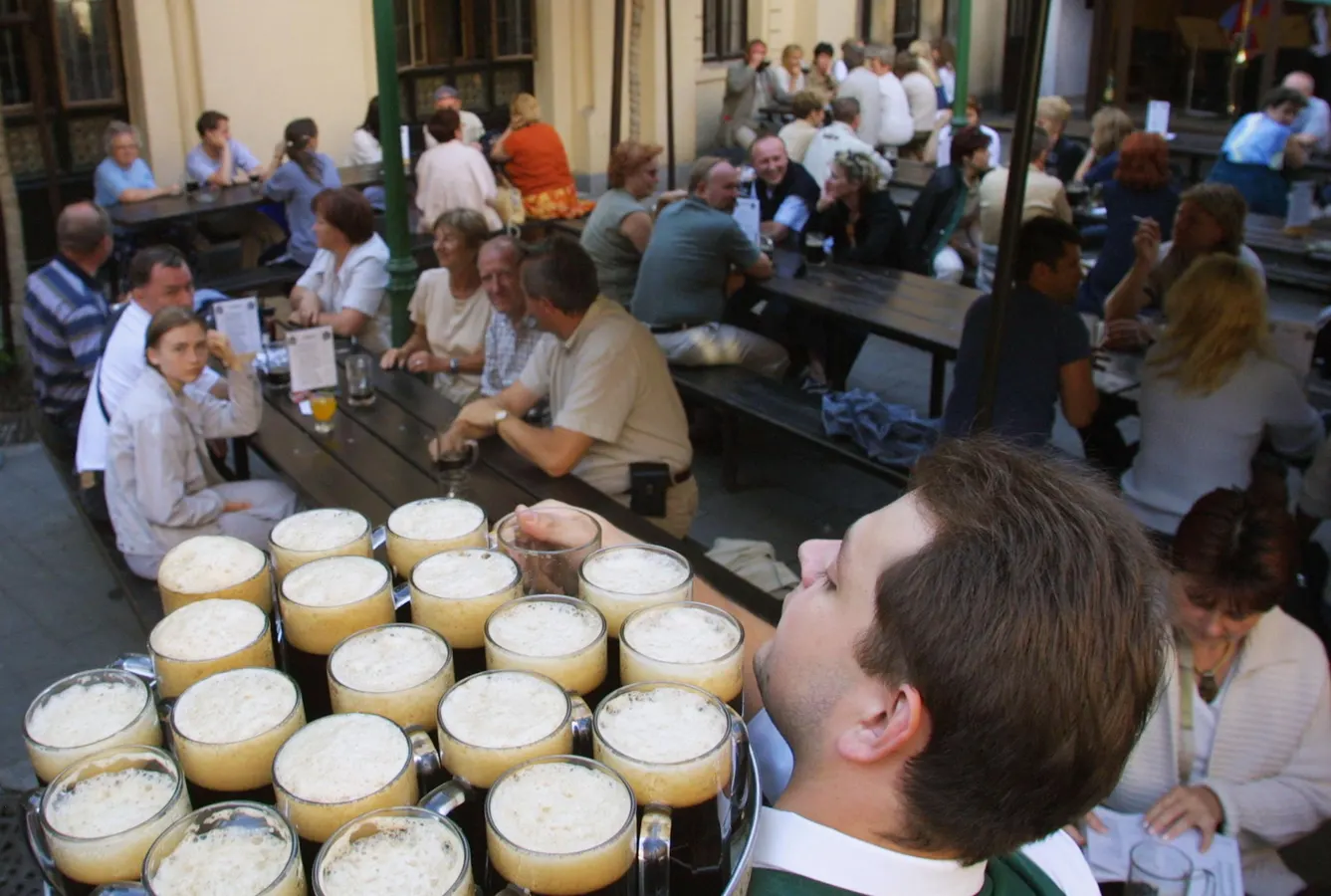
U Fleků, in Prague, is the world’s oldest brewpub, tracing its history back to 1499.
Getty Images
Prague is more than 1,000 years old. And with Czechs drinking more beer per capita than the population of any other country—the average Czech citizen drinks about about 39 gallons of beer per year, almost 35% more than the citizens of runner-up Lithuania—the City of a Hundred Spires has a long and rich beer history.
Some argue that Czech beer is the best in the world. The culture appreciates not only the beer, but also the manner in which it is served.
Drinking Old
Perhaps it is no surprise, then, that Prague is home to what is widely recognized as the world’s oldest continuously-operating brewpub, U Fleků, which traces its history to 1499.
Today, U Fleků can welcome up to 1,200 guests at a time: 800 seats divided among eight historic halls and 400 more in the outdoor garden. According to U Fleků, about 800,000 guests visit the brewpub every year.
Documents prove that brewing started on the site in 1499 when a brewmaster, Vic Skřemenec, acquired the house in which the brewery still resides. The brewery had many owners over the centuries and obtained its current name, U Fleků, when Jakub Flekovský acquired the brewery pub in 1762.
The brewery is famous for one beer. Since 1843, U Fleků has brewed Flekovský Tmavý Ležák 13°, a dark lager available only at the pub, a few select restaurants in Prague and in bottles and cans in shops in Prague. The beer is not exported.
Considering the United States is this year celebrating its 250th anniversary as a nation, it is remarkable that brewing has continued on this single site for over twice that long. Some of the brewing equipment still in use today dates to 1937, though there was a significant renovation from 1983 to 1986.
For food, U Fleků offers traditional Czech fare, relying heavily on potatoes and pork in roasted, schniztel and goulash forms. The trifecta of historic building, historic beer and traditional food makes U Fleků the perfect stop for both tourist and local alike. Indeed, U Fleků is the largest restaurant in Czechia.
Despite brewing one of the most famous and iconic beers available in Prague, U Fleků decided that making Flekovský Tmavý Ležák 13° was not enough. In October 2021, the historic brewpub added a light-colored beer to their menu, Svatováclavský Světlý Ležák 13°. The addition of this beer is a nod to new trends in beer, which Prague also celebrates.
With clean lines, a stainless steel bar and open space, PULT is a modern beer bar in Prague.
Courtesy of PULT
Drinking New
It is true that Czech beer has a long history. It received Protected Geographical Indication protection from the European Union on October 16, 2008. But that does not mean that Czech beer drinking is stuck in the past.
In October 2021, Pult opened the doors to its modern beer bar with clean lines, stainless steal and pale wood. In contrast to U Fleků’s maximum capacity of 1,200 people, Pult has room for just 80. But then, Pult serves many more different beers than its much older sibling.
While most bars in Prague serve beer from only one brewery, Pult was opened, “To have a place with multiple Czech lagers on tap, which is not very common, and give our customers an opportunity to taste and explore this traditional Czech beer style, which could be also very rich in the flavours, and very wide in the way of how many lagers we brew in Czechia,” said Magdaléna Hoppová, tapster and manager via email. Hoppová has become a celebrity in Czech beer, travelling the world teaching traditional Czech beer pouring techniques.
In fact, Pult is the only bar in Czechia that serves both Budvar and Pilsner Urquell, the two most prominent Czech beers. But in addition to those traditional beers, Pult always has four other Czech lagers on tap along with three other rotating beers, typically of a more modern craft beer style, such as sour beers and IPAs. Approximately 90 additional beers are available in cans and bottles.
“Also, as we are focused on perfectly poured beers,” said Hoppová. “Pult wanted to offer other beer styles the same way we treated the lagers—same temperatures, same conditions, same care, same pouring routines.” Next to the taps on the bar—facing the customer while pouring beer is important, so taps in Czechia are rarely located against a wall—Pult features a water bath in which clean glasses sit. The water bath is kept at the same temperature as the beer, so that the beer does not change temperature when entering the glass.
That type of attention to detail to both traditional and modern Czech beer has been well received. Pult will soon open a second location, with 12 beers on tap—six lagers and six rotating beers—and approximately double the capacity.
Pult is proof that the long history of beer in Czechia has not yet finished being written. Prague proves that beer history can be celebrated at the same time as innovation moves beer forward.
Na zdraví!
















Leave a comment