


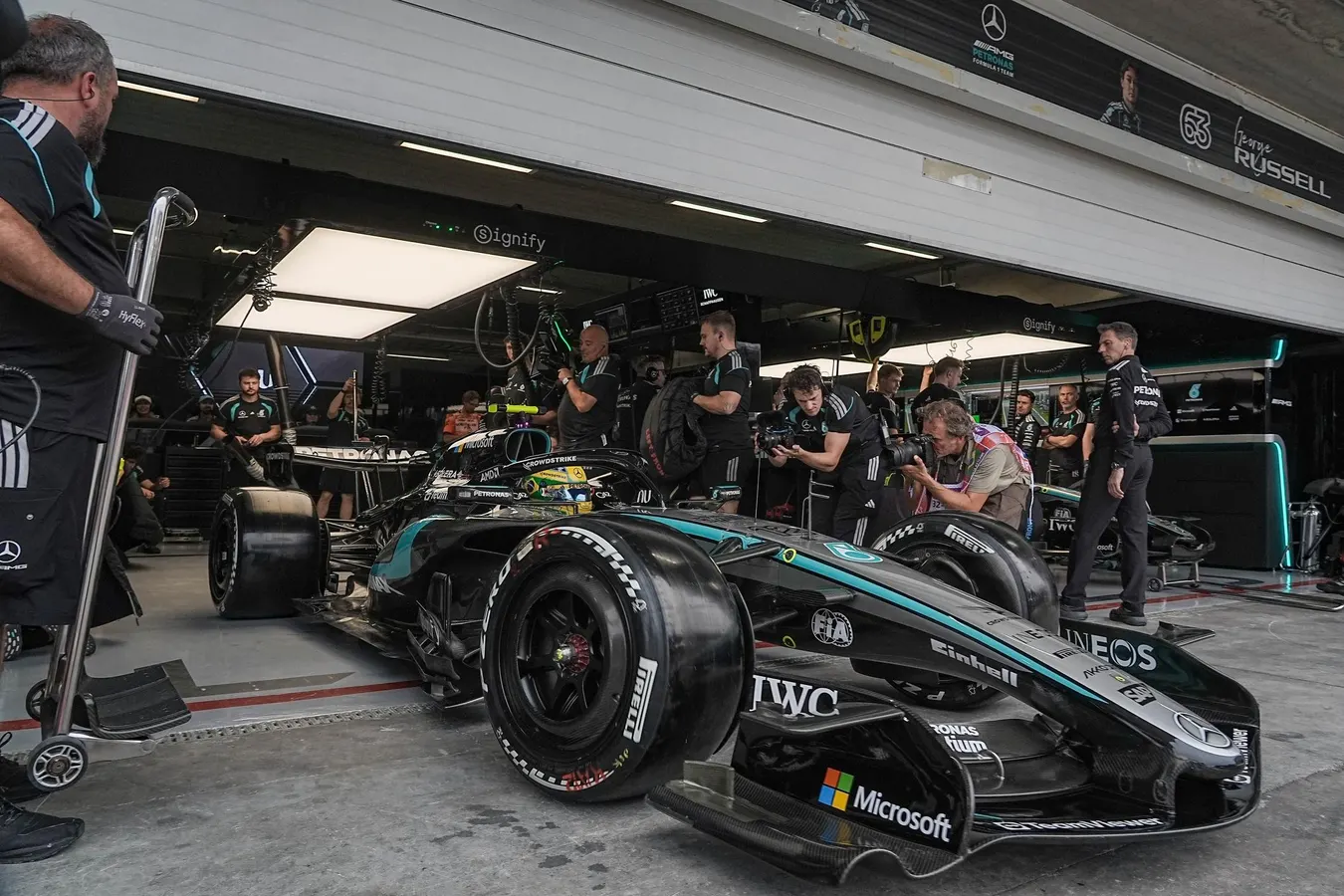

Mercedes-AMG PETRONAS Formula One Team driver Kimi Antonelli competes during the second practice session on November 6, 2026, ahead of the Formula 1 São Paulo Grand Prix at Interlagos in São Paulo, Brazil. (Photo by Stringer/Anadolu via Getty Images)
Anadolu via Getty Images
Across nine European Grands Prix this season, transport drivers for the Mercedes-AMG PETRONAS Formula One Team logged more than 17,000 kilometers hauling car parts and garage equipment from paddock to paddock in an all-electric, extended-range truck nicknamed “EVie.”
The bright blue Mercedes-Benz Trucks eActros 600 turned heads on public motorways and around pit lanes. But, for the Mercedes racing outfit, the vehicle was never conceived as a traveling billboard.
“We don’t just want to be telling a story, tacking it on the end,” Alice Ashpitel, Head of Sustainability for the Mercedes team, explained in a recent conversation. “It’s really got to be across everything, and that’s what’s then resonating when we talk about things like EVie.”
EVie is an output of what the Mercedes team calls its brainprint—an organizational philosophy that purposefully links competitive performance, knowledge work, industrial innovation, and environmental sustainability.
The philosophy guides everything from the engineering work developed within the team’s headquarters shops at Brackley and Brixworth in the English countryside to tracks at racing circuits across five continents.
“Simply put, we’re a small manufacturing business based in the middle of England,” Stuart Lakin, the team’s Head of Commercial Development, noted. “But then we go racing on the weekend in front of 80 million people. We report to the street every two weeks, not every quarter. So, we feel we have an opportunity and an obligation to take what we learn within our four walls and share it beyond them.”
In 2023, the Mercedes team began trialing the use of HVO100, a fully renewable diesel fuel derived largely from vegetable and cooking oils, across part of its transport fleet. By 2024, the new fuel was being phased in across the entire fleet, reaching 99 percent coverage by 2025. Then, on a day during that same year, a Mercedes transport driver climbed into EVie’s cab for a 15-minute run along the A43 from the factory in Brackley to Silverstone Circuit, home of the British Grand Prix.
Before a car ever takes to the track, advance crews arrive at the paddock during overnight hours to unload freight, organize the garage, and assemble the cars. They depend entirely on the logistics team to ensure the equipment, parts, and tools arrive on schedule. The Silverstone run was designed to test those logistics protocols. It was also an exercise in building confidence among the Mercedes team members.
Following positive feedback from the personnel involved in the effort, team planners advanced to the next milestone: dispatching EVie to carry the primary race cars from Brackley across the North Sea to the Dutch Grand Prix at Zandvoort. Power would be sourced using public highway charging stations and trackside energy systems. Arrival in the Netherlands “would be a real proof,” Ashpitel said, “because the cars have to get there or we’re not going racing.”
The Zandvoort haul proved successful.
“The driver said, ‘I don’t want to go back to my old truck,’” Ashpitel recalled. He had enjoyed piloting the electric truck, finding it a quiet and responsive drive that delivered environmental benefits without compromising schedule reliability. The feedback convinced team leadership to approve deploying EVie across all European Grands Prix for the 2026 season.
The summer schedule presented an even greater real-time test. Consecutive double-header race weekends required transits between Monaco and Barcelona, Austria and England, and Belgium and Hungary, followed by a late-summer leg through Monza, Italy and Madrid, Spain. With turnaround times too short to permit a return to Brackley between rounds, the logistics team routed EVie through existing public highway chargers and trackside energy hookups.
The Mercedes-Benz Trucks eActros 600, nicknamed “EVie,” drives through the Mercedes-AMG PETRONAS Formula One Team headquarters in Brackley, England.
Photo courtesy of Mercedes-AMG PETRONAS Formula 1 Team
The truck’s presence on highways and around paddocks “is not the single thing that’s going to move the needle on our carbon footprint,” Ashpitel said. “But EVie is capturing imagination and making sustainability in sport accessible in a way that doesn’t feel artificial.”
Named by a team member’s child through an internal company contest, the truck has attracted a wide audience. People engaging with it have ranged from commuters at roadside service plazas to young karting drivers at circuits to representatives from rival racing teams, other major sports leagues, and commercial freight operators in industries outside of motorsport.
That span of interests points to a long-time reality that is gaining broader recognition among global sports fans, organizations, and partners: effective performance capacity is not accomplished without genuine social responsibility.
The results of a recent F1 Fan Voice survey reflect that connection.
According to those results, Mercedes ranked number one among teams in the “Sustainable,” “Innovative,” “Best Technology,” and “Engineered Excellence” categories. The findings also show that supporters link sustainability action directly to technical performance.
More than half of respondents who identified themselves as “dedicated fans” stated that the team’s visible leadership in sustainability actively increases their support; nearly three-quarters felt they had an informed understanding of how the team designs, develops, and delivers those changes. The results revealed a requirement for the future, too: nearly two-thirds of fans in the 18- to 24-year-old demographic viewed sustainability initiatives as vital to the future and ongoing cultural relevance of Formula 1.
“Largely speaking,” Lakin said, “we’re trying to show everyone that competitiveness, profitability, and sustainability can go hand-in-hand. The business cases are becoming easier.”
For example, at the team’s 60,000-square-meter technology center in Brackley, more than 500 submeters monitor energy usage across manufacturing bays. They are linked to real-time dashboards accessible 24 hours a day, seven days a week to the 1,300-plus employees who work at the facility. The precision system allows operators in the machine shops and composite bays to monitor and adjust the high-temperature autoclaves used to cure carbon fiber. At the same time, they can identify equipment anomalies before mechanical breakdowns occur. Those adjustments contributed to a 20 percent reduction in energy consumption per employee across the organization last year compared to three years ago.
As Ashpitel explained, “Kilowatt-hours sometimes don’t really mean anything to most people. But when you see it’s this many pounds and pence or dollars, that’s performance for us in the cost cap. If we can save this much, that’s a front wing on the car.”
Today’s Formula 1 cars consist of approximately 75 percent carbon fiber and 25 percent metal. But it is difficult to decarbonize carbon fiber because its energy-intensive manufacturing process leaves a large environmental footprint. To tackle that challenge, Mercedes set out across its networks and piloted a sustainable composite resin system composed of 30 percent bio-based material sourced from the byproducts of biodiesel refining. The resin was used to form the rear brake duct wheel shields placed on the team’s car for the 2025 Azerbaijan Grand Prix and remained there for more than 7,000 kilometers across subsequent races without any performance deficit.
“What we have now done is proven that it can withstand the highest performance criteria,” Ashpitel said. “We can then start to talk to the aerospace industry. That sends the signal back down the supply chain.”
As Lakin put it, “What we can do is say, ‘Well, look, if it works for us, we’re in our competitive environment. There’s no reason it can’t work for others.’ And so we’re trying to start that flywheel of demand and understanding across sectors.”
“Our impact on the market is not the money that we can bring. It’s the name and fame as the team and what we do,” he continued.
Racing circuits around the world are the proving grounds for that ambition.
With two races to go before the season finale at Abu Dhabi’s Yas Marina Circuit, Mercedes’s 20-year-old driver Kimi Antonelli has become the youngest in Formula 1 history to capture the world championship, teammate George Russell is in a chase for second place in the drivers’ standings, and the team has secured the constructors’ title.
It is not happenstance that Mercedes has taken this early lead in the sport’s new regulatory era of cars with slimmer chassis profiles, reduced aerodynamic downforce, and greater reliance on drivetrains fed by battery power. It is the team’s brainprint at work, a genuine balance of sports performance and social impact.
“Sustainability, at heart, is about efficiency,” Ashpitel said, “and efficiency is what makes a racing car go fast.”















Leave a comment