


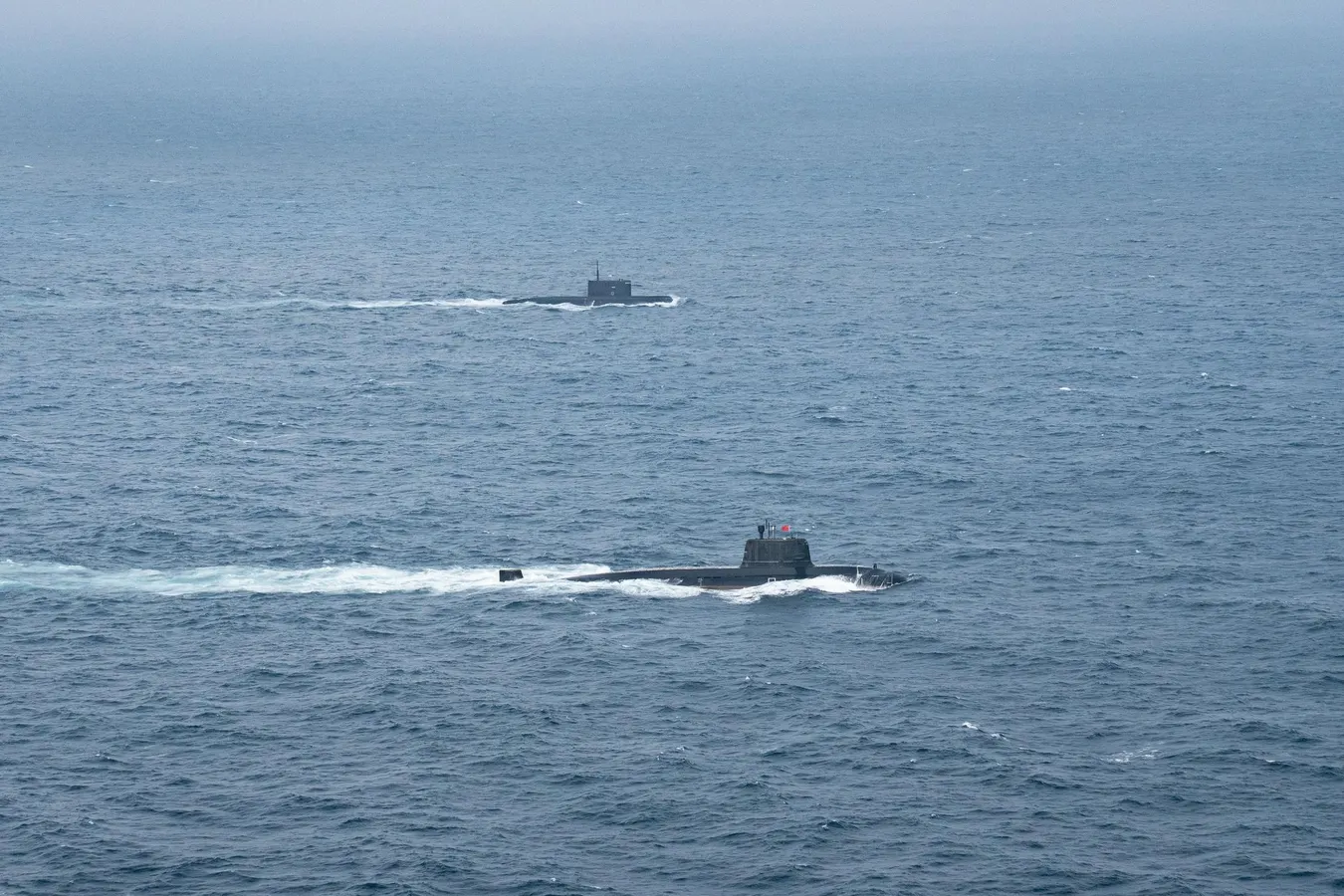

Chinese and Russian submarines navigate on the surface during a joint exercise between China and Russia on July 10, 2026. In an era of global naval strategic competition, the U.S. Navy seeks to develop an anti-submarine weapon that unmanned aircraft systems can fire from above water. (Photo by Cheng Jiahao/Xinhua via Getty Images)
Xinhua News Agency via Getty Images
The U.S. Naval Air Systems Command seeks to develop a small anti-submarine weapon that unmanned aircraft systems can fire after taking off from carriers or other vessels at sea.
A request for information released by the service this month has specified that the new weapon, known as the Silent Anvil Air-Launched Torpedo or SAA-LT, will be designed at a smaller scale than most torpedoes at 70 inches long and weigh no more than 268 pounds.
The Navy also wants the Silent Anvil to easily fit in the BRU-61/A bomb rack, which fits on a wide array of fighter jets, bomber aircraft and also on unmanned aircraft systems. The bomb rack is typically used to carry precision-guided glide bombs known as GBU-39Bs, which have a nearly equivalent weight to the planned Silent Anvil torpedo.
Potential Revolution in Undersea Warfare
A GBU-39 Small Diameter Bomb sits on the rail of an MQ-9 Reaper drone in Nevada in 2025. The Navy’s new Silent Anvil would be about the same size and just as easily deployable. (U.S. Air Force photo by Senior Airman Ariel O’Shea)
U.S. Air Force
A key component of the Navy’s desired design is stealth. The Silent Anvil is intended to approach and strike underwater targets with an extremely low detection profile.
By reducing the torpedo to the size of a small diameter bomb, the service could in theory enable a host of U.S. airplanes and unmanned systems, such as the MQ-9 Reaper, to conduct anti-submarine warfare.
This new weapons development thus has the potential to upend the status quo of undersea warfare considerably.
Until now, the Navy’s primary aircraft designed for anti-submarine warfare has been the P-8A Poseidon manufactured by Boeing, which is designed to hunt submarines and is armed with torpedoes and cruise missiles.
Relief For Shipbuilding?
Air Commandos prepare to load a GBU-39B Small Diameter Bomb onto an MQ-9 Reaper in New Mexico in March 2026. Nearly the same size as the GBU-39B, the Navy’s new air-delivered torpedo would deliver precision strikes against underwater vessels. (U.S. Air Force photo by Staff Sgt. Kevin Williams)
U.S. Air Force
The development of the Silent Anvil comes during a time when growing Chinese naval power has been a source of concern to U.S. lawmakers, military forces and allies in the Arctic and Pacific regions.
If the Navy succeeds in shrinking ship-killing munitions to the size of small bombs, it could relieve pressure on the service to make immediate gains in shipbuilding as anti-ship warfare would shift significantly to the aerial domain.
Enhancing unmanned aircraft systems platforms with torpedoes could potentially reduce strain on human service members and open new AI-enhanced possibilities for tracking and targeting submarines.
Long-Term Implications
The world witnessed the devastating effect of a torpedo when the U.S. Navy sunk the Iranian warship IRIS Dena using a Mark 48 on March 4. The same level of firepower now stands to be condensed and fielded by unmanned aerial platforms.
Will weapons like the Silent Anvil make submarines less relevant over time? If development of this new air-delivered torpedo proves successful, it has potential to shape not only sea warfare but how the world has perceived best practices for maintaining undersea nuclear deterrents.













Leave a comment